How to Establish Company in Vietnam
When foreign investors invest in Vietnam, they could establish company in Vietnam. Foreign investors have the right to choose the appropriate forms of enterprise such as a limited liability company, joint stock company, etc.
Vietnam offers a compelling environment for foreign investors seeking to establish company in Vietnam. There are several reasons why investors should consider Vietnam as their business destination.
Firstly, Vietnam boasts a rapidly growing economy, characterized by robust GDP growth and a favorable business climate. The country has implemented various market-oriented reforms, attracting foreign investment and fostering a dynamic entrepreneurial ecosystem.
Additionally, Vietnam benefits from a strategic geographical location, serving as a gateway to the vibrant markets of Southeast Asia. Its membership in regional trade agreements, such as the Comprehensive and Progressive Agreement for Trans-Pacific Partnership (CPTPP) and the ASEAN Economic Community (AEC), provides investors with access to a vast consumer base and favorable trade conditions.
Furthermore, Vietnam offers a young and skilled workforce, with competitive labor costs, making it an attractive destination for manufacturing and service industries. The government has also taken steps to enhance transparency, streamline administrative procedures, and improve investor protection, demonstrating its commitment to facilitating business operations.
Overall, Vietnam presents a promising investment landscape, offering market potential, strategic advantages, and a supportive business and legal environment for investors seeking to establish a company in Vietnam.
Step by step to set up company in Vietnam
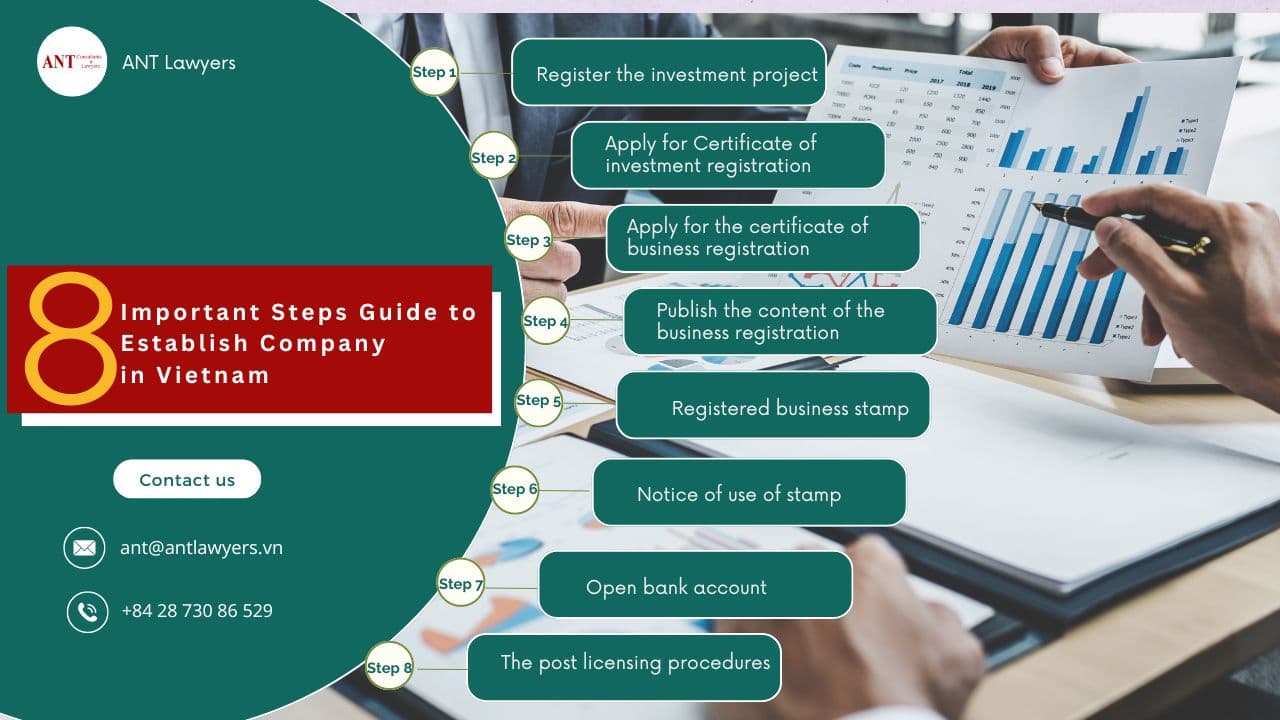
Step 1: Register the investment project
Step 2: Apply for Certificate of investment registration
Step 3: Apply for the certificate of business registration
Step 4: Publish the content of the business registration
Step 5: Registered business stamp
Step 6: Notice of use of stamp
Step 7: Open bank account
Step 8: The post licensing procedures
How to Establish Company in Vietnam?
Investors submit an investment project registration file to the Business Registration office of the province or city or the management board of an industrial zone, an export processing zone or a high-tech zone for the approval of an investment project during the period within 15 days (without time for clarification).
After approval of the investment project, investors submit a valid record to the Department of Planning and Investment within 10 days to apply for a business registration certificate in Vietnam.
After obtaining the business registration certificate, the investor shall submit the application for enterprise registration certificate to the enterprise registration office within 3 days.
After being granted the certificate of enterprise registration, the investor shall disclose information about the enterprise on the national enterprise registration portal within 30 days, including the following information:
i, Business lines;
ii, List of founding shareholders and shareholders being foreign investors for joint-stock companies.
The enterprise has the right to decide on the form, quantity and contents of the stamp of the enterprise. The content of the stamp must show the following information:
-Company’s name;
-Business code.
After receiving the legal entity stamp and before using the business stamp, the enterprise must send a notice on the stamp of the enterprise to the business registration office for publication in the National Information Portal on the business registration.
After having stamp made, investors submit notices on use of stamp forms to the Investment registration agency. After receiving the record, the Investment registration agency issues a receipt for the enterprise, publishes the notice of the enterprise on the National Business Information Portal and issues a notice of the posting, stamp samples of enterprises, branches and representative offices for enterprises.
Investors need to open two types of bank accounts, namely the investment capital account to receive the investment amount and the transaction account for conducting daily transaction in Vietnam.
For the conditional business lines:
Investors investing in conditional businesses lines as must apply certificate of business qualification, practicing certificates, professional liability insurance, legal capital requirements, etc. before conducting business in Vietnam.
Q1: What does it mean to establish company in Vietnam?
A: To establish company in Vietnam means to legally form a business entity, such as an LLC, joint-stock company, or partnership, through official registration, licensing, and compliance with Vietnamese laws and regulations.
Q2: Who can establish company in Vietnam?
A: Both foreign investors and Vietnamese nationals can establish company in Vietnam. Foreigners typically pursue a process involving an Investment Registration Certificate (IRC) followed by an Enterprise Registration Certificate (ERC).
Q3: What are the main steps to establish company in Vietnam?
A: The process to establish company in Vietnam generally includes:
Q4: How long does it take to establish company in Vietnam?
A: Typically around 30 to 60 days, depending on the complexity and whether your business is in a conditional sector.
Q5: What documents are required to establish company in Vietnam?
A: You’ll need:
Q6: Which business structure is most common when you establish company in Vietnam?
A: The Limited Liability Company (LLC) is the most popular choice which allows 100% foreign ownership in many sectors, limits liability to contributed capital, and is administratively simpler than a joint-stock company.
Q7: What’s the difference between conditional and non-conditional investment when you establish company in Vietnam?
A:
Q8: Can operations begin before the bank account is open, when setting up to establish company in Vietnam?
A: Yes, operations can begin once the IRC and ERC are granted. However, to legally receive revenue or investment capital, a corporate Vietnamese bank account must be opened.
Q9: What are common mistakes when foreign investors establish company in Vietnam?
A: Avoid pitfalls by not:
Q10: Do timelines vary by city when you establish company in Vietnam?
A: Absolutely. While the framework is national, administrative efficiency varies between provinces, Hanoi, Da Nang and Ho Chi Minh City tend to be faster than more remote areas. Between those key cities, there might be different priorities to attract investments hence the project explanation at the application of dossiers might be different.
Establishing a company in Vietnam requires careful adherence to these steps and compliance with relevant regulations, particularly for businesses with conditional requirements.
The above outlines the process to establish company in Vietnam for foreign investors. By engaging the services of a reliable law firm in Vietnam, investors can navigate through these steps efficiently and ensure compliance with legal requirements, ultimately facilitating a smooth and successful establishment of their business in the country.
We help clients overcome cultural barriers and achieve their strategic and financial outcomes, while ensuring the best interest protection, risk mitigation and regulatory compliance. ANT Lawyers has lawyers in Ho Chi Minh city, Hanoi, and Danang, and will help customers in doing business in Vietnam.
Setting up trading company in Vietnam
10 questions to ask before setting up company in Vietnam
Vietnam Company Formation. How to proceed?
5 Powerful Steps to Register Company in Vietnam: Seizing Opportunities in a Growing Market
How Foreign Entity Could Set-up Representative Office in Vietnam?
From Compliance to Excellence – Corporate Governance Lawyers in Vietnam
How ANT Lawyers Could Help Your Business?
You could reach ANT Lawyers for advice via email ant@antlawyers.vn or call our office at (+84) 24 730 86 529
A data project can be technically successful yet still face legal and commercial barriers to…
After a PCT application enters the national phase in Vietnam, the applicant must complete the…
A company with an international patent application must complete a local filing step if it…
A conflicting trademark application can affect sales and distribution plans in Vietnam. The brand owner…
When the Intellectual Property Office of Vietnam (IP Vietnam) raises an objection to a trademark…
Before committing to an investment in a free trade zone (FTZ), a foreign investor needs…
This website uses cookies.