Even if your company wins in a court case and a favourable judgement is issued, recovery does not happen automatically. In Vietnam, many practitioners at Vietnam litigation law firms observe that a court victory is only halfway to justice! You hear it right.
In Vietnam, enforcement determines whether a legal victory becomes financial reality. As the country modernizes its civil judgment enforcement system, digitizes execution workflows, strengthens insolvency protections, and expands cross border judicial cooperation, the risk profile of disputes has changed.
Litigation law firms handling Vietnam matters increasingly focus less on argument and more on recovery design that help foreign general counsel and investors answering practical questions i.e can we collect? or how long will it take? or what happens if the debtor restructures, or will regulators become involved?
This article explains seven enforcement risks in Vietnam that deserve early attention. The objective is not to describe procedure. It is to examine structural realities that impact outcomes.
Everyone should now know that winning a case does not ensure payment. Civil judgment enforcement in Vietnam depends on identifiable assets, creditor ranking, encumbrances, and liquidity. A debtor may own assets through related entities. Property may be pledged to banks. Cash flow may be limited.
The management’s questions often begin here. If we win, can we recover or not. How exposed are we to competing creditors and what is the realistic recovery percentage.
Litigation law firms involved in Vietnam disputes must examine asset structure at the beginning of the case, not after judgment is issued. Enforcement risk is financial risk.
Vietnam has implemented a national digital platform for civil judgment enforcement. In theory, workflows for case intake, asset handling, and payment tracking are processed electronically. Administrative steps have been streamlined.
This development improves transparency and speed. However, it also increases procedural rigidity.
Digital systems do not forgive documentation errors. Deadlines are monitored electronically. Filing discipline becomes critical. Claimants must be ready to act immediately when enforcement opens.
Board questions shift accordingly. Are we operationally prepared to move quickly. Is our documentation ready for digital scrutiny.
Digitalization reduces delay but increases the cost of unpreparedness.
Recent reforms to recovery and bankruptcy law allow a debtor facing imminent insolvency to request protection that suspends enforcement actions.
If a company demonstrates inability to meet debts due in the near term, enforcement against its assets may be temporarily halted. This can include actions against secured assets.
For foreign creditors, this introduces timing risk. Filing delay can increase exposure. Secured status may not guarantee immediate recovery.
Board discussions often focus on this issue. What happens if the debtor enters restructuring during enforcement. How does that affect our timeline.
Litigation law firms must evaluate insolvency signals early and integrate them into strategy.
In Vietnam disputes, practical control often determines leverage.
Issues frequently arise around company seal custody, bank signing authority, director appointment validity, and access to accounting records. A minority shareholder may have legal rights but lack operational influence.
If control of the seal or bank authority shifts during litigation, operational disruption can occur regardless of court proceedings.
Questions naturally are who controls the company during the dispute, if we are protected against sudden governance moves.
Litigation law firms must understand governance mechanics in practice, not only statutory provisions.
Vietnam’s regulatory environment has tightened as the economy evolves. Data protection, investment screening, sector licensing, and tax oversight have become more active.
A commercial dispute may attract regulatory review. Tax inspections or licensing scrutiny may arise during litigation. Compliance posture becomes part of litigation exposure.
Important questions to addressed include whether of not filing this claim trigger wider scrutiny or if we are fully compliant if regulators look closer.
Litigation law firms operating in Vietnam must align dispute strategy with regulatory awareness.
Vietnam courts rely heavily on documentary evidence. Contracts must be properly executed. Authority must be proven. Translations must be accurate. Informal amendments weaken enforceability.
Common weaknesses include inconsistent bilingual versions, incomplete board approvals, and poorly preserved electronic records.
Board questions often address this quietly. Is our documentation defensible in local procedure. Are our approvals properly recorded.
Litigation law firms should conduct early evidence review to avoid later procedural surprises.
Many foreign investors prefer international arbitration. However, enforcement of foreign arbitral awards in Vietnam often requires recognition through domestic courts.
Interim relief may depend on court cooperation. Recognition procedures may raise public policy considerations.
The decision between court litigation and arbitration should be evaluated through enforceability, not perception of neutrality.
Board questions reflect this. Does our forum choice increase recovery probability. Have we assessed recognition risk.
Litigation law firms must analyze arbitration clauses within the broader enforcement framework.
Recent modernization of mutual judicial assistance mechanisms has improved cross border cooperation in civil matters. Recognition and enforcement of foreign decisions may become more structured.
At the same time, greater institutional coordination increases procedural visibility. Documentation standards and compliance expectations are higher.
Board questions often extend beyond Vietnam. How smoothly will enforcement proceed across jurisdictions. Are we aligned procedurally.
Litigation law firms handling cross border disputes must ensure procedural precision at every stage.
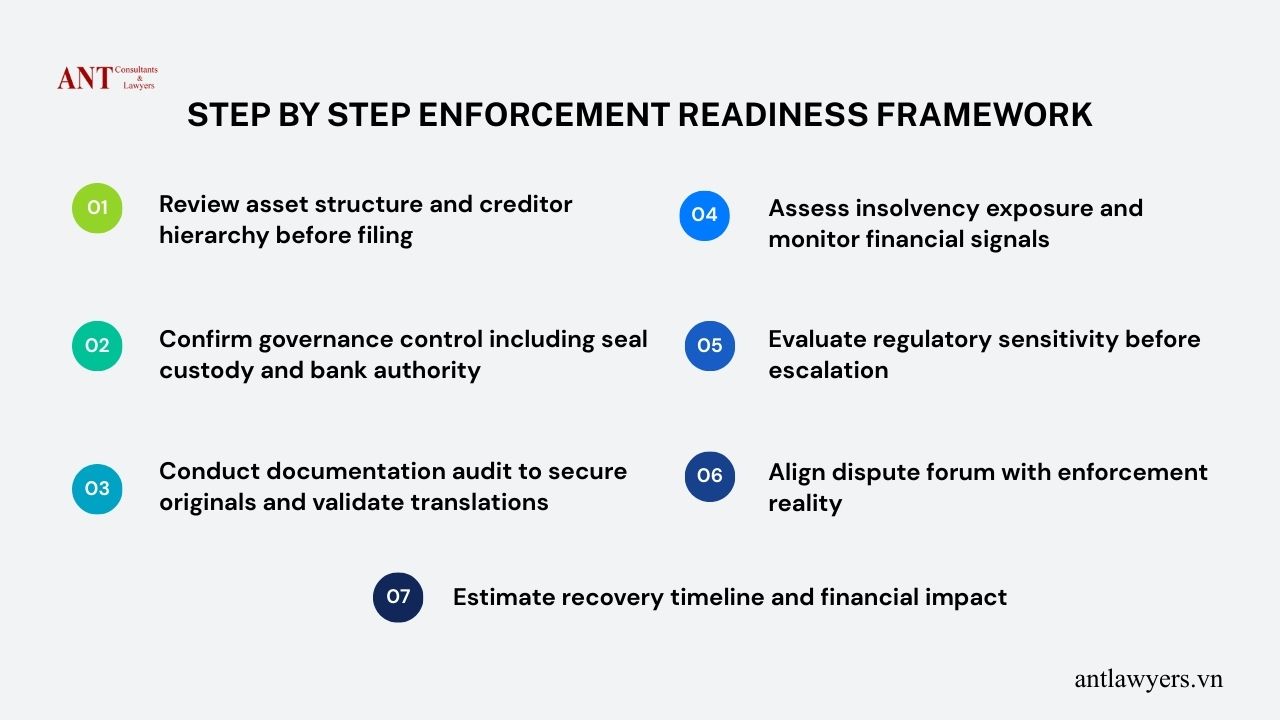
Foreign investors can reduce uncertainty by following a structured approach.
Step 1: Review asset structure and creditor hierarchy before filing.
Step 2: Confirm governance control including seal custody and bank authority.
Step 3: Conduct documentation audit to secure originals and validate translations.
Step 4: Assess insolvency exposure and monitor financial signals.
Step 5: Evaluate regulatory sensitivity before escalation.
Step 6: Align dispute forum with enforcement reality.
Step 7: Estimate recovery timeline and financial impact.
Litigation law firms operating in Vietnam disputes increasingly adopt this sequence as part of early strategy.
Q1: Is enforcement improving in Vietnam
A1: Digital systems have improved transparency and administrative speed. However, insolvency protection and asset complexity still create risk.
Q2: Can a debtor suspend enforcement
A2: Yes, under insolvency protections, enforcement may be temporarily halted if financial distress is demonstrated.
Q3: Does international arbitration eliminate enforcement risk
A3: No. Recognition and enforcement may still require domestic court procedures.
Q4: How important is documentation
A4: Critical. Poor documentation weakens enforcement prospects.
Q5: Should litigation law firms be involved before disputes escalate?
A5: Early involvement allows structured enforcement planning and risk assessment.
Vietnam’s dispute environment is evolving. Enforcement has become more digital, more transparent, and more connected to insolvency and regulatory oversight. But modernization does not eliminate structural risk.
Recovery depends on asset availability, governance control, insolvency timing, documentation discipline, and procedural accuracy.
For foreign boards and general counsel, enforcement risk is a governance matter. It is not simply a litigation issue.
Litigation law firms handling Vietnam matters must think in terms of recovery architecture rather than courtroom performance.
In Vietnam, winning the case at court is only the first stage. Recovery defines the outcome.
We help clients overcome cultural barriers and achieve their strategic and financial outcomes, while ensuring the best interest protection, risk mitigation and regulatory compliance. ANT Lawyers has lawyers in Ho Chi Minh city, Hanoi, and Danang, and will help customers in doing business in Vietnam.
How ANT Lawyers Could Help Your Business?
You could reach ANT Lawyers for advice via email ant@antlawyers.vn or call our office at (+84) 24 730 86 529
A data project can be technically successful yet still face legal and commercial barriers to…
After a PCT application enters the national phase in Vietnam, the applicant must complete the…
A company with an international patent application must complete a local filing step if it…
A conflicting trademark application can affect sales and distribution plans in Vietnam. The brand owner…
When the Intellectual Property Office of Vietnam (IP Vietnam) raises an objection to a trademark…
Before committing to an investment in a free trade zone (FTZ), a foreign investor needs…
This website uses cookies.