Vietnam’s real estate market is rapidly expanding, making it an attractive destination for foreign investors, expatriates, and multinational companies. However, Vietnam has a unique legal framework governing real estate, which differs significantly from property laws in many other countries.
Foreigners often assume that buying or leasing property in Vietnam follows the same legal principles as in Western countries. However, Vietnam’s real estate laws are based on a land-use rights system, rather than private land ownership. This makes it crucial for foreign investors to seek legal guidance from conveyance lawyers in Vietnam to avoid potential legal pitfalls and financial losses.
Buy Property in Vietnam as a Foreigner: 7 Legal Mistakes That Buyers Must Avoid
Vietnam’s real estate sector is governed by several key laws, including:
Understanding these laws is critical, as real estate transactions in Vietnam are more complex than in many other countries. This is why conveyance lawyers in Vietnam play a crucial role in helping foreign investors navigate legal complexities and ensure safe, compliant transactions.
Conveyance lawyers in Vietnam are legal professionals specializing in real estate transactions. They handle the legal transfer of property rights, ensuring that transactions comply with Vietnamese laws and protecting buyers, sellers, and investors from legal risks.
Their role is particularly important for foreign individuals and businesses, as they help navigate Vietnam’s restrictive land ownership laws, ensure compliance, and prevent fraud.
Unlike real estate agents, conveyance lawyers provide legal protection by verifying land titles, drafting contracts, and resolving disputes. Their services are essential for anyone investing in Vietnam’s property market.
Conducting Due Diligence
Drafting and Reviewing Contracts
Handling Regulatory Compliance
Managing Financial Transactions
Resolving Property Disputes
Foreign individuals and companies should always engage a conveyance lawyer in the following scenarios:
Buying Property in Vietnam
Leasing Commercial or Industrial Property
Transferring Land-Use Rights
Dealing with Construction and Development Projects
Handling Inheritance or Family Property Transfers
Preventing Fraud and Scams
Ensuring Legal Compliance
Securing Favorable Contract Terms
Handling Government Regulations Efficiently
Experience in Real Estate Law
Knowledge of Vietnamese Land Laws
Transparency in Legal Fees
Reputation and Client Reviews
Strong Communication Skills
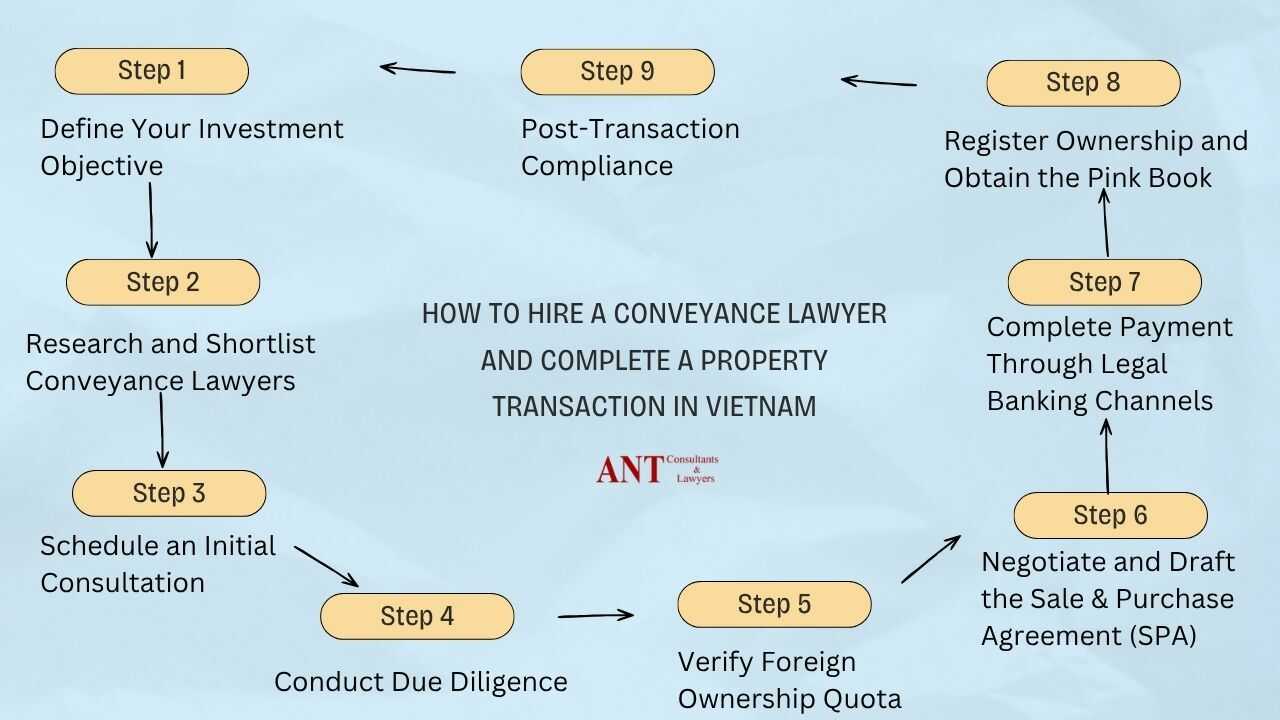
Step 1: Define Your Investment Objective
Determine whether you plan to buy an apartment, lease commercial space, or develop a real estate project. This shapes the type of legal support you need.
Step 2: Research and Shortlist Conveyance Lawyers
Look for law firms with proven experience in real estate transactions for foreigners. Check client reviews, bilingual capability, and expertise in the Land Law and Housing Law.
Step 3: Schedule an Initial Consultation
Discuss your investment goals, timeline, and budget. Ask for a clear fee structure upfront.
Step 4: Conduct Due Diligence
Your lawyer verifies the property’s legal status. It’s essential to confirm project eligibility for foreign buyers and check the foreign ownership quota .
Step 5: Verify Foreign Ownership Quota
Foreign ownership is capped at 30% of units per condominium building and 250 houses per project.
Step 6: Negotiate and Draft the Sale & Purchase Agreement (SPA)
Your conveyance lawyer drafts or reviews the contract, ensuring all terms, including price, payment schedule, penalties, ownership duration comply with Vietnamese law.
Step 7: Complete Payment Through Legal Banking Channels
Payments should only be made through official banking channels in Vietnam, not to personal accounts or in foreign currency.
Step 8: Register Ownership and Obtain the Pink Book
Submit the application to the Land Registration Office. The Pink Book (Certificate of Land Use Rights and Ownership of House) is issued, confirming your ownership for a 50 year term.
Step 9: Post-Transaction Compliance
Your lawyer advises on tax obligations (transfer tax, VAT, stamp duty), rental notification requirements, and ownership renewal procedures before the 50-year term expires.
Q: Can foreigners own land in Vietnam?
No. Foreigners cannot buy land or hold land-use rights directly. They can own apartments and houses in approved commercial projects on a 50-year renewable leasehold .
Q: What is a conveyance lawyer in Vietnam?
A conveyance lawyer is a legal professional who specializes in the legal transfer of property rights, verifying titles, drafting contracts, handling regulatory compliance, and protecting clients from fraud in real estate transactions.
Q: Is hiring a conveyance lawyer mandatory when buying property in Vietnam?
Hiring a lawyer is not legally required, but strongly recommended due to the complexity of Vietnam’s property rules and paperwork .
Q: What is the foreign ownership quota for apartments in Vietnam?
Foreigners may own no more than 30% of total apartments in a residential building, and no more than 250 standalone houses per project.
Q: How long can a foreigner own property in Vietnam?
Foreign individuals can own residential property for up to 50 years.
Q: What is the Pink Book in Vietnam real estate?
The Pink Book is the official certificate confirming land-use rights and ownership of houses and attached assets. It is the key legal document proving your property rights.
Q: What taxes do foreigners pay when buying property in Vietnam?
Foreigners pay the same taxes as Vietnamese citizens, including registration tax, VAT (if applicable), and personal income tax on property transfers.
Q: What does due diligence include for property in Vietnam?
Due diligence covers verifying the seller’s legal title, checking for mortgages or liens, confirming the project is approved for foreign buyers, ensuring the property is not in a restricted zone, and confirming quota availability.
Q: Can a foreigner rent out property they own in Vietnam?
Yes, but the owner must notify local authorities before renting. Tax obligations on rental income also apply.
Q: What risks do foreigners face buying property without a lawyer in Vietnam?
Key risks include purchasing property with delaying project due to lack of licenses or permits, buying in projects not approved for foreign ownership, exceeding quota limits, signing contracts with unfavorable or unenforceable terms, and failing to comply with tax or registration requirements.
We help clients overcome cultural barriers and achieve their strategic and financial outcomes, while ensuring the best interest protection, risk mitigation and regulatory compliance. ANT Lawyers has lawyers in Ho Chi Minh city, Hanoi, and Danang, and will help customers in doing business in Vietnam.
How ANT Lawyers Could Help Your Business?
You could reach ANT Lawyers for advice via email ant@antlawyers.vn or call our office at (+84) 24 730 86 529
A data project can be technically successful yet still face legal and commercial barriers to…
After a PCT application enters the national phase in Vietnam, the applicant must complete the…
A company with an international patent application must complete a local filing step if it…
A conflicting trademark application can affect sales and distribution plans in Vietnam. The brand owner…
When the Intellectual Property Office of Vietnam (IP Vietnam) raises an objection to a trademark…
Before committing to an investment in a free trade zone (FTZ), a foreign investor needs…
This website uses cookies.