
Why Judicial Certainty is the Attraction For Foreign Investment into Vietnam?
Vietnam is at an important moment in its economic history.
For many years, Vietnam’s growth model relied heavily on competitive manufacturing and cost efficient labour.
That foundation still matters. But it is no longer sufficient on its own.
Across the world, digital transformation is reshaping how businesses create value, move capital, manage supply chains, and allocate risk. Vietnam is now positioning itself for the next phase of growth,
Vietnam is actively pursuing a transition to a high income economy, a journey supported by digital transformation, technological innovation, and high quality human resources.
This ambitious shift requires a legal and judicial system that can keep pace with the complexity and speed of global commerce and investment.
For international investors taking part in driving this transition, the ultimate measure of a mature legal environment is the certainty of contract enforcement.
The question is not just whether a dispute can be resolved through arbitration, but whether the resulting award can be reliably enforced against assets in the country. The successful recognition and enforcement of foreign arbitral awards in Vietnam is not only a legal technicality, but it is a critical piece of the national infrastructure that supports the inflow of foreign direct investment and builds global trust in Vietnam’s justice system.
When the process for recognition and enforcement of foreign arbitral awards is clear, consistent, and efficient, it lowers the risk for foreign companies. This certainty encourages greater investment, fosters long term commitment, and accelerates Vietnam’s goal of becoming a destination for high value global business.
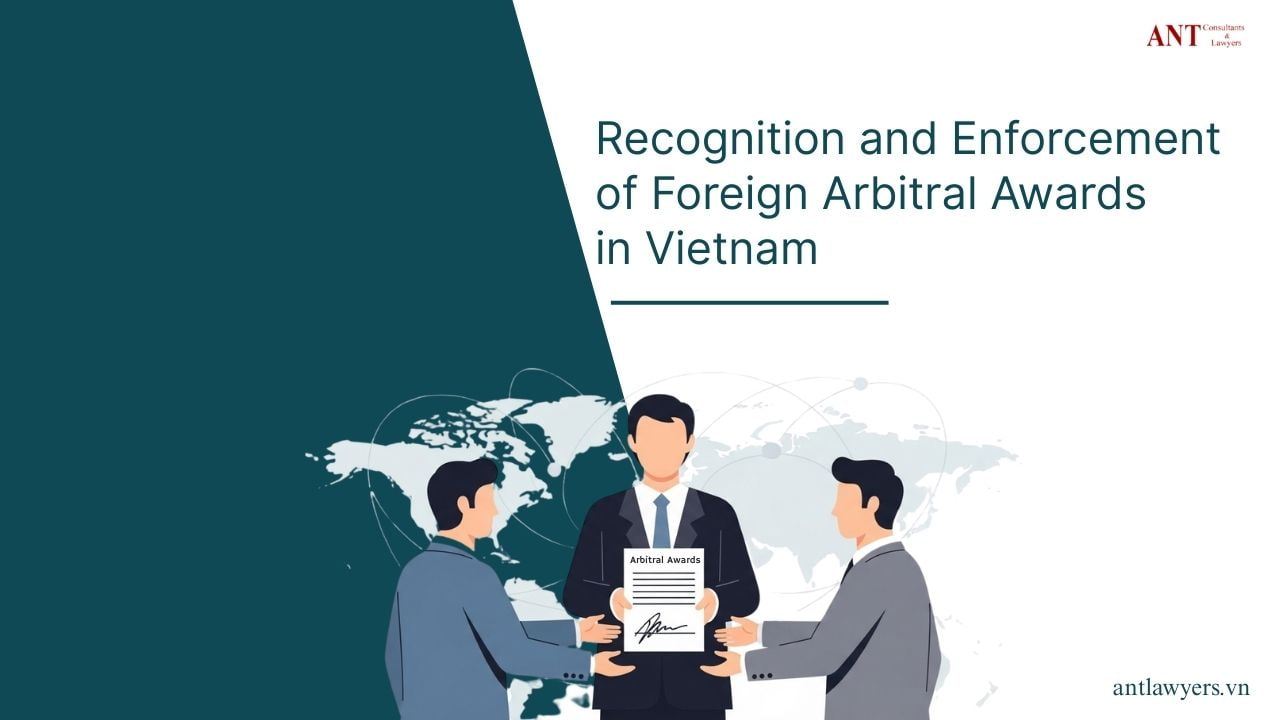
The Global Commitment of Vietnam in Joining The New York Convention
Vietnam’s commitment to international commerce is assured by its status as a Contracting State to the 1958 New York Convention (NYC). This treaty is the global standard for ensuring that an arbitration award issued in one member state is honored in another. In Vietnam, the procedures for recognition and enforcement of foreign arbitral awards process are governed by the Civil Procedure Code (CPC).
The core principle is that Vietnamese courts will review an application for the recognition and enforcement of foreign arbitral awards in Vietnam based on a narrow, internationally agreed upon checklist.
The court’s role is not to re-examine the facts or merits of the original commercial dispute. Instead, it acts as a procedural safeguard, ensuring that the arbitration process itself was fair and that the underlying agreement was valid.
But that simple principle had been many times tested in courts throughout Vietnam over the years.
Recent practice confirms that the Vietnam courts focus on procedural integrity. When the procedural file is complete and accurate, the process moves forward. The process recognition and enforcement of foreign arbitral awards stalled or was refused were due to procedural missteps.
Above comments have been drawn from the study of the Vietnam Ministry of Justice (MOJ) on the recognition and enforcement of foreign arbitral awards and court judgements, as of September 30th, 2019, which recorded 82 cases involving requests to recognize and enforce foreign arbitral awards.
Hopefully, with the reorganization of Vietnam court system from Jul 1st, 2025, the process of recognition and enforcement of foreign arbitral awards in Vietnam can be more transparent, simplified and efficient..
Procedural Challenges of Enforcement
To ensure the successful recognition and enforcement of foreign arbitral awards in Vietnam, the applicant must satisfy two fundamental procedural requirements. These are the areas where the courts apply the most strict scrutiny, and where most applications historically encounter difficulty.
1. The Proof of Notice That Ensuring the Right to be Heard
The first requirement is to prove that the losing party was properly notified of the arbitration proceedings and had a full opportunity to present their case. This is the essence of due process under the NYC.
Vietnamese courts need certain proof that the documents were delivered. Any ambiguity in the record can be interpreted as a denial of the right to be heard, which is a valid and frequently cited ground for refusal.
- The Address Challenge: Service must be directed to the legally registered head office and the legal representative of the company. Sending documents to a branch, a personal email, or an unauthorized employee is a common mistake that can stall the entire enforcement process.
- The Contents Requirement: Sometimes, a simple courier receipt is insufficient. The court might requires proof of what was delivered i.e. include a list of the documents served to confirm that the respondent received the necessary information to participate.
- Electronic Evidence: While electronic service is common, it must be verifiable. Using official, contractually agreed upon email addresses, backed by server logs or delivery confirmations, is essential to meet the court’s high standard of proof.
2. The Proof of Authority That Validate the Agreement
The second requirement is to prove that the person who signed the arbitration agreement had the legal capacity and authority to bind the company. This relates directly to the validity of the arbitration agreement itself.
The court must be certain that the agreement to arbitrate was a legitimate act of the company.
- The Signatory’s Mandate: If the contract was signed by someone other than the legal representative such as a deputy director, then a clear, timely documentation of their authority is required. This means having a valid Power of Attorney (POA) or a board resolution in place before the contract was executed.
- Internal Governance: Companies must ensure that their internal rules, such as those in the company charter requiring co-signatures for major contracts, were strictly followed. A failure to observe these internal requirements can be used by the opposing party to challenge the validity of the agreement.
- Correct Entity Identification: The arbitration must be conducted against the correct legal entity. Naming a branch or a related company instead of the principal entity can lead to a procedural challenge that undermines both the notice and the authority requirements.
The Evolution of Vietnam’s Justice System
The legal landscape for the recognition and enforcement of foreign arbitral awards in Vietnam is always improving. The judicial system is actively working to align its practices with international standards, a necessary step for a transitioning country.
The judiciary, with support from the Ministry of Justice, has invested in training judges on the practices of international arbitration and the New York Convention. This effort is leading to greater consistency and predictability in court decisions. This consistency is a powerful signal to the global investment community that Vietnam’s legal system is improving and that the risk of inconsistent judicial outcomes is decreasing.
Furthermore, the courts continue to apply the public policy defense, the ground for refusal based on a violation of fundamental Vietnamese law very narrowly. This is a crucial point for investors. It means the courts are resisting the temptation to use this defense as a means to re-examine the merits of the case. Instead, it is reserved for clear instances of procedural unfairness, reinforcing the principle that arbitration awards are final and binding.
Effective July 1st, 2025, Vietnam implemented a significant court reform that reshaped the civil court structure and introduced Regional People’s Courts as a key first instance tier. This is a change from the past, which these requests were generally handled at first instance by provincial level People’s Courts.
From an investment and risk management perspective, enforceability is a main part of the deal. Investors do not price risk only at signing but they price risk at exit, when a dispute happens, an award is issued, and recovery must be executed against assets in Vietnam.
A court system that aims for greater procedural clarity and consistency can reduce risk and counterparties have fewer opportunities to exploit venue ambiguity, procedural delays, or inconsistent handling across locations.
Over time, this supports a more credible arbitration framework in Vietnam, strengthens the practical value of arbitration clauses in cross border contracts, the process of recognition and enforcement of foreign arbitral awards, and can improve confidence for long term capital, particularly in sectors where recoverability, security, and dispute predictability directly affect financing terms and investment decisions.
Step by Step Guide on The Enforcement Procedure
Navigating the enforcement process requires a structured approach. Hence, the typical procedure for seeking the recognition and enforcement of foreign arbitral awards in Vietnam should be clarified here for understanding.
Step 1: Prepare the Application Package
The first step is to prepare a complete and authenticated set of documents. This package must include:
- The original or a certified copy of the arbitration award.
- The original or a certified copy of the arbitration agreement.
- Evidence that the award is final and binding under the law of the seat (lex arbitri).
- All documents proving proper service and notice throughout the arbitration process.
- All documents proving the signatory’s authority to enter the arbitration agreement.
- Certified and notarized Vietnamese translations of all foreign language documents.
Step 2: File with the Competent Court
The application must be filed with the competent Provincial People’s Court where the judgment debtor resides, is headquartered, or where the debtor’s assets are located.
Step 3: Court Review and Hearing
The court will review the application to ensure it meets all formal and procedural requirements. A hearing will be scheduled, and the judgment debtor will be notified. The court’s focus will be exclusively on the grounds for refusal under the New York Convention.
Step 4: Respond to Court Queries
If the court identifies any ambiguity, particularly concerning service or authority, it will issue a request for clarification. The applicant would need to arrange to repond in timely manner comprehensively, and with additional supporting evidence is critical to maintaining momentum and avoiding dismissal.
Step 5: Obtain the Decision and Proceed to Execution
Once the court issues a decision granting the recognition and enforcement of foreign arbitral awards in Vietnam, the award takes on the same legal force as a final Vietnamese court judgment. The final step is to coordinate with the local civil judgment enforcement agencies to execute the award against the debtor’s assets.
Frequently Asked Questions (FAQ)
Q1: Does the location of the arbitration (the seat) matter?
A: The seat or the arbitral institution is less important than the quality of procedural file. Vietnamese courts focus on whether the arbitration was conducted fairly and whether the agreement was valid, in line with the New York Convention. The outcome of recognition and enforcement of foreign arbitral awards process is determined by the evidence of proper notice and authority.
Q2: What is the most common reason for refusal?
A: The most common reason for the refusal of the recognition and enforcement of foreign arbitral awards process is a failure to prove proper notice and the right to be heard. This usually arises from technical defects in the service record, such as sending documents to the wrong address or failing to provide a list of the documents served.
Q3: How is public policy applied in Vietnam?
A: The public policy defense is growing to be applied narrowly in the process of recognition and enforcement of foreign arbitral awards. Now, it is almost not a tool for the court to re-examine the merits of the dispute. It is typically reserved for cases where enforcement would violate the most fundamental principles of Vietnamese law, often linked to a serious procedural defect that amounts to a denial of justice.
Q4: Do I need to prove the award is final?
A: Yes. The court must be satisfied that the award is final and binding under the law of the seat of the arbitration. The award document should explicitly state this, and it is helpful to provide a brief legal opinion or reference to the relevant law of the seat to confirm its finality.
Q5: How to best prepare for enforcement from the start?
A: The best preparation happens at the contracting stage with consideration to the process of future recognition and enforcement of foreign arbitral awards in Vietnam. Clearly define the method and coordinates for service in the contract, and ensure to have clear, documented proof of the signatory’s authority (POA, board resolution) before the contract is signed. This approach is the most effective way to secure the successful recognition and enforcement of foreign arbitral awards in Vietnam.
Certainty as a Competitive Advantage
Vietnam’s journey toward a high income, digitally driven economy should be linked to the strength of its legal institutions. By consistently and predictably managing the recognition and enforcement of foreign arbitral awards in Vietnam, the country reinforces its position as a reliable partner in global commerce. For international investors, understanding and adhering to the procedural requirements is the key to explore this certainty, ensuring that their contractual rights are fully protected and that their investments in Vietnam are built on a foundation of trust and legal stability.
About ANT Lawyers, a Law Firm in Vietnam
We help clients overcome cultural barriers and achieve their strategic and financial outcomes, while ensuring the best interest protection, risk mitigation and regulatory compliance. ANT Lawyers has lawyers in Ho Chi Minh city, Hanoi, and Danang, and will help customers in doing business in Vietnam.

Dispute Resolution Through Arbitration in Asia

8 Essential Lessons Arbitration Counsel Helps Companies to Build Effective Dispute Strategies

Arbitration vs Litigation in Vietnam: 5 Facts and Cultural Insights Every Business Should Know
Vietnam Arbitration Law Reform: 7 Reasons Foreign Counsels Cannot Ignore
How ANT Lawyers Could Help Your Business?
You could learn more about ANT Lawyers Dispute Resolution Practice or contact our Dispute Lawyers for advice via email ant@antlawyers.vn or call our office at (+84) 24 730 86 529