
Let’s face the reality. After the contract is signed, the project owner expects you on site and your team is ready to mobilize. Then someone asks whether your company already has a construction operation license in Vietnam, and that question can change the project schedule.
This is often the gap between two different schedules: the commercial schedule the project owner expects, and the licensing schedule the foreign contractor must follow. The job of the project manager is to close that gap before it delays the project.
If you are the project manager, country head, EPC lead, construction director, commercial manager, or foreign contractor representative responsible for delivery, here are the 9 things to know before the contract start date arrives.

What Is a Construction Operation License in Vietnam?
A construction operation license in Vietnam is the approval that allows a foreign contractor to legally perform construction-related work in Vietnam for a specific project or contract.
It answers the question if this foreign company actually do this job here.
It is not a general permission to do all construction work in Vietnam. And it is separate from the construction permit for the building itself.
If your company does not have the construction operation license in Vietnam when the contract start date arrives, you have a challenge that costs time and money. Solve it early, and you can start the real work on time.
9 Things Foreign Project Managers Should Know Before the Contract Start Date
The Project Construction Permit Does Not Clear the Foreign Contractor
It is a common misconception that a ready site and an approved project permit automatically clear a foreign contractor for real sitework. While the project owner or investor is responsible for securing the Construction Permit, this document only validates that the building itself is authorized to be built. It does not extend legal authority to the foreign contractor to execute its specific scope of work.
The Construction Operation License, by contrast, is a separate regulatory requirement that the foreign contractor must apply for independently. While the owner’s permit focuses on the legality of the physical development, the operation license focuses on the legality of the contractor’s presence and performance.
These two permissions operate on different timelines and carry distinct risks.
| Construction Permit | Construction Operation License | |
|---|---|---|
| Main question | Can this building be built? | Can this foreign contractor do the work? |
| Who applies | Project owner or investor | Foreign contractor |
| What it covers | The construction works | The contractor’s scope of work |
| Risk if missing | Project cannot proceed | Foreign contractor cannot lawfully work |
If the project permit is missing, the entire development is halted. However, if the project permit is active but the foreign contractor lacks an operation license, the project may proceed, but that specific contractor cannot lawfully perform work, sign off on milestones, or meet regulatory compliance. This is the single most common source of mobilization delay we see.
For a full comparison, see: Contractor Permit in Vietnam: 5 Points Explained
Your Global Track Record Does Not Replace Local Licensing
Your company may have built projects in many countries, or the engineers may have decades of experience. These points help show capacity and credibility. They do not replace the Vietnamese licensing step.
Vietnamese licensing is a separate administrative step that every foreign contractor goes through, regardless of size or reputation. It is not about whether your company is capable. The question is whether your company is licensed to perform this scope of work, in this country, for this project.
The License Is Tied to the Specific Contract You Signed
You cannot apply for a general Vietnam construction license and then use it for any project that comes along. The construction operation license in Vietnam is project-specific.
This means:
- You apply after you are selected for a project, not before
- The license covers the scope of work in that contract, not other future work
- If the scope changes significantly, the license may need to change too
- A second project means a second license application
For project managers, note that each project starts the clock again.
What you can prepare in advance are the corporate documents, experience records, financial statements, and authorizations that every application will need. Companies that keep these documents notarized, legalized, and ready to go save weeks on every Vietnam project.
Most Lost Time Happens Before Filing
Project managers often wonder how long the authority will take to issue the license. In our experience, once you are awarded the project, the authority review period is usually the shortest part of the process. The longer part is getting proper documents in place for submission:
- Collecting corporate documents from headquarters
- Getting internal sign-off on the application
- Notarizing documents in the country of origin
- Legalizing documents at the Vietnamese embassy
- Translating everything into Vietnamese
- Confirming the contractor-selection paperwork from the project owner
- Resolving inconsistencies in names, dates, and signatures across documents
- Answering follow-up questions from the authority
Most of this depends on how fast your internal process works, how cooperative the project owner is, and how clean your corporate paperwork is.
A delay in the construction operation license in Vietnam process can quickly become a contract delay. The realistic planning is to budget significantly more time than the official review period suggests.
The License Does Not Solve Your People Problem
You may get the company license. Your foreign engineers still may not be allowed to work.
These are separate issues. The company license allows your company to perform the contract. Work permits allow individual foreign employees to work in Vietnam. Visas and temporary residence cards allow them to enter and stay. Construction practicing certificates may be required for individuals performing regulated roles like design, supervision, or project management.
The fix is to plan personnel compliance in parallel with the company license, not after it.
For details, see: Work Permit for Foreign Engineers in Vietnam: 7 Issues Foreign Contractors Should Plan Before Mobilization
The Tax Picture May Be Different from What Your Bid Assumed
The construction operation license is one compliance track. Tax is another.
Foreign contractors performing work in Vietnam may face foreign contractor tax, VAT, corporate income tax, and withholding obligations that affect how invoices are issued and how payments are received. The exact numbers and treatment depend on the project structure, the contract wording, and the tax position taken by the project owner.
The construction operation license itself does not address any of this. But for many project managers, the licensing process is the first moment they realize the tax structure of their project deserves a separate review by a qualified tax advisor, ideally before mobilization, not after the first invoice.
Foreign Subcontractors May Have Their Own License Problem
If you are bringing foreign subcontractors with you, for specialized installation, technical commissioning, design support, or specific equipment, they may need their own construction operation license in Vietnam for their own scope of work.
This surprises project managers because subcontractors usually feel like an internal arrangement. From a Vietnamese licensing perspective, they are not. A foreign subcontractor performing regulated construction work in Vietnam is a foreign contractor in its own right.
The same applies in reverse. If the project requires you to engage a Vietnamese subcontractor, that arrangement needs to be documented before your own application is filed, because the application may ask about it.
Check your subcontracting chain early. Identify which parties need their own licensing, which need work permits, and which can operate from outside Vietnam without local approvals.
Your Contract May Not Have Planned for Licensing Delay
Review your construction contract and check for clauses:
- Does the start date depend on the license being issued, or is it a fixed date?
- Who is responsible for filing the license application, you or the project owner?
- Who provides the contractor-selection documents the authority will ask for?
- What happens if the authority asks for more documents or takes longer than expected?
- Are delay penalties suspended during the licensing period?
- Can you do any preparatory work, meetings, surveys, planning, before the license is issued?
- How is foreign contractor tax allocated between the parties?
Clarifying responsibilities and timing early is much easier to do before a dispute arises.
The Project Owner Will Not Absorb Your Licensing Delay
When licensing problems arise, project managers sometimes assume the project owner will allow the delay. Think twice.
After all, the project owner needs the work done and wants the contractor to be well informed and well prepared.
In most foreign construction projects in Vietnam, the foreign contractor is responsible for its own licensing. The project owner is responsible for the project’s permits. If the contractor cannot mobilize because its construction operation license in Vietnam is not ready, the contractor, not the project owner, typically bears the delay risk.
Project owners may be cooperative. They may provide letters, documents, and support. But cooperation is not the same as responsibility. The contractual position usually places the licensing risk on the foreign contractor.
The right mindset for a project manager is to assume your company is fully responsible for getting your license, on time, with no help.
A 7-Step Plan You Can Start Early
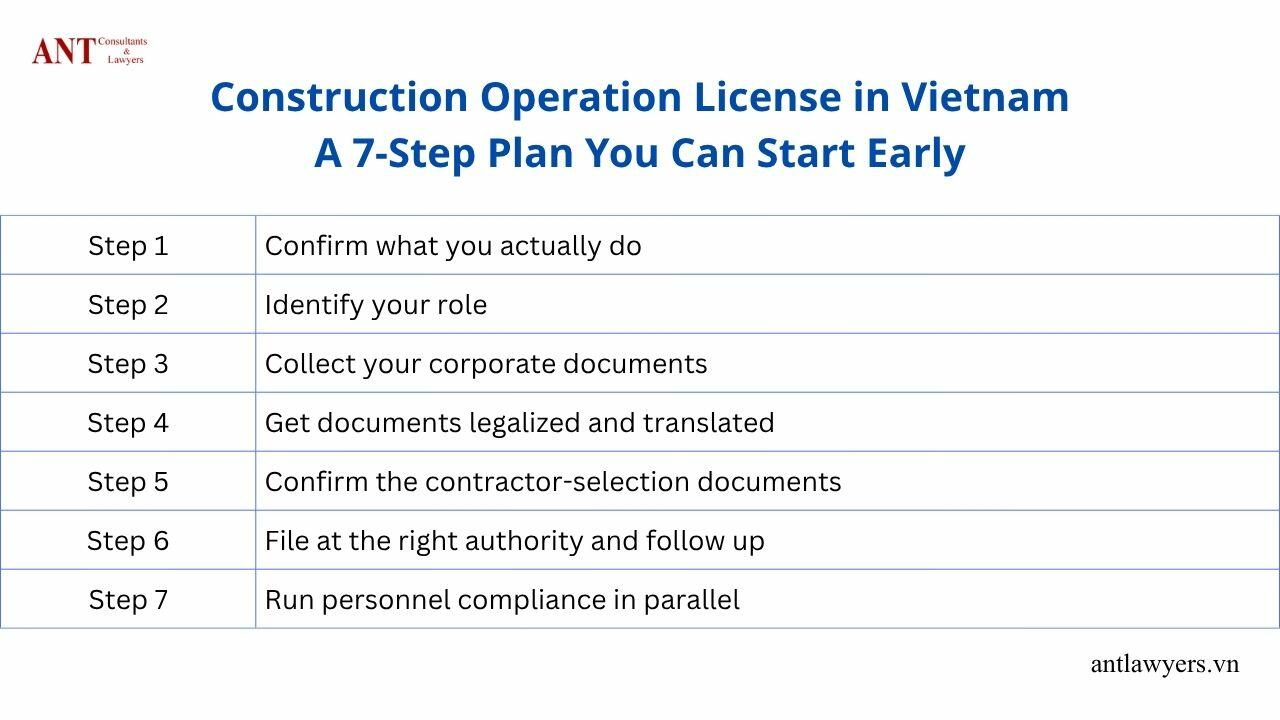
Step 1: Confirm what you actually do. Pay attention to the real scope of work, the actual tasks your company will perform in Vietnam. This determines whether and how the license applies.
Step 2: Identify your role as the main contractor, EPC contractor, subcontractor, consortium member, design consultant, supervision consultant, or specialist contractor. Each role has slightly different licensing implications.
Step 3: Collect your corporate documents. Business registration, incorporation papers, audited financial statements for the most recent years, evidence of past similar projects, and a board authorization or power of attorney for the person who will sign in Vietnam.
Step 4: Get documents legalized and translated. Notarize them in the country of origin, authenticate and certify them at the Vietnamese embassy or consulate, then have them translated into Vietnamese by a certified translator.
Step 5: Confirm the contractor-selection documents. Ask the project owner for the official documents showing your company was selected for this project.
Step 6: File at the right authority and follow up.
Step 7: Run personnel compliance in parallel. While the company license is pending, start work permits, visa applications, and individual practicing certificates for the key foreign personnel who will be on site.
For a procedural guide, see: Apply for A Construction Operation License in Vietnam: 9 Steps Foreign Contractors Should Plan Before Mobilization
Frequently Asked Questions
Q1: What is a construction operation license in Vietnam?
The construction operation license in Vietnam is the approval that allows a foreign contractor to legally perform construction-related work in Vietnam for a specific project or contract.
Q2: Is it the same as a construction permit?
No. A construction permit allows the building to be built. A construction operation license allows the foreign contractor to do the work. Different applicants, different purposes.
Q3: Does every foreign contractor need one?
Most do, but it depends on the actual scope of work. The closer the activity is to regulated construction work performed inside Vietnam, the more likely the license is required.
Q4: Can I apply before winning the project?
The construction operation license in Vietnam is tied to a specific contract, so the formal application happens after selection. But you can prepare corporate documents, legalize papers, and get translations ready in advance.
Q5: How long does it take?
The official authority review is usually relatively short. The full timeline, including document collection, legalization, translation, and back-and-forth questions, is typically much longer.
Q6: Does the license let my foreign engineers work in Vietnam?
No. Individual work permits, visas, and in some cases professional practicing certificates are separate from the company license.
Q7: Does it cover taxes?
No. Foreign contractor tax, VAT, and corporate income tax are separate compliance tracks that should be reviewed with a qualified tax advisor before signing the contract.
Q8: Can I start any work before the license is issued?
Preparatory and planning work is usually different from regulated construction activity. But you should be cautious about mobilizing personnel or starting regulated work before the construction operation license in Vietnam is in hand.
Q9: What if the contract start date arrives before the license is ready?
Document the situation in writing with the project owner, suspend regulated activities, and continue any permitted preparatory work.
Conclusion
A construction operation license in Vietnam is the link between a signed contract and a project that can actually proceed.
The project managers who handle Vietnam well start licensing work early, prepare documents early, and get help early. That is usually the difference between a project that starts on time and one that does not.
About the Author
Tuan Nguyen is the Managing Partner and founder of ANT Lawyers, with more than 20 years of experience across legal practice, management and compliance. He advises foreign companies, investors and manufacturers on corporate, commercial, international trade, regulatory and dispute-related matters in Vietnam. He holds an LLB from Hanoi National University School of Law and an MBA from Warwick Business School, and is an Associate Member of the Chartered Institute of Arbitrators.
About ANT Lawyers, a Law Firm in Vietnam
Founded in 2012, ANT Lawyers is a Vietnam law firm with offices in Hanoi, Ho Chi Minh City and Da Nang. Our construction lawyers advise on construction contracts, licensing and regulatory compliance, project delivery issues and construction disputes in Vietnam. We combine legal analysis with practical understanding of Vietnam’s regulatory environment and local administrative practice.
General Disclaimer
This article is for general informational purposes only, does not constitute legal advice, and does not create a lawyer-client relationship. Vietnamese laws, regulations and administrative practice change over time, and the correct position for any matter depends on its specific facts and the rules in force when action is taken. Verify the current position before relying on anything stated here, and consult qualified counsel on your specific situation.




How ANT Lawyers Could Help Your Business?
You could reach ANT Lawyers for advice via email ant@antlawyers.vn or call our office at (+84) 24 730 86 529