
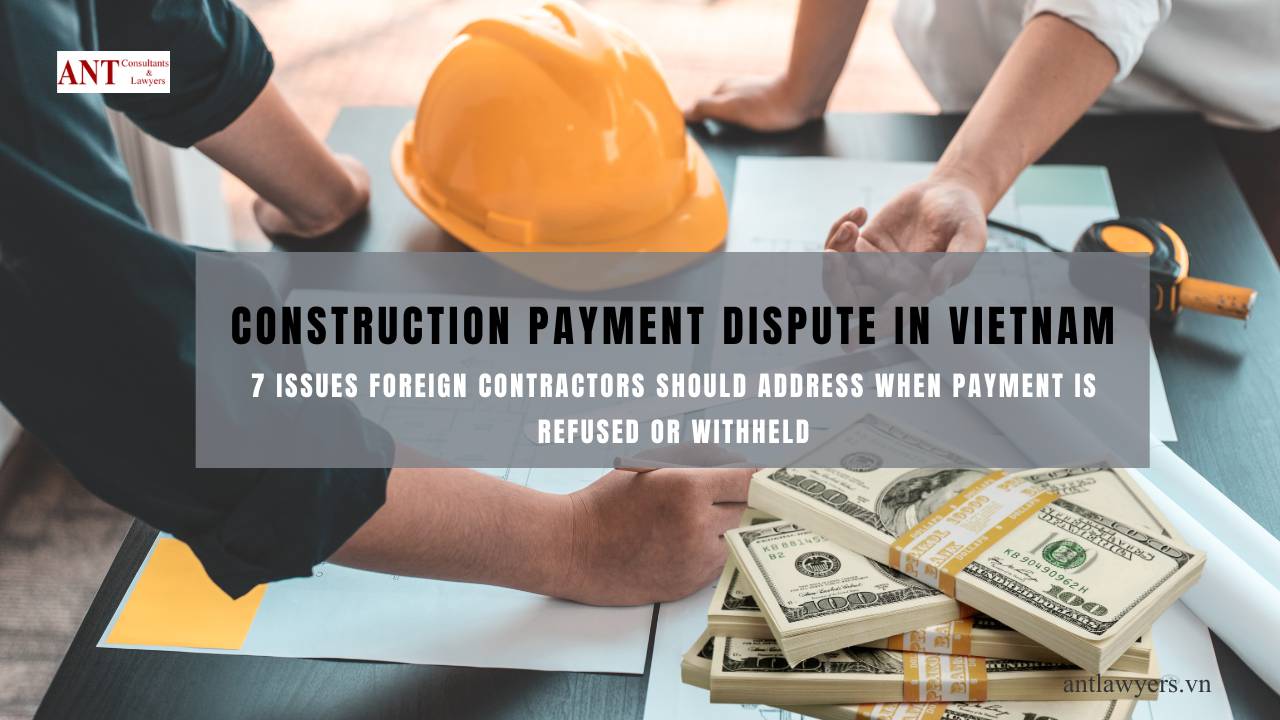
A construction payment dispute in Vietnam often becomes visible when a contractor submits a progress or final payment application and the project owner refuses, withholds, deducts, or does not respond. The works may already be complete, or the contractor may still be performing while unpaid amounts and cash-flow exposure continue to grow.
Before handover and final settlement, the focus is on managing foreign EPC contractor payment risk in Vietnam. Once payment has been refused or withheld, the contractor must prove the amount due, answer the owner’s defenses, protect its contractual position, and decide when negotiation should move to formal recovery.
Quick Reference
A construction payment dispute in Vietnam arises when the project owner refuses, withholds, deducts, or delays an amount claimed under a construction contract. Once the dispute has started, the contractor should move beyond payment administration and identify the contractual basis of the claim, the owner’s defenses, the effect of notices and settlement documents, and the available recovery route.
The claim should be organized around entitlement and proof. The contractor should establish what amount became due, why it became due, what work or benefit the owner received, how deductions should be answered, and whether any notice, release, timing, or recovery issue may affect the result.
7 Issues in a Construction Payment Dispute in Vietnam
Prove Contractual Entitlement and the Amount Due
The contractor should not argue only that the work was completed. In a dispute, the owner will ask which clause created the right to payment and whether the conditions for that payment were met.
The starting point is the contract. The contractor should identify the clause that creates the payment right, the payment event or milestone that occurred, whether the conditions were satisfied or were prevented by the owner, how the amount was valued, what has already been paid, and what remains outstanding.
Retention requires separate attention. The contractor should check whether the defects-liability or warranty period has expired and whether every contractual release condition has been met. The fact that work is complete does not always mean retention has become payable.
A payment claim may also include late-payment interest where the contract or applicable law provides a basis. Before stating an amount, the contractor should verify the legal or contractual basis, the starting date, the applicable rate, and the calculation period.
The contractual foundation should be checked against the payment conditions, certification process, retention, and final account provisions addressed through EPC contract review in Vietnam.
Owner Use or Benefit May Support the Claim Where Records Were Not Signed
A common situation is that the owner has taken the works, operated them, or put them to use, but the acceptance record or payment certificate was never signed. The contractor is told the file is incomplete while the owner continues to benefit from the work.
Owner conduct matters. Possession or site transfer, commissioning or operation records, production records, use by the owner, tenants, or an operator, maintenance requests, owner instructions after completion, partial acceptance, and payment history may all support the claim.
In Vietnam construction practice, signed acceptance and testing records remain central to payment and handover. Owner use may support the contractor’s case, but it should be treated as supporting evidence rather than a complete substitute for the formal project file.
Physical use should therefore be distinguished from formal acceptance and the records required for construction acceptance inspection in Vietnam.
Owner Defenses, Counterclaims, and Security Actions May Reduce Recovery
An owner refusing payment rarely says only that it will not pay. It usually raises a defense and may also bring a counterclaim. Common examples include liquidated damages for delay, defect and rectification costs, incomplete work, set-off, back charges, warranty claims, replacement-contractor costs, unauthorized subcontracting, and challenges to the authority of people who signed the records.
The contractor should treat each item as a separate allegation with its own answer, calculation, and evidence. A counterclaim may be larger than the unpaid invoice, which can change the commercial position and the value of continued negotiation.
Licensing is a defense that deserves specific attention in Vietnam. The effect of a licensing objection should be assessed against the requirements for a construction operation license in Vietnam, the contract wording, the scope actually performed, the timing of any gap, the owner’s cooperation and knowledge, and the remedy being claimed.
The analysis should also consider whether the owner continued to require performance, accepted or used the work, or delayed providing documents needed for the filing. A licensing issue should not be treated as having the same effect in every case.
Security actions can escalate the dispute quickly. A call on a performance or advance-payment guarantee may affect cash flow before the underlying payment dispute is resolved. The contractor should review the guarantee wording, call conditions, alleged default, and issuing-bank process as soon as a call is threatened or made.
Notice and Contractual Time-Bar Problems May Weaken the Claim
A claim with a sound commercial basis can still face a procedural objection. Many EPC and construction contracts require notice within a stated period, in a stated form, to an identified recipient, with supporting particulars.
The contractor should check the deadline, authorized recipient, contractual address, delivery method, required contents, continuing updates, final claim submission, and any reservation of rights.
The contractor should assess a notice defect carefully. It may not defeat the claim, but it gives the owner a procedural argument that must be answered. The owner may argue that the contractor failed to preserve its contractual entitlement because the required notice procedure was not followed.
This is the dispute-stage consequence of the notice and claim provisions that should be tested during EPC contract review in Vietnam.
Final Settlement, Release, or Waiver May Close the Claim Too Early
The first concerns where the right to payment comes from. This issue concerns whether the contractor has already limited or released that right.
Under settlement pressure, contractors may sign final accounts, releases, waivers, or taking-over documents to obtain part of the payment. The wording of those documents can materially affect whether the remaining claims survive.
The contractor should review any full and final settlement language, release of claims, no-further-claim wording, carve-outs for disputed amounts, reservation of rights, authority of the signer, conditional signature, and whether the promised payment was actually received.
A document titled final account may have a different effect from a document that expressly releases all claims. The wording, signing authority, payment status, and circumstances of execution should be reviewed together and before signature.
Construction Payment Evidence Must Prove Each Disputed Amount
A large project file is not the same as a strong payment claim. The useful question is whether each disputed amount can be traced to its own contractual basis, calculation, supporting record, and response to the owner’s defense.
For each amount, the contractor should identify the contract clause supporting it, the payment application and certificate, the certified volume or valuation, the acceptance or testing record, the variation instruction where relevant, the retention release condition, the deduction notice, and the payment history.
The record should be organized amount by amount. A schedule that links each figure to its contract basis and evidence is usually more useful than a folder organized only by document type.
If proceedings move to arbitration in Vietnam, the same records should also be organized consistently with the evidentiary process addressed in evidence in arbitration in Vietnam.
Check Timing, Forum, and Asset Position Early
Once payment has been refused or withheld, timing becomes a live management issue. Limitation risk, contractual negotiation periods, and any mediation or expert-determination step should be checked at the start, not after months of correspondence.
The dispute clause should be reviewed again to confirm whether the contract points to a Vietnamese court, arbitration in Vietnam, or another forum, together with the seat, language, governing law, and escalation steps.
The broader organization and preservation of a claim should remain consistent with the approach used for serious contract disputes in Vietnam.
Recovery also depends on the counterparty’s position. The contractor should identify the owner’s assets, available guarantees or security, and the location where recovery may practically occur. For state-related entities or publicly funded projects, internal approval, audit, and capital-control processes may affect settlement timing, approval routes, and the documents required before an amount can be released.
Management Decisions When Payment Is Refused or Withheld
Continue Performance or Consider Suspension
Continuing work may protect the schedule and commercial relationship, but it increases cash exposure. Suspending without a contractual right, or without following notice and cure requirements, may lead to delay damages, termination, or replacement-contractor costs. Management should check the contract right, notice period, safety duties, and protection-of-works obligations before deciding.
Accept Undisputed Payment Without Releasing the Balance
If the owner offers to pay an undisputed amount, the contractor should check whether acceptance is tied to a release of the balance. Receipt of part payment should not unintentionally become a settlement of the disputed part.
Negotiate Item by Item While Preserving Rights
Negotiation is more effective when each disputed item is tied to its contract basis, amount, and evidence. The parties may still protect the commercial relationship, but the contractor should not allow negotiations to erode notice positions, timing protection, or reserved rights.
Respond Promptly to a Guarantee Call or Security Action
If the owner calls a performance or advance-payment guarantee, management should immediately review the guarantee terms, the alleged default, the issuing-bank process, and any urgent response available. A guarantee call can change the contractor’s cash position before the underlying payment dispute is resolved.
Set a Decision Date Before Negotiation Extends Too Long
Long negotiation can become costly if cash-flow exposure, notice risk, limitation risk, or security pressure continues to grow. Management should set a date to review the evidence, timing position, counterparty assets, and available recovery route.
Construction Payment Dispute Checklist
|
Issue |
Dispute exposure |
What to prepare |
|
Entitlement and amount |
Completed work may not prove that payment became due |
Contract basis, payment event, valuation, retention, interest basis |
|
Owner use or benefit |
Unsigned acceptance records may weaken the claim |
Possession, use, operation, correspondence, payment history |
|
Defenses and counterclaims |
Delay, defects, licensing, set-off, or guarantee calls may reduce recovery |
Defense analysis, license file, defect and delay records, guarantee terms |
|
Notice and time-bar |
Procedural objections may weaken a valid claim |
Notice log, delivery proof, recipient authority, reservation of rights |
|
Final settlement |
The contractor may close the claim through its own signature |
Final account, waiver, carve-outs, signing authority |
|
Payment evidence |
Documents may not prove each disputed amount |
Certificates, certified volume, variations, deductions, chronology |
|
Timing and forum |
Delay in escalation may reduce practical recovery |
Dispute clause, timing review, assets, security, recovery route |
Step-by-Step: What Foreign Contractors Should Do When Payment Is Refused or Withheld
The issues above identify what must be addressed. The steps below set out a practical working order. There are more steps than issues because several issues require more than one management action.
- Identify each refused, withheld, deducted, or unpaid amount.
- Check each amount to its contractual payment basis.
- Separate undisputed amounts from disputed amounts.
- Check retention release and late-payment interest positions.
- Record every owner defense, counterclaim, deduction, and guarantee action.
- Review all notice and claim deadlines.
- Decide whether continued performance or suspension is contractually and commercially supportable.
- Review final account, waiver, release, and settlement documents before signing anything.
- Build an amount-by-amount evidence schedule.
- Review the dispute clause, timing risk, and escalation steps.
- Identify the owner’s assets, available security, and practical recovery route.
- Prepare a management decision note covering negotiation, continued performance, settlement, court, or arbitration.
Conclusion
A construction payment dispute in Vietnam often turns on contractual entitlement, the owner’s deductions, and proof of each disputed amount. Once payment is refused or withheld, the contractor should organize the claim around the contract, answer each defense separately, protect its position before signing settlement documents, and review timing and recovery options early.
About the Author
Tuan Nguyen is a lawyer at ANT Lawyers advising foreign contractors, EPC companies, and engineering consultants in Vietnam on matters including licensing, contracts, personnel compliance, and related dispute resolutions.
About ANT Lawyers, a Law Firm in Vietnam
ANT Lawyers is a Vietnam law firm with lawyers in Ho Chi Minh City, Hanoi, and Da Nang. We advise foreign companies, investors, contractors, managers, and individuals on corporate, commercial, regulatory, employment, dispute resolution, intellectual property, real estate, construction, trade, tax, and other legal matters in Vietnam. Our work combines legal analysis with practical understanding of Vietnam’s business environment, local procedures, and cross-cultural issues. We help clients protect their interests, manage legal and commercial risk, maintain regulatory compliance, and make informed decisions in transactions, operations, investments, and disputes.
General Disclaimer
This article is for general informational purposes only and does not constitute legal advice for any specific situation. Laws and practice may change, and the position is stated as of the publication date. For advice on your matter, please consult qualified counsel.

How ANT Lawyers Could Help Your Business?
You could reach ANT Lawyers for advice via email ant@antlawyers.vn or call our office at (+84) 24 730 86 529