
On August 14, 2026, Taiwan’s Ministry of Finance opened an anti-dumping investigation into certain cold-rolled, flat-rolled stainless steel products imported from Vietnam. The official initiation notice issued by Taiwan’s Customs Administration identifies the product scope, the known producers and exporters, the investigation procedure and the initial filing requirements.
No anti-dumping duty has yet been imposed. The 31.36% dumping margin reported in the notice is the petitioners’ allegation for 2025, not an official finding or a duty rate determined by the authority.
What Taiwan Is Investigating
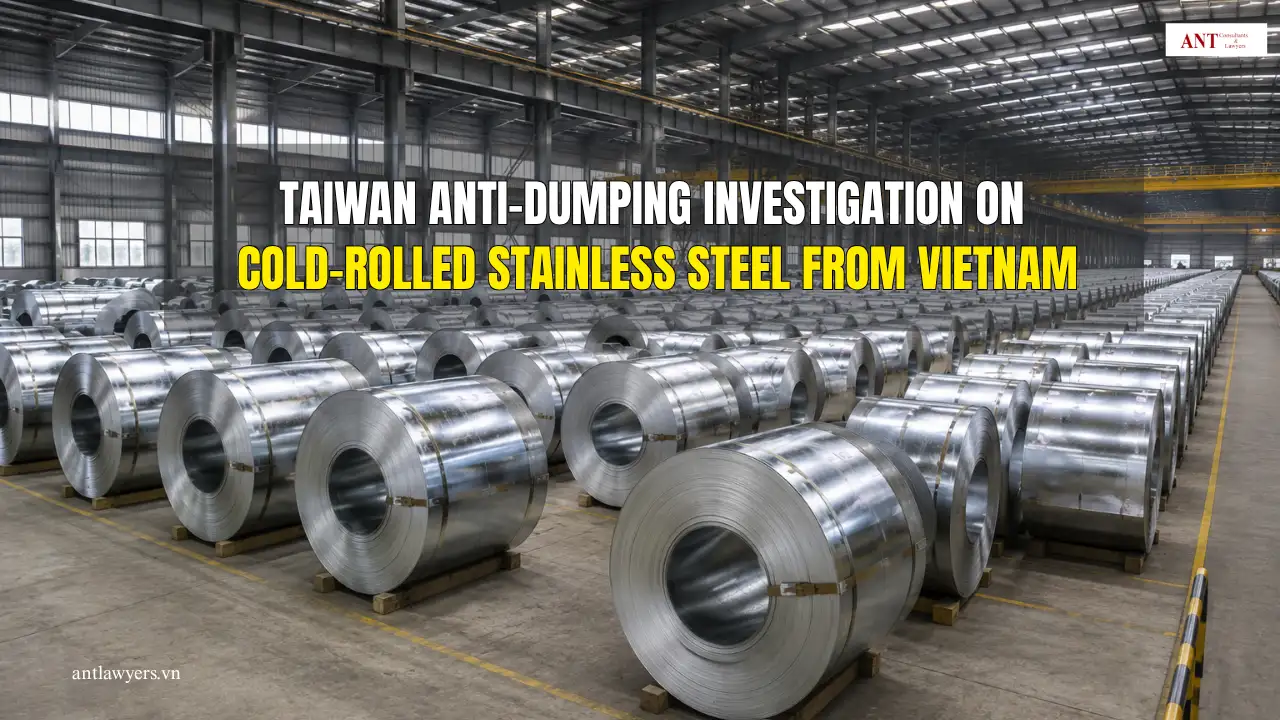
The investigation covers certain cold-rolled stainless steel flat products, whether in coils or not, and whether or not they have undergone surface treatment or further processing.
The stated specifications include:
- Thickness from 0.05 mm to 6.10 mm;
- Nickel content from 5% to 20% by weight;
- Chromium content from 15% to 25% by weight;
- Manganese content of no more than 3%; and
- Aluminum content of no more than 0.5%.
Steel products whose surfaces are plated, coated or covered with metal are excluded from the stated scope.
The notice lists 50 reference tariff lines, principally within headings 7219 and 7220. Exporters should not rely on the tariff code alone. They should compare the product description, technical specifications, customs declarations, invoices and product data sheets.
The dumping investigation period is July 1, 2025 through June 30, 2026. The preliminary injury questionnaire requests information covering January 1, 2023 through June 30, 2026. The case is identified as original investigation No. 19-115-02.
An important feature of the notice is that it covers subject goods imported into Taiwan from Vietnam whether or not the goods were produced in Vietnam. A trading company, processor or exporter should therefore review both the product and the shipment route before deciding that the case does not apply.
The Complaint Was Filed by Taiwan’s Domestic Industry
The investigation followed an application by Taiwanese manufacturers.
The applicants allege that imports from Vietnam increased substantially from 2024, gained market share and were sold below comparable domestic-product prices. They claim that Taiwan producers were forced to reduce their own prices, in some cases below their production costs, and that the domestic industry consequently lost customers, market share and profitability.
These statements are allegations supporting the opening of the investigation. The investigating authorities must still examine the evidence and determine whether dumping, injury and a causal connection are established.
The 31.36% Figure Is Not an Anti-Dumping Duty
The petitioners calculated an alleged dumping margin of 31.36% for 2025. According to the notice, their calculation compares adjusted import prices with domestic selling prices for certain 304 and 316 grade products in Hanoi and Ho Chi Minh City.
The 31.36% figure should not be presented as a duty already imposed on Vietnamese goods. The actual result, if any, will depend on the authority’s investigation and the company-specific information accepted during the proceeding.
How the Investigation Will Proceed
Taiwan’s Ministry of Finance is responsible for examining whether dumping occurred. The Ministry of Economic Affairs is responsible for examining injury to the domestic industry.
The Ministry of Economic Affairs is expected to make its preliminary injury determination within 40 days from the day after receiving the referral. If the preliminary injury finding is affirmative, the Ministry of Finance generally has 70 days from receipt of that finding to make its preliminary dumping determination and consider whether provisional anti-dumping duties are appropriate.
The process then continues through final dumping and injury determinations before any decision on a definitive duty. The timetable may depend on the authority’s receipt of notices, the information submitted and any procedural developments. Businesses should follow the official case page rather than work only from an estimated calendar.
Taiwan’s English preliminary injury investigation announcement and questionnaire materials provide additional information for interested parties.
A Company Not Named in the Notice Can Still Participate
The initiation notice identifies known Vietnamese producers and exporters. It also expressly includes other manufacturers, exporters and importers that are not named in the application.
A company should not assume that it is outside the investigation merely because its name does not appear in the notice. The first questions are whether its goods fit the product description and whether they were imported into Taiwan from Vietnam.
An exporter that did not manufacture the investigated goods must coordinate with the producer so that both can apply to participate. This makes early supply-chain confirmation important where the exporter, processor and producer are different companies.
The Risk of a Determination Based on Available Information
The Ministry of Finance may select a reasonable number of producers or exporters for individual examination, based on export volume. A fully cooperating company may have an opportunity to receive an individually determined dumping margin and duty rate.
A producer or exporter that does not apply to participate may have its dumping margin determined from the application and other information available to the authority. That information may not reflect the company’s actual prices, costs, product differences or commercial circumstances.
Taiwan importers also need to preserve evidence of the producer and the direct export route. If duties are later imposed, an importer seeking a company-specific rate may need to prove that the goods were produced and directly exported by the enterprise receiving that rate.
The Immediate Deadlines
Known and unnamed manufacturers, exporters and importers that wish to participate must submit the required participation form by September 3, 2026. Interested parties wishing to comment on product scope or the content of the notice are subject to the same deadline. This is the 20-day period stated in the initiation notice, counted from the day after the August 14 announcement.
Separately, the Ministry of Economic Affairs requested relevant domestic producers, importers, purchasers, Vietnamese manufacturers and exporters to return the preliminary injury questionnaire and supporting information by September 1, 2026.
These are different procedural steps. A business should confirm which forms apply to it, the correct filing channel, the required language and confidential and non-confidential versions, rather than treating one submission as completing the entire response.
The Applicants Have Requested Possible Retroactive Duties
The applicants requested provisional anti-dumping duties and also asked that duties be collected on qualifying imports made during the 90 days before provisional duties begin.
Taiwan has not decided to impose provisional or retroactive duties. The Ministry of Finance has indicated that it will address retroactivity when completing its final dumping determination.
Retroactive collection would require additional legal findings, including findings concerning massive dumped imports over a relatively short period and the relevant history-of-dumping or importer-knowledge conditions. It is not an automatic consequence of the request.
The request nevertheless creates a commercial planning issue. Exporters and importers should review who bears new customs duties under existing contracts, whether prices can be adjusted, how pending shipments will be handled and what information customers need before placing new orders.
What Vietnamese Producers and Exporters Should Do Now
The Vietnam Ministry of Industry and Trade’s case notice recommends timely registration, careful review of the product scope, preparation of production and sales data, and full cooperation with the investigating authorities.
For management, the immediate work should include:
- Confirm whether the company’s products fall within the technical description and reference tariff lines.
- Trace direct and indirect shipments into Taiwan, including sales through traders, processors, affiliates and regional sales offices.
- Decide promptly whether to participate and coordinate with the producer if the exporter did not manufacture the goods.
- Preserve consistent sales, cost, production, inventory, accounting, customs and logistics records for the investigation period.
- Coordinate with Taiwan importers and customers on questionnaires, producer identity, direct-export evidence and commercial communications.
- Review contracts for duty allocation, price adjustment, delivery commitments and treatment of shipments made while the investigation is pending.
- Coordinate with the Trade Remedies Authority of Vietnam and qualified Taiwan trade-remedy advisers on the filing process and local procedural requirements.
FAQs on the Taiwan Anti-Dumping Investigation on Cold-Rolled Stainless Steel from Vietnam
Q1: Has Taiwan already imposed an anti-dumping duty on cold-rolled stainless steel from Vietnam?
No. The case is at the investigation stage. No provisional or definitive anti-dumping duty has yet been imposed.
Q2: Which products are covered by the investigation?
The case covers certain cold-rolled, flat-rolled stainless steel products imported from Vietnam that meet the stated thickness and composition requirements. Products plated, coated or covered with metal are excluded under the current notice.
Q3: Is 31.36% the anti-dumping duty rate for Vietnamese exporters?
No. It is the dumping margin alleged by the petitioners for 2025. The authority has not determined an official dumping margin or duty rate.
Q4: Can a Vietnamese exporter that is not named in the notice participate, and by when?
Yes. The notice permits other manufacturers, exporters and importers not named in the application to participate. The participation application and any scope comments are due by September 3, 2026.
Q5: Does the investigation cover goods shipped from Vietnam but produced elsewhere?
The notice states that subject goods imported into Taiwan from Vietnam are covered whether or not they were produced in Vietnam. Businesses should therefore check product specifications and shipment routes carefully.
Q6: Can Taiwan impose anti-dumping duties retroactively?
The applicants requested possible collection on qualifying imports made during the 90 days before provisional duties begin. No decision has been made, and any retroactive application would depend on the applicable legal conditions and the authority’s determination.
Conclusion
The Taiwan anti-dumping investigation on cold-rolled stainless steel from Vietnam is at the initiation stage. No anti-dumping duty has yet been imposed, and the alleged 31.36% margin is not an official rate.
Vietnamese producers and exporters should now determine whether their products and shipment routes are covered, identify the filings that apply to them, preserve the required data and coordinate with their Taiwan importers. Early control of the facts and the response process gives management more options than waiting for a preliminary determination.
About the Author
About ANT Lawyers, a Law Firm in Vietnam
Founded in 2012, ANT Lawyers is a Vietnam law firm with offices in Hanoi, Ho Chi Minh City and Da Nang. Our international trade and tax lawyers assist manufacturers, exporters and importers with trade-remedy risk assessments, evidence organization, questionnaire preparation, coordination with investigating authorities and foreign counsel, and related customs and commercial issues. We combine legal analysis with practical understanding of Vietnam’s regulatory environment and local administrative practice.
General Disclaimer
This article is for general informational purposes only, does not constitute legal advice, and does not create a lawyer-client relationship. Vietnamese laws, regulations and administrative practice change over time, and the correct position for any matter depends on its specific facts and the rules in force when action is taken. Verify the current position before relying on anything stated here, and consult qualified counsel on your specific situation.
Vietnam Anti-dumping Investigation on Prestressed Steel Bars from China
Malaysia Anti-dumping Investigation on Aluminium Zinc Coated Steel from Vietnam

How to Answer Anti-Circumvention Investigation Questionnaire

Anti-Circumvention Investigation Procedures in Vietnam: 7 Powerful Steps to Protect Fair Trade
How ANT Lawyers Could Help Your Business?
You could learn more about ANT Lawyers International Trade and Tax Practice or contact our International Trade Dispute Lawyers for advice via email ant@antlawyers.vn or call our office at (+84) 24 730 86 529