Our lawyers practicing international trade and taxes have observed that Vietnamese exporters nowadays face anti-dumping cases more often than most managers expect, across markets such as the United States, the European Union, India, and Turkey. The product and the country change, but the pattern repeats, and so does the way a prepared company should respond.
A Vietnamese exporter might think this is not relevant or that it is the buyer’s problem. But a careful look at the facts is enough to know where you stand to evaluate the business risks.
Turkey Anti-Dumping Investigation on Polyester Tire Cord Fabric from Vietnam
Quick Reference
This is the case at a glance, and a reference point for any Vietnamese exporter selling the below mentioned products abroad.
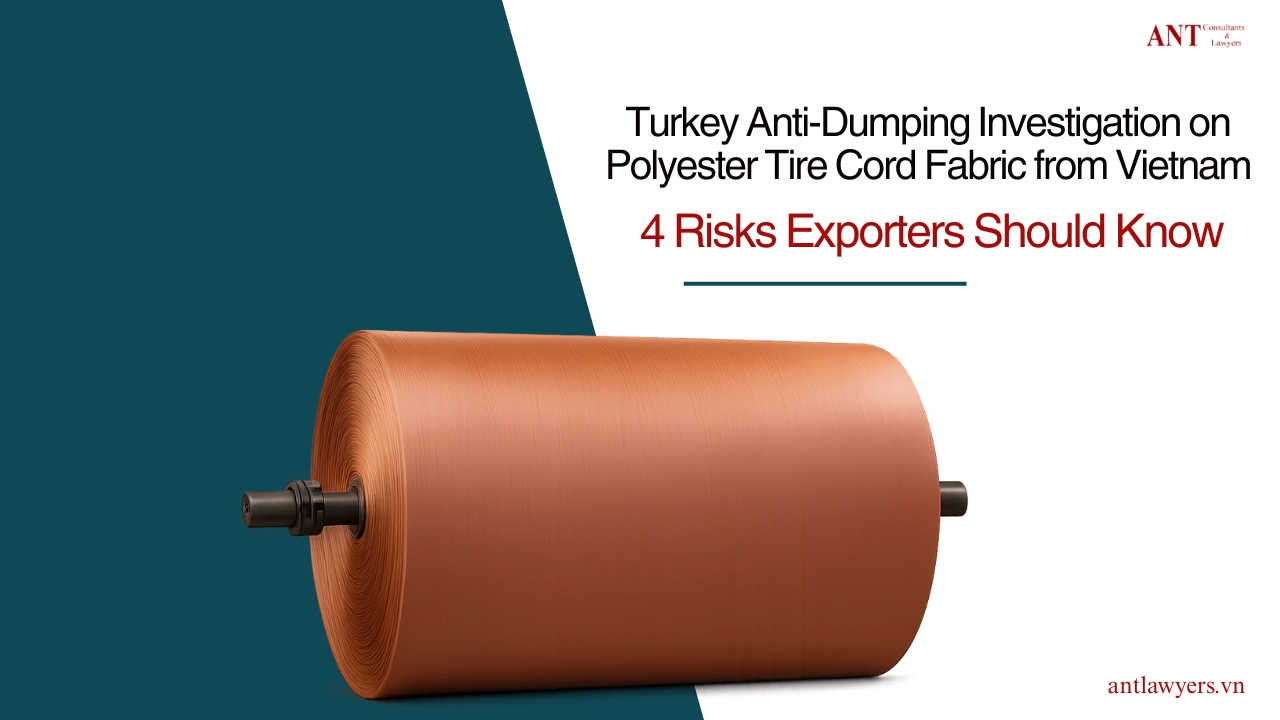
Product: polyester tire cord fabric, a strong rubber treated fabric made from high tenacity polyester yarn, used to reinforce vehicle tires.
Turkish tariff position (GTIP): 5902.20.10.00.00. The broader HS heading 5902.20 covers tyre cord fabric of high tenacity yarn of polyesters.
Origin under review for the polyester product: Vietnam and China. The nylon cord fabric part of the case applies to China only.
Stage: investigation opened by Turkey’s Ministry of Trade in June 2026, on a complaint by a Turkish producer. A duty, if any, comes only after the process is complete.
The Turkish authority believes imports may be priced too low and may be harming local industry leading to an anti-dumping investigation.
Why This Matters Even If Your Company Is Not Named
Same as in Vietnam, an anti-dumping investigation does not pick out one company by name but it looks at a product from a country.
In this case, for Turkey’s investigation, if your product fits the description and your goods reached Turkey, you can be inside the case whether or not you see your name in the news.
If Turkey later sets an anti-dumping duty, that duty can change your price, break your supply contracts, and push your Turkish customers to buy from another country.
Although your company did anything wrong. An anti-dumping investigation is a trade matter, and the question is whether your data can protect your price and your market.
These cases against Vietnamese exporters tend to follow a familiar pattern, and recognizing it early helps you judge your own exposure before a deadline forces the decision.
You May Be In Scope
Many Vietnamese factories do not export directly to Turkey. They sell to a trading company, to a group affiliate, or to a buyer who then ships the goods on. The factory may not even know its tire cord fabric ended up in Turkey.
Foreign invested makers face a second layer. In many groups, the factory in Vietnam produces the goods, but sales, invoicing, and export are handled by a regional office in another country.
You need to find out whether your polyester tire cord fabric reached Turkey, and how, so you can evaluate the situation.
The Real Business Risks You Should Worry About
Turkey Anti-Dumping Investigation on Polyester Tire Cord Fabric from Vietnam: 4 Risks Exporters Should Know
The Deadlines Are Short
An anti-dumping notice and its questionnaires come in the language and procedure of the importing country, and the response window is fixed and tight. The Turkish notice refers to a 37 day response period in the relevant circumstances, and the exact deadline can depend on whether your company received direct notification and when it was sent. Confirm the date from the notice and act on it early.
A Less Favourable Outcome If You Stay Silent
If you stay silent, the authority may rely on the information available to it instead of your own company data. Past trade remedy cases show that cooperating and non-cooperating exporters can face very different outcomes, which is why early review matters.
The Loss of Your Turkish Customers
Even a temporary anti-dumping duty makes your price uncompetitive. Your buyer in Turkey will look for a supplier in a country with no duty.
The Data Problem
Vietnamese accounting and cost records are not always kept in the format a foreign authority expects. Related party prices, cost build ups, and production records may need work before they can defend your position. That work takes time you do not have if you start late.
Once a duty is in place, it reaches into customs, pricing, and your wider trade and tax position, so it is worth seeing the whole picture early.
What Happens If You Stay Silent
In an anti-dumping investigation, the authority asks interested parties to send information through questionnaires. For exporters and producers, this can include company structure, production, sales, export records, costs, accounting data, related party dealings, and product details.
If a company does not reply in time, the authority can decide the case using the information available to it. In plain words, the company may lose the chance to explain its own prices, costs, product differences, and transaction structure.
This often leads to a less favourable outcome than for a company that cooperates and provides usable information.
This does not mean every company must file a full response. A company with no exports to Turkey may only need to document that fact. But that decision should follow a quick review of your records.
Step by Step on What to Do Now
You need to take the right steps in the right order.
Step 1: Confirm the product
Check whether you make or export polyester tire cord fabric, tire cord fabric, rubber treated polyester cord fabric, or similar tire reinforcement made from high tenacity polyester yarn.
Step 2: Check the tariff line
Look at the codes on your export papers, in particular HS 5902.20 and the exact position 5902.20.10.00.00 named in the Turkish notice.
Step 3: Trace your goods to Turkey
Review direct exports, indirect exports through traders, and any sales through affiliates or group companies. Find out if your product reached Turkey at all, and how.
Step 4: Map your Turkish side
Identify your Turkish buyers, importers, and distributors. Ask whether any of them already received a notice or questionnaire from the Turkish Ministry of Trade.
Step 5: Lock down your documents
Keep export contracts, invoices, packing lists, customs declarations, product specifications, cost data, and production and sales records. These are your evidence.
Step 6: Check the deadline
The notice refers to a 37 day response period in the relevant circumstances. Confirm the exact deadline and how it is counted, from the notice and any direct communication, so you do not rely on memory or rumor.
Step 7: Decide whether to take part
Make this choice early. A real response needs sales, accounting, production, export, and legal teams working together, and that coordination takes time.
Step 8: Name one owner
Choose one person to gather information, check it, and handle outside communication. Anti-dumping cases involve sensitive commercial data, so a single clear line avoids mistakes.
Conclusion
An anti-dumping investigation on polyester tire cord fabric from Vietnam can reach any company in the supply chain, including those that did not export directly. The investigation stage is early, but the deadlines and the data demands are real from the start.
Check the product, trace your goods to the market under review, save your records, confirm the deadline, and decide your response early. Early review is the cheapest insurance you can buy against a missed deadline and a high duty.
Cases like this come and go across markets and products. The exporters who treat them as a routine part of selling abroad, with records ready and a plan to respond, are the ones who keep their markets.
Frequently Asked Questions on Anti-Dumping Investigation on Polyester Tire Cord Fabric from Vietnam
Q1: Is this already an anti-dumping duty on tire cord fabric from Vietnam?
No. This is the investigation stage. Turkey has opened an anti-dumping investigation, but no duty has been set. A duty can only come later, after the process is finished.
Q2: My company never exported to Turkey. Do I still need to act?
Maybe only a little. If you have no exports to Turkey, you usually just need to document that fact in case it is ever asked. The risk appears when goods reached Turkey through a trader, an affiliate, or a buyer without your direct knowledge.
Q3: What product exactly does this cover for Vietnam?
Polyester tire cord fabric. This is a strong rubber treated fabric made from high tenacity polyester yarn, used to reinforce vehicle tires, classified under Turkish tariff position (GTIP) 5902.20.10.00.00. The nylon cord fabric part of the case applies to China, not Vietnam.
Q4: What happens if we do nothing?
The authority can decide your case using the information available to it, rather than your own company data. This can lead to a less favourable outcome than for companies that cooperate and provide usable information.
Q5: How much time do we have to respond?
The Turkish notice refers to a 37 day response period in the relevant circumstances. The exact deadline can depend on whether your company received direct notification and when it was sent, so confirm it from the notice itself and from any direct communication from the Turkish Ministry of Trade.
Q6: Who should handle this inside our company?
One named owner should coordinate sales, accounting, production, export, and legal input, and manage outside communication. Anti-dumping data is sensitive, so a single clear line of control protects you.
About the Author
Linh Pham is a Legal Research Specialist at ANT Lawyers with more than 10 years of experience, supporting legal teams through regulatory research, authority liaison, documentation review, and knowledge development. She has been trained in corporate law and related areas.
About ANT Lawyers, a Law Firm in Vietnam
We help clients overcome cultural barriers and achieve their strategic and financial outcomes, while ensuring the best interest protection, risk mitigation and regulatory compliance. ANT Lawyers has lawyers in Ho Chi Minh city, Hanoi, and Danang, and will help customers in doing business in Vietnam.
General Disclamer
This article is for general informational purposes only and does not constitute legal advice for any specific situation. Laws and practice may change, and the position is stated as of the publication date. For advice on your matter, please consult qualified counsel.