
Winning an arbitration does not by itself recover money in Vietnam. To enforce a foreign arbitral award in Vietnam, the award creditor normally needs a Vietnamese court to recognize the award first, before the civil judgment enforcement system can act against assets here. The commercial risk is a filing that succeeds on paper but arrives late, targets the wrong route, lacks decisive records, or reaches a debtor with no recoverable assets.
This enforcement process forms part of the wider framework for arbitration in Vietnam. The narrower management question is whether the award, the evidence, the filing route and the asset plan are ready.
It is important that the award creditor treats this as one controlled project. Legal analysis, document preparation, asset intelligence, budget approval and settlement authority all need to synchronize, because a gap in any one of them shows up later as delay.
Quick Reference: How Do You Enforce a Foreign Arbitral Award in Vietnam?
A foreign arbitral award normally needs recognition by a competent Vietnamese court before it can be executed against assets in Vietnam. Before filing, confirm the award classification, the treaty basis, the filing period, the competent court, the required documents, the likely refusal arguments and the execution plan. Under the framework in force since July 1, 2025, the first-instance application is generally handled by the territorially competent Regional People’s Court, and an appealed decision is reviewed by the provincial-level People’s Court. The primary legal sources are the 1958 New York Convention, Vietnam’s Civil Procedure Code as amended, and the law on civil judgment enforcement.
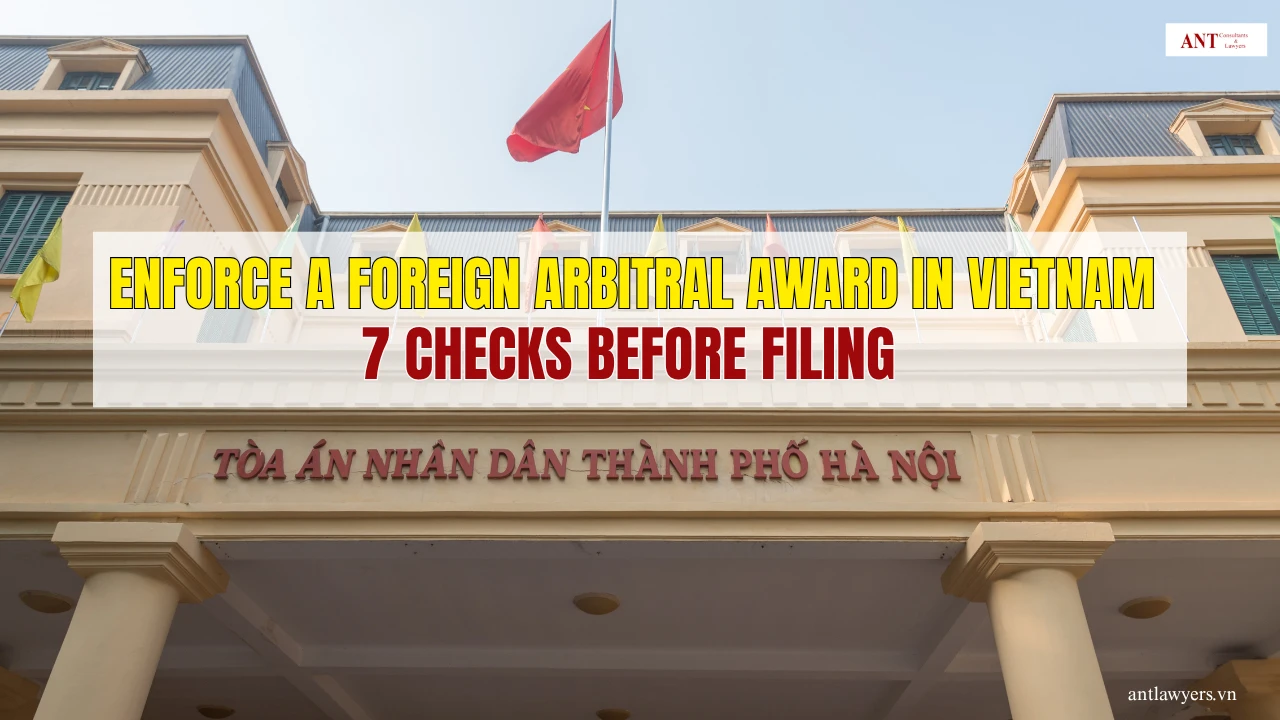
7 Checks Before You File to Enforce a Foreign Arbitral Award in Vietnam
Confirm That the Award Uses the Foreign-Award Route
Do not assume that the hearing location, the institution name or the language alone answers whether an award is foreign for Vietnamese law purposes.
The legal team should identify the arbitral institution, the legal seat or place of arbitration, the body that issued the award, the applicable rules, the award date and whether the award is binding. It should then match those facts to the current Vietnamese definition and recognition route.
This separates two different court processes:
- A foreign award may require recognition and permission for enforcement in Vietnam.
- An award made by a Vietnamese arbitral tribunal follows Vietnam’s domestic award enforcement and setting-aside framework.
Confusing the two routes can affect the deadline, the competent court, the grounds and the evidence plan.
Test the Treaty and Legal Basis Before Spending on the File
Vietnam is a contracting state to the New York Convention. The Convention is often the starting point for commercial awards made in another contracting state, subject to Vietnam’s declarations and the facts of the case.
Counsel should also confirm the seat state’s Convention status, the commercial character of the dispute, the arbitration agreement, whether the award is binding, and whether any reciprocity issue needs attention. Vietnamese civil procedure law then controls the local application and the court process.
For a useful decision record, analyze the legal seat and the issuing institution, the Convention status relied on, the commercial nature of the dispute, the basis on which the award is binding, and any declaration or reservation that needs attention.
Check the Debtor and Assets Before Choosing the Court Route
Recognition is a legal process. Recovery is an asset process. Both should start together.
Before filing, identify the debtor’s current legal name, enterprise number, registered address, operating locations, bank relationships and material assets in Vietnam. The asset map should cover receivables, inventory, machinery, shares, contract payments, land-use rights and other property that may support execution.
Identifying the right legal entity matters as much as identifying the assets. A case run against a branch or an affiliated company rather than the contracting entity creates a problem that follows the file all the way to execution. Check that the party named in the contract, the party named in the arbitration, the party named in the award and the party you intend to pursue in Vietnam are the same legal person.
This information affects both the commercial case for filing and the territorial route.
Lock the Filing Clock and Build the Dossier Early
The filing clock should be opened when the award becomes effective, not when settlement talks fail. Vietnamese law generally allows three years from the date the foreign arbitral award takes legal effect. The treatment of objective obstacles, force majeure, the trigger date and the current filing route must be verified for the specific award.
Document preparation can consume more time than expected. Vietnamese civil procedure law and the applicable treaty govern the formal package. A working dossier may also need proof that the award is binding, procedural notices, delivery records, corporate authority documents, certified copies, Vietnamese translations and any certification or legalization required for the source documents and the filing route.
Two parts of that package deserve early attention because deficiencies in either can become major recognition risks.
Proof of notice:
Build the record around the addresses and methods required by the arbitration agreement, the applicable rules and the governing law. Where the respondent is a company, service to its registered head office and legal representative generally provides the safest record. Documents sent only to a branch, a personal email address or an employee without authority can invite a notice objection. A courier receipt may not show exactly what was delivered, so keep a list of the documents served. Where service was electronic, use the addresses designated by the contract or applicable rules and keep server logs or delivery confirmations that make the record verifiable.
Proof of signing authority:
If the contract was signed by someone other than the legal representative, the file needs contemporaneous evidence that the signatory had authority when the contract was executed, such as a valid power of attorney or board resolution. A document created only after a dispute arises may be challenged and should not be treated as a substitute for proof of authority at signing. Internal rules also matter. Where the company charter required a co-signature for a contract of that size, a failure to follow it can give the other side an argument about the validity of the arbitration agreement itself.
Prepare to answer the likely questions. What agreement gave the tribunal authority? Was the respondent properly informed and able to present its case? Did the award stay within the submitted dispute? Is the award binding and still effective? Are the documents authentic, complete and usable in a Vietnamese court?
Answer Refusal Grounds Before the Debtor Raises Them
Recognition is not a second trial on the underlying contract. Vietnamese law directs the court not to retry the dispute. The court instead checks the award and the filing materials against the recognition framework and the applicable refusal grounds.
Although the court does not review the merits, recognition and enforcement of foreign arbitral awards in Vietnam can still involve detailed challenges over the statutory refusal grounds. These include incapacity or invalidity affecting the arbitration agreement; inadequate notice or inability to present a case; an award dealing with matters outside the submission; tribunal composition or procedure that did not follow the relevant agreement or law; an award that is not yet binding or has been set aside or suspended at the seat; a dispute that Vietnamese law does not permit to be resolved by arbitration; and a conflict with the fundamental principles of Vietnamese law.
Vietnamese courts have sometimes applied the ground based on conflict with fundamental principles of Vietnamese law by focusing on serious procedural unfairness rather than reopening the merits. The result remains fact-sensitive, so an award creditor should not assume that the ground will be interpreted narrowly in every case. A complete procedural record remains essential.
The application file should respond with evidence, not conclusions. Preserve procedural orders, appointment records, notices, proof of delivery, hearing records, objections and the final award.
Separate Court Recognition From Civil Judgment Enforcement
A recognition decision is not the same as successful recovery of money.
Once the recognition decision has legal effect, the award carries the same legal effect as an effective decision of a Vietnamese court and is implemented through civil judgment enforcement procedures. The creditor still needs to manage the enforcement request, the asset verification and the available execution steps under the law and practice in force at that stage.
It is worth asking early whether interim protection is needed while the recognition or execution plan develops, because assets can move faster than a court file.
Use the Enforcement Plan to Control Settlement Risk
An enforcement application can change negotiation dynamics, but only if the debtor sees a credible route from award to assets.
A strong position combines a timely filing, a clean service record, a clear answer to refusal grounds, identified assets and management authority to accept or reject settlement terms. A weak position may encourage delay, asset movement or repeated requests for extensions.
Award creditors should define in advance who can approve a discount, a payment plan or a security package, which assets or guarantees are acceptable, what information the debtor must disclose, which missed payment triggers escalation, and whether a settlement pauses or changes any filing or execution step.
Step-by-Step: From Foreign Award to Recovery in Vietnam
Step 1: Classify the award and identify the recovery target
Confirm that the foreign-award route applies, identify the correct debtor entity and locate assets or payment flows that may support recovery.
Step 2: Fix the deadline, filing route and current court
Calendar the three-year period, confirm whether filing is direct or through the Ministry of Justice under the applicable treaty route, and identify the territorially competent Regional People’s Court.
Step 3: Prepare and translate the application package
Control the application, the award, the arbitration agreement, the Vietnamese translations, the authority documents and the supporting notice and procedural record.
Step 4: File and manage acceptance, service and clarification
Track the court file, service events and requests for explanation, and answer promptly with indexed supporting documents.
Step 5: Prepare for the recognition hearing
Present the file to the panel of judges, answer the statutory refusal grounds with evidence, and keep the case focused on recognition rather than a re-argument of the merits.
Step 6: Manage review rights and move to execution
Track any appeal or protest, and once the recognition decision has legal effect, commence civil judgment enforcement while keeping the asset and settlement plan current.
Foreign Arbitral Award Enforcement Risk Table
|
Risk |
Business consequence |
Management response |
|
Wrong award route |
Time and cost spent under the wrong procedure |
Approve an award classification note |
|
Outdated court route |
Filing delay or transfer risk |
Verify court competence under current law |
|
Missed filing period |
Loss of a possible recovery route |
Calendar from the award’s effective date |
|
Weak notice record |
Due-process objection gains force |
Preserve notices, delivery proof and orders |
|
Signing authority not documented |
Challenge to the arbitration agreement itself |
Hold the power of attorney or board resolution from the contract stage |
|
Translation or authority defect |
Rejection, amendment or delay |
Use a dossier checklist and a named document owner |
|
No asset map |
Recognition may not produce recovery |
Investigate assets before major spend |
|
Uncontrolled settlement |
Delay without security or payment |
Set authority, terms and escalation triggers |
Frequently Asked Questions About Foreign Arbitral Award Enforcement in Vietnam
Q1: Can a Vietnamese court review the merits of a foreign arbitral award?
No. Vietnamese civil procedure law states that the court must not retry the dispute decided by the foreign tribunal. The court reviews the award and the filing materials against the recognition framework and the applicable refusal grounds.
Q2: How long does a creditor have to apply in Vietnam?
Generally three years from the date the foreign award takes legal effect, with qualifying treatment for force majeure or objective obstacles. Counsel should calculate the deadline from the actual award record and the applicable law.
Q3: Which Vietnamese court handles the application?
Under the Civil Procedure Code as amended in 2025, first-instance applications are generally within the Regional People’s Court whose territory covers where the debtor resides, works or has its head office, or where the enforcement assets are located. An appealed decision is reviewed by the provincial-level People’s Court. Confirm the exact court immediately before filing.
Q4: Which procedural issues can create serious recognition risk?
A weak notice record can support a due-process objection. Examples include service to an unreliable address, a delivery receipt that does not identify what was delivered, or electronic service that cannot be verified. Gaps in proving the signatory’s authority can also affect the validity analysis. These are not the only refusal grounds, so each case should be assessed against the full statutory framework and its evidence.
Q5: What documents usually create the greatest risk?
The award, the arbitration agreement, proof of notice, proof that the award is binding, the Vietnamese translations and the corporate authority documents usually require the closest control. Exact certification and legalization requirements need case-specific review.
Q6: Should a company file if the debtor has no identified assets in Vietnam?
Possibly, but management should understand why. Recognition may support a settlement or a future recovery, but an asset-light case can produce poor economics. The decision should rest on asset intelligence, limitation risk, cost and strategic value.
Conclusion
The decision to enforce a foreign arbitral award in Vietnam is a commercial decision before it is a filing decision. The award tells you that you were right. The asset map, the notice record and the authority documents tell you whether being right can be converted into money.
Award creditors should preserve the service record, retain contemporaneous signing-authority documents, and check both the debtor and the filing deadline early. Award enforcement is therefore part of the same risk-management cycle as arbitration in Vietnam: drafting a workable arbitration clause, managing the arbitration procedure, preserving evidence and planning recovery.
About the Authors
Written by Tuan Nguyen and Thuong Nguyen, lawyers at ANT Lawyers and contributors to the Vietnam chapter of GAR Know-How: Commercial Arbitration. Their work focuses on arbitration, enforcement, and cross-border dispute strategy for foreign companies doing business in Vietnam.
About ANT Lawyers, a Law Firm in Vietnam
Founded in 2012, ANT Lawyers is a Vietnam law firm with offices in Hanoi, Ho Chi Minh City and Da Nang. Our dispute resolution lawyers advise on commercial litigation, arbitration and enforcement of awards in Vietnam. We combine legal analysis with practical understanding of Vietnam’s regulatory environment and local administrative practice.
General Disclaimer
This article is for general informational purposes only, does not constitute legal advice, and does not create a lawyer-client relationship. Vietnamese laws, regulations and administrative practice change over time, and the correct position for any matter depends on its specific facts and the rules in force when action is taken. Verify the current position before relying on anything stated here, and consult qualified counsel on your specific situation.
5 Essential Steps for Recognition and Enforcement of Foreign Arbitral Awards in Vietnam

Arbitration Clause in Vietnam: 7 Drafting Mistakes Foreign Companies Should Avoid
Evidence in Arbitration in Vietnam: 7 Problems Foreign Companies Often Underestimate

Arbitration Procedure in Vietnam: 7 Stages Foreign Companies Should Prepare For
VIAC Arbitration Rules: 8 Things Foreign Companies Should Check
How ANT Lawyers Could Help Your Business?
You could learn more about ANT Lawyers Dispute Resolution Practice or contact our Dispute Lawyers for advice via email ant@antlawyers.vn or call our office at (+84) 24 730 86 529