Vietnam Company Formation in the ERC 1st Era
Vietnam company formation process has changed from March 1, 2026.
Under the Investment Law 2025, ERC first in Vietnam allows the foreign investor to establish the company and obtain its Enterprise Registration Certificate (ERC) before carrying out the Investment Registration Certificate (IRC) procedure. Market access conditions still apply at establishment. If the project is in an IRC-required category, the IRC must be obtained before the project begins. The ERC creates the legal entity. The IRC records and controls the investment project. The two files must be planned together, especially for capital contribution, bank accounts, premises, operating licences and the first commercial activity.
Vietnam continues to attract manufacturers, tech companies, service providers, and regional holding structures looking for a stable and commercially strategic base in South East Asia. But for many investors, Vietnam company formation is not difficult because of the market. It is difficult because of the sequence that should be taken consideration in the market entry strategy.
Now that sequence has changed, for better. For a comprehensive guide on why and how to start a business in Vietnam, investors should understand the broader strategic considerations before diving into the formal registration process.
Since March 1, 2026, Vietnam company formation has started shifting from the familiar IRC-first model to an ERC-first model.
In other words, a foreign investor may establish the enterprise before carrying out the procedure for issuance or adjustment of the Investment Registration Certificate.
This is a meaningful departure from the previous legal position, under which foreign investors generally needed to have an investment project and complete the IRC stage before establishing the economic organization.
This matters because Vietnam company formation is not just paperwork. It is the legal architecture of market entry. The ERC first model gives investors more flexibility to form the vehicle, arrange governance, and structure the entry path with greater commercial realism. But it does not remove investment control. It changes the order in which the law deals with that control.
The core rule is simple.
Under the 2025 Investment Law, a foreign investor may establish an economic organization to implement an investment project before carrying out the procedure for issuance or adjustment of the Investment Registration Certificate. However, when doing so, the investor must still satisfy market access conditions applicable to foreign investors.
This is different from the old framework. Under the earlier law, foreign investors generally had to have an investment project and complete IRC procedures before establishing the company.
From a practical perspective, Vietnam company formation has moved from investment project first, IRC first, company second, to company first, IRC procedure after that, where applicable.
That is a structural change in legal sequencing, not a full removal of investment licensing. Projects of foreign investors still fall within the category requiring IRC procedures.
The policy direction appears to be administrative simplification combined with business environment reform.
The 2025 Investment Law continues Vietnam’s pro-investment approach while preserving screening tools such as market access conditions, restricted sectors, and project registration requirements. The ERC first model makes Vietnam company formation more aligned with actual business behavior. Investors often want to form the legal entity first, appoint management, arrange internal governance, prepare leases, and negotiate commercial relationships before finalizing the full project registration path.
The old model often forced investors to define the project in a strict way before the enterprise itself legally existed. The new structure allows more logical staging. That can reduce friction, shorten certain preparation stages, and improve transaction planning.
So the reform should be understood as re-sequencing, not deregulation.
In practice, Vietnam company formation now allows the foreign investor to establish the enterprise earlier in the process. That can help with:
But this does not mean the investor is automatically free to operate immediately in every case. Depending on the sector, the business line, and the project, the company may still need an IRC, sectoral approvals, operating permits, or satisfaction of specific conditions before actual operations can lawfully begin.
That is why Vietnam company formation in the ERC first era is more flexible, but still technical.
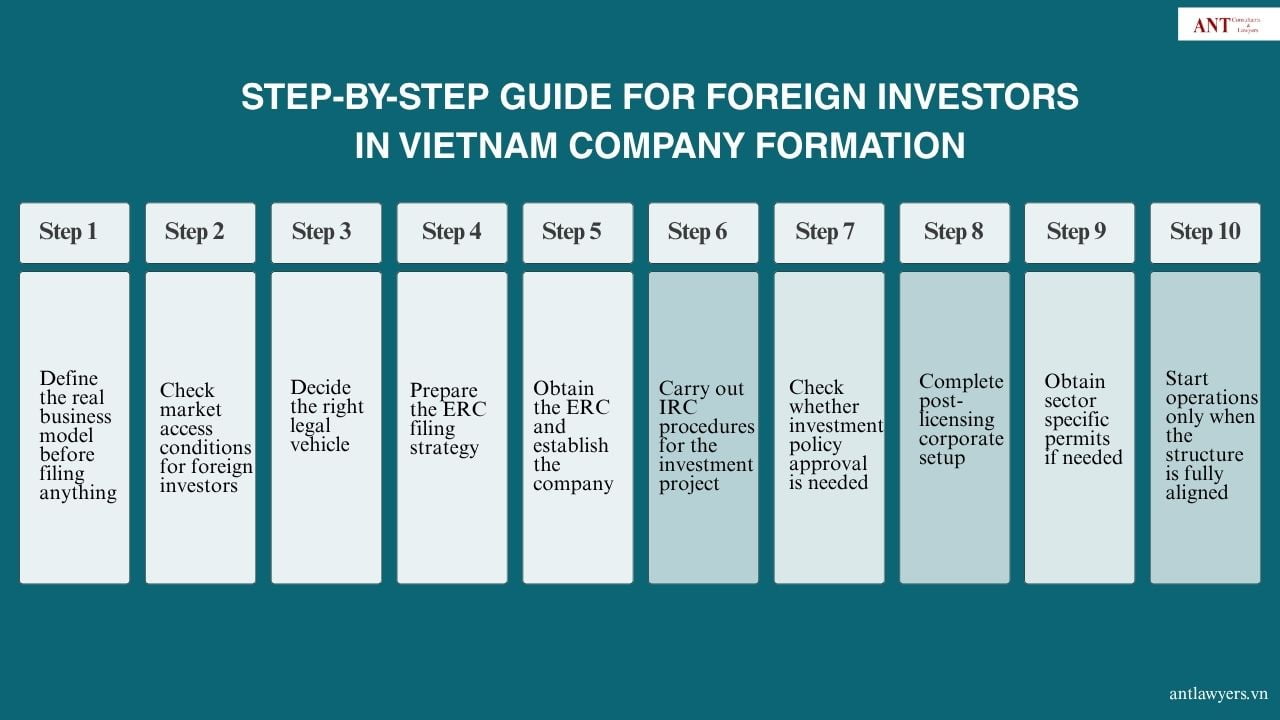
Before starting Vietnam company formation, the investor should identify the actual business model, not just a broad idea. That means clarifying what the company will do, how it will earn revenue, whether it will hold assets, whether it needs premises, and whether the investor wants a wholly foreign-owned structure or a joint venture.
This first step matters because later filings, including business lines, ownership structure, and project registration, should all be consistent. For investors considering real estate acquisitions for office premises, understanding property regulations is essential. Additionally, companies with significant intellectual property should review the Vietnam Intellectual Property Law Amendments to ensure proper asset protection from the outset.
The 2025 Investment Law keeps market access conditions in place. Even under the ERC first model, foreign investors must satisfy applicable market access conditions when establishing the economic organization.
In practice, this means checking whether the intended sector is:
This is one of the most important parts of Vietnam company formation because it determines whether the structure is feasible from the start.
Most foreign investors will consider one of the common company forms, typically a limited liability company or a joint stock company, depending on ownership plans, governance needs, and fundraising strategy. When selecting an ownership structure, investors should be aware of potential equity transfer disputes that can arise later, particularly if future capital raising or ownership transfers are contemplated.
Alternatively, some foreign investors may prefer a representative office in Vietnam as a lower-risk, lower investment market entry vehicle before committing to a full company structure.
At this stage of Vietnam company formation, the investor should decide:
Under the ERC first model, the enterprise registration stage comes earlier. This means the investor should prepare the ERC application carefully, including the proposed company name, address, charter, ownership details, legal representative information, and registered business lines. Enterprise registration procedures are governed under the enterprise registration framework, with specific guidance provided in Decree 239/2025/ND-CP.
This step is where good drafting matters. Weak planning here can create inconsistencies later.
Once the ERC is issued, the legal entity exists. This is the formal company establishment stage in Vietnam company formation.
From that point, the investor has a recognized enterprise vehicle. But this does not always mean the company can immediately launch full operations. The next steps still depend on the investment project and regulated activities.
The 2025 Investment Law still provides that projects of foreign investors fall within the category requiring IRC procedures. So after the ERC stage, the investor should proceed with IRC filing or project registration as required.
This is where Vietnam company formation becomes project specific. The needed documents, timeline, and scope of review may vary depending on the business sector, location, land use, incentives, or whether policy approval is also required.
The ERC first model does not displace the separate rules on investment policy approval. For projects that fall within the category requiring policy approval, that approval still has to be handled in accordance with the law before implementation of the project.
This is critical. Some investors may think ERC first means every project is now simple. That is not correct.
After establishment, Vietnam company formation usually requires a number of post-licensing actions, such as:
The exact post-licensing scope depends on the company’s sector and operating model. For comprehensive guidance on maintaining Vietnam corporate compliance after establishment, investors should review the regulatory expectations for foreign-owned companies. Companies planning to employ staff should understand electronic employment contracts and regulations on employing foreign workers. Additionally, companies with significant contractual obligations should review contract matters that foreign general counsels must get right to minimize future disputes.
Some businesses require additional operational approvals after company establishment and investment registration. For example, sectors such as education, logistics, e-commerce, retail, fintech, food, and other regulated industries may require licenses beyond ERC and IRC.
For companies in the e-commerce sector, understanding the e-commerce business startup process and compliance with the E-Commerce Law 2025 is essential. Companies engaged in import-export should familiarize themselves with Vietnam customs law to avoid costly delays. For companies in regulated sectors like real estate, reviewing Decree 357/2025 on the Real Estate Market Data System is important. Technology companies should also review the Law on Artificial Intelligence 2025 to ensure compliance with AI-related obligations.
Hence Vietnam company formation should always be viewed as one layer of compliance, not the whole compliance picture.
The safest approach is to begin substantive operations only after the company structure, project registration, capital plan, business lines, and sector-specific requirements are all aligned.
That is the real completion point of Vietnam company formation from a risk-management perspective. Understanding enforcement risks in Vietnam and the importance of proper legal structuring can help investors mitigate future complications.
A frequent mistake is assuming that ERC-first means that IRC no longer matters. The law does not support that conclusion. The sequencing changed, but the project registration requirement remains relevant for foreign invested projects.
Another mistake is registering business lines too broadly or too narrowly without matching them to the actual project. That can create amendment issues later.
A third mistake is treating Vietnam company formation as a corporate filing exercise only. In reality, it is a combined corporate, investment, tax, licensing, and operational structuring exercise.
Q1: What is the biggest change in Vietnam company formation from March 1, 2026?
The main change is that a foreign investor may establish the economic organization first and then carry out the IRC procedure, rather than always needing the IRC before the enterprise exists.
Q2: Does the new law mean the IRC is abolished?
No. Investment projects of foreign investors still fall within the category requiring IRC procedures. The reform changes the order, not the existence, of investment registration.
Q3: Can a foreign investor start business immediately after getting the ERC?
Not always. Depending on the business sector and project, the company may still need IRC completion, sectoral permits, or other approvals before operating lawfully.
Q4: Is Vietnam company formation now easier for all sectors?
No. The process may be more flexible, but market access conditions still apply, and regulated sectors remain subject to additional scrutiny.
Q5: Do foreign investors still need to check market access conditions at the start?
Yes. The 2025 Investment Law expressly requires foreign investors to satisfy market access conditions when establishing the economic organization.
Q6: What is the difference between ERC and IRC?
The ERC is the enterprise registration certificate for the company itself. The IRC is the investment registration certificate for the investment project. Under the current model, Vietnam company formation may begin with the ERC, while the project still proceeds through the IRC track where required.
Q7: Does ERC-first apply to every foreign-invested company structure?
The legal rule allows foreign investors to establish the economic organization before the IRC procedure, but the real implementation still depends on the nature of the project, the sector, and any separate approval requirements.
Q8: What if the project requires investment policy approval?
Then the investor must still comply with the separate rules on investment policy approval. ERC first does not override those requirements.
Q9: What documents should foreign investors usually think about first?
At the planning stage of Vietnam company formation, foreign investors usually need to think first about the ownership structure, investor legal documents, intended business lines, proposed charter, legal representative, address, and the later project registration path. The exact document set depends on the structure and sector.
Q10: Does the new process reduce legal risk?
It can reduce procedural friction, but only when planned correctly. If investors misunderstand the new sequence and treat ERC as a substitute for full investment compliance, legal risk can increase instead of decrease.
Q11: Why should foreign investors care about this change?
Because Vietnam company formation is often the foundation for market entry, tax planning, staffing, banking, contracts, and compliance. A change in licensing sequence can affect all of those workstreams.
The ERC first era changes how Vietnam company formation should be planned, explained, and executed for foreign investors. The older model forced the project to come first and the company second. The new model allows the company to come first, while preserving project registration and market access controls.
That is a more commercially sensible sequence. But it also means investors need more disciplined structuring at the beginning. The key question is no longer just whether a foreign investor can set up a company in Vietnam. The real question is how to structure Vietnam company formation so that the ERC, the IRC, the business lines, and the operating plan fit together without later correction.
Tuan Nguyen is a lawyer at ANT Lawyers advising foreign investors and foreign-invested companies in Vietnam on market entry, foreign investment, company formation, licensing, and regulatory compliance. He works with clients to assess market access conditions, structure their Vietnam presence, prepare licensing strategy, and manage legal risks during establishment and operation.
We help clients overcome cultural barriers and achieve their strategic and financial outcomes, while ensuring the best interest protection, risk mitigation and regulatory compliance. ANT Lawyers has lawyers in Ho Chi Minh city, Hanoi, and Danang, and will help customers in doing business in Vietnam.
This article is for general informational purposes only and does not constitute legal advice for any specific situation. Laws and practice may change, and the position is stated as of the publication date. For advice on your matter, please consult qualified counsel.
How ANT Lawyers Could Help Your Business?
You could reach ANT Lawyers for advice via email ant@antlawyers.vn or call our office at (+84) 24 730 86 529
A data project can be technically successful yet still face legal and commercial barriers to…
After a PCT application enters the national phase in Vietnam, the applicant must complete the…
A company with an international patent application must complete a local filing step if it…
A conflicting trademark application can affect sales and distribution plans in Vietnam. The brand owner…
When the Intellectual Property Office of Vietnam (IP Vietnam) raises an objection to a trademark…
Before committing to an investment in a free trade zone (FTZ), a foreign investor needs…
This website uses cookies.