
A breach of contract demand letter in Vietnam should be an approved business position, not a summary of everything that went wrong. It must identify the correct parties and obligations, state material facts accurately, request a legally supportable outcome and preserve the company’s procedural and commercial options. It must also be distinguished from a contractual notice, cure notice, statutory complaint and the document that starts court or arbitration proceedings.
Quick Reference
A demand letter is a formal written request asking the other party to pay, perform, cure a breach or take another specific action. It records the company’s position, gives the recipient a clear opportunity to respond and helps management decide whether to negotiate, preserve its rights or proceed further.
- Choose the objective. Decide the preferred result, acceptable fallback and consequence of no response.
- Separate legal documents. A commercial demand may not satisfy a contract notice, complaint, cure or commencement requirement.
- Prove before asserting. Connect each material allegation and amount to the controlling contract and reliable record.
- Control the response. Use a realistic deadline, valid service, approved negotiation channel and an escalation plan.
A demand is one step in managing contract disputes in Vietnam. It should support the broader strategy on performance, evidence, limitation, forum, assets, settlement and enforcement rather than operate as a standalone threat.
Breach of Contract Demand Letter in Vietnam: 7 Checks Before Escalation
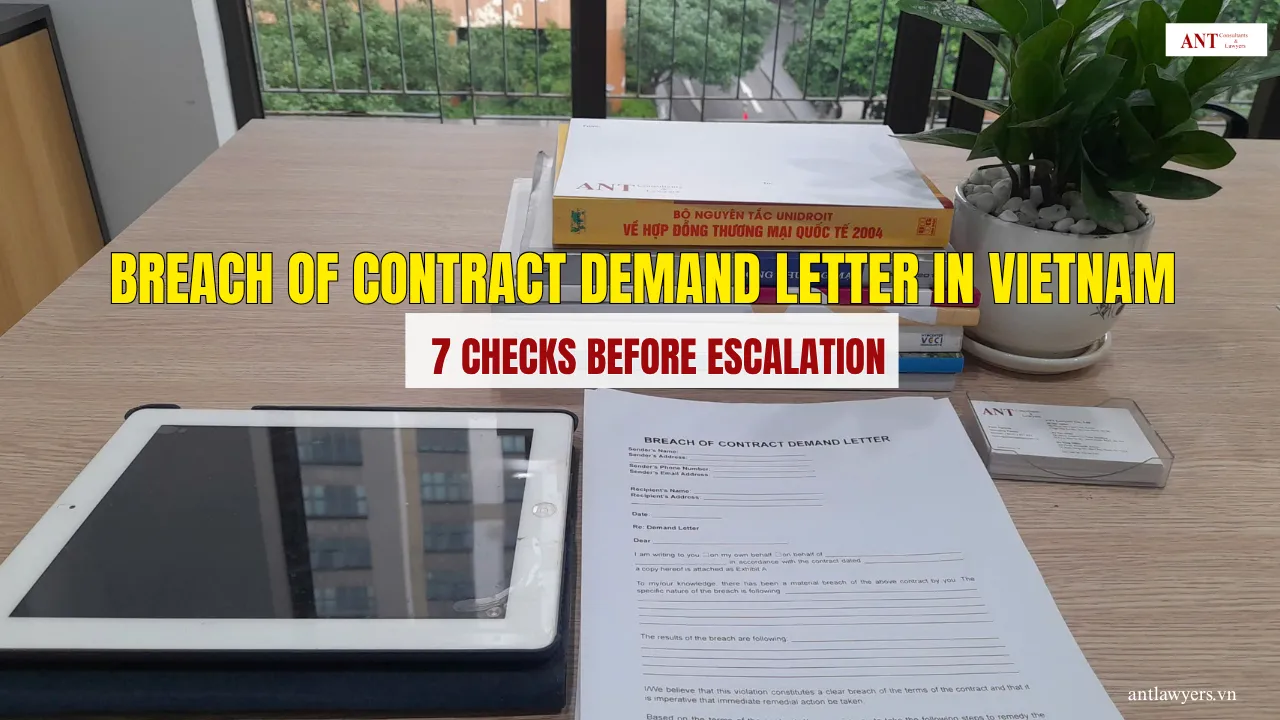
Decide the Business Objective and Possible Responses
Before drafting, management should decide what the company wants the recipient to do. The primary objective may be payment, delivery, repair, replacement, access, return of property, confirmation of a schedule, document disclosure, preservation of assets, an executive meeting or a structured settlement. A letter that demands inconsistent outcomes without priority gives the recipient no clear path to respond.
Define the acceptable fallback. If full performance is no longer useful, would a replacement plan, partial payment, security, credit note, price adjustment or orderly exit protect more value? If the relationship should continue, the tone and deadline should leave room for operational cure. If recovery is the priority, the letter should avoid concessions that make later enforcement harder.
Before sending, decide how the company will handle the likely responses. If the recipient complies fully, confirm who will verify performance and close the issue. If the response is only partial, decide who may negotiate. If the recipient denies the claim, remains silent, moves assets or commits another breach, confirm who will decide whether to escalate. This avoids issuing a deadline without knowing what the company will do when it expires.
The commercial objective also determines the audience. An operational cure may require project leaders; payment security may require finance; a settlement path may require senior executives with authority. Copying many recipients can make the parties less willing to compromise and may disclose strategy without improving the result.
In Vietnam, local teams may prefer a call or meeting before a formal letter because it can affect the business relationship. Management should choose the timing without delaying a required notice or protective step.
Separate the Demand From Required Notices and Proceedings
A demand letter is not a universal legal instrument. The contract may separately require a notice of breach, cure notice, delay notice, variation notice, payment claim, complaint, notice of suspension, notice of termination or dispute-escalation notice. Each may have its own recipient, address, method, content and timing.
Do not assume one letter can safely perform every function. Combining a cure request, settlement proposal and immediate cancellation may create ambiguity about whether the contract remains in force. A notice addressed to a project contact may not satisfy a clause requiring service on the legal representative at the registered address.
For a Vietnam entity, verify its registered office and legal representative on the National Business Registration Portal, while following any different notice details in the contract.
A statutory complaint period may also differ from the contract’s notice regime.
A demand also does not automatically stop a limitation period or commence proceedings. Court and arbitration have their own procedural requirements. If time is short, the company may need a demand and a protective filing in parallel. Negotiations can continue after an arbitration is commenced, so management should not treat those choices as mutually exclusive.
Before drafting, list each document that may be required, together with its legal purpose, trigger, sender, recipient, deadline, delivery method and proof. Decide whether the necessary points can safely be combined in one set of documents or should be sent separately for clarity.
Verify the Record and Test the Counterparty’s Case
The demand should assert only what the company can support. Confirm the controlling contract, amendments, purchase orders, specifications, variations, acceptance records, invoices, payments, notices and later communications. Identify the correct legal entity on both sides and verify the signatory’s authority.
Use the separate framework for evidence for contract disputes in Vietnam to preserve complete communications and original records. The demand-letter review should cite the evidence needed for each assertion without reproducing the full evidence workflow.
Test the counterparty’s strongest explanation. It may allege late approvals, denied access, incomplete specifications, an agreed extension, acceptance, company-caused delay, force majeure, state action, set-off or payment to another entity. A letter that ignores a credible defense can be answered quickly and may damage later settlement credibility.
Separate admitted, provable, disputed and missing facts. Do not convert suspicion into a statement of fraud, bad faith or intentional misconduct without a verified basis and strategic reason. Describe the contractual failure precisely and reserve further claims where the evidence is incomplete.
Check consistency with operations. If the company continued accepting goods, issuing new orders, approving work or promising payment, the letter must address that later conduct accurately. A general reservation of rights does not automatically neutralize conduct that appears inconsistent with the position now asserted.
How to Organize the Demand Letter
A demand letter should be organized so that the recipient can quickly understand the problem, the company’s position, the requested action and the response deadline.
1. Sender, recipient and authority
Identify the legal entities, addresses, contract references and capacity of the sender. If counsel sends the letter, confirm instructions and the client’s authority chain.
2. Purpose and status
State whether the document is a commercial demand, contractual notice, cure notice, complaint, settlement communication or serves more than one of these purposes. Avoid labels that imply an effect the letter may not have.
3. Controlling contract
Identify the agreement, relevant orders or annexes, governing law, document priority, notice clause and dispute clause. State only the provisions needed to explain the demand.
4. Material chronology
Present dated events in a short, neutral sequence. Include performance, approvals, variations, notices, responses and payments that affect the position, including material facts unfavorable to the sender.
5. Breach or claim statement
For each issue, connect the obligation, required performance, actual event and legal or contractual consequence. Keep separate claims separate.
6. Amount and remedy
Show principal, currency, invoice or milestone, payment date, interest basis, penalty basis, damages category or requested cure. Identify estimates and items still being verified.
7. Required action and deadline
Specify what the recipient must do, where and by when. The period should reflect contractual cure rights, operational feasibility, urgency and any independent legal deadline.
8. Negotiation and reservation
State the approved contact and meeting path. Reserve rights carefully without implying that continued performance, delay or negotiation has no possible effect.
9. Service and attachments
Use the required language, address and delivery method, retain proof and attach only the documents needed for understanding and response.
Where the recipient works mainly in Vietnamese, consider a Vietnamese or bilingual version after checking the contract’s language provisions.
State Remedies and Numbers Without Overclaiming
A demand should distinguish performance, payment, contractual penalty, interest, damages, restitution, suspension, termination and cancellation. The legal basis and consequences differ. Demanding every remedy at the maximum level can create inconsistency, obscure the primary objective and give the recipient an easy target.
For money claims, show the calculation transparently. Identify principal, currency, invoice, due date, payments, credits, tax treatment and exchange-rate assumption. State the contractual or legal basis for interest and the period used. If a penalty is claimed, confirm that the contract contains the clause and that any applicable statutory limit is measured against the correct violated portion.
Damages require more than a round number. Separate actual direct loss, claimed lost benefit, mitigation and causation under the applicable framework. A demand may reserve damages still being quantified, but should not state an unsupported figure as established fact.
For non-monetary cure, define an observable result: the item to deliver, defect to remedy, test to pass, access to provide, document to issue or schedule to confirm. Name dependencies and the person who will verify completion. A vague request to ‘fully comply’ can produce another dispute about whether cure occurred.
If suspension, termination or cancellation is contemplated, obtain separate legal approval before announcing it. The trigger, notice, cure, exemption, continuing obligations and consequences must be confirmed. A threat that the company cannot safely carry out reduces leverage and may create a counterclaim.
Control Service, Timing, Negotiation and Confidentiality
Service should be treated as evidence. Check the contract’s address, attention line, language, permitted delivery methods, deemed-receipt rule and requirements for copies. Use a method that creates reliable proof. If operational delivery is also useful, distinguish it from the formal service route.
Choose the response deadline by working backward from the company’s next decision. Allow enough time for a genuine cure or authorized response, but do not let the deadline consume a limitation period, security window or asset opportunity. A short artificial deadline may appear tactical and may not create the legal consequence assumed.
Decide who may negotiate and what they may offer. Keep the settlement range, approval limits and communication channel outside the letter. Record calls and meetings accurately, circulate agreed minutes where appropriate, and avoid operational promises that contradict the formal position.
Do not assume that marking a letter ‘without prejudice’ creates the same privilege or admissibility effect associated with every common-law system. Confidentiality, settlement treatment and admissibility depend on the applicable law, forum, agreement and circumstances. Separate commercial settlement content when counsel considers that safer.
Approve the Escalation Path Before Sending
The demand should be approved together with the next-step plan. Confirm the decision owner, sender, service date, monitoring responsibility and response categories. Calendar contractual, statutory and internal deadlines independently rather than treating the response date as the only control.
Prepare for likely responses: full cure, partial cure, request for time, counter-demand, denial, silence, insolvency signs, asset movement or an urgent operational event. For each, identify who can accept, negotiate, investigate or escalate. The company should not improvise after receiving a serious counter-allegation.
If proceedings may follow, confirm the forum, claimant, respondent, authority documents, evidence, translations, filing costs and interim-protection options before the letter expires. The demand should not reveal unnecessary strategy or make a promise that limits a later filing.
After service, preserve proof, log every response and update the claim and limitation registers. Management should review whether the letter improved performance, narrowed the issues, produced useful admissions, exposed a defense or changed the recovery risk. The result, not the forcefulness of the wording, is the measure of success.
Step-by-Step: Prepare and Send the Demand Letter
Use this sequence before any formal communication is released:
- Appoint the decision owner and identify the legal, commercial, finance and operational reviewers.
- Define the primary objective, acceptable fallback and how the company will handle each likely response.
- Confirm the contracting entities, authority chain, controlling contract and governing framework.
- List each required notice, complaint, cure, escalation and procedural document separately.
- Preserve and review the supporting evidence, including material records adverse to the company.
- State each obligation, breach or claim precisely and test the counterparty’s strongest defense.
- Calculate principal, interest, penalty, damages or non-monetary cure using verified assumptions.
- Draft the letter with a clear action, realistic deadline and limited necessary attachments.
- Check remedy compatibility, limitation, forum, service, language, confidentiality and settlement treatment.
- Obtain legal and management approval for the letter and the action after each likely response.
- Serve by the required method, retain proof and log every communication and deadline.
- Review the result, update the evidence and limitation files, and approve settlement or escalation based on the agreed plan.
The output should be a concise, supportable demand and an internal response plan. It should not be an accusation.
Frequently Asked Questions About Breach of Contract Demand Letters in Vietnam
Q1: Is a demand letter legally required before every contract claim in Vietnam?
No universal rule applies to every dispute. The contract, governing law, specialized rules and forum may require particular notices, complaints, cure or escalation steps.
Q2: Can one letter serve as both a demand and a breach notice?
Sometimes, if every applicable requirement is satisfied and the functions are not inconsistent.
Q3: Does a demand letter stop the limitation period?
Not automatically. If time is short, counsel should confirm the correct protective court or arbitration step and whether it must proceed in parallel.
Q4: How long should the response period be?
It depends on the contract, cure required, urgency and independent deadlines.
Q5: Should the letter be marked without prejudice?
Do not assume the label creates a common-law privilege or uniform exclusion from evidence. Its effect depends on the applicable law, forum, agreement and circumstances.
Q6: Who should sign and receive the letter?
Use the correct legal entity and authorized signatory, and comply with contractual and legal service requirements.
Conclusion
A demand letter is most effective when it states a clear business objective, rests on verified facts, follows the applicable notice and delivery requirements, and is supported by an approved next step. It should help the recipient understand what is required and help management decide what to do if the response is full, partial, late or absent. Its value lies in its accuracy, clarity and place within the wider dispute strategy, not in forceful wording.
About the Author
Tuan Nguyen is the Managing Partner and founder of ANT Lawyers, with more than 20 years of experience across legal practice, management and compliance. He advises foreign companies, investors and manufacturers on corporate, commercial, international trade, regulatory and dispute-related matters in Vietnam. He holds an LLB from Hanoi National University School of Law and an MBA from Warwick Business School, and is an Associate Member of the Chartered Institute of Arbitrators.
He is also one of the contributors to the Vietnam chapter of GAR Know-How: Commercial Arbitration in Vietnam.
About ANT Lawyers, a Law Firm in Vietnam
Founded in 2012, ANT Lawyers is a Vietnam law firm with offices in Hanoi, Ho Chi Minh City and Da Nang. Our dispute resolution lawyers advise on commercial litigation, arbitration and enforcement of awards in Vietnam. We combine legal analysis with practical understanding of Vietnam’s regulatory environment and local administrative practice.
General Disclaimer
This article is for general informational purposes only, does not constitute legal advice, and does not create a lawyer-client relationship. Vietnamese laws, regulations and administrative practice change over time, and the correct position for any matter depends on its specific facts and the rules in force when action is taken. Verify the current position before relying on anything stated here, and consult qualified counsel on your specific situation.
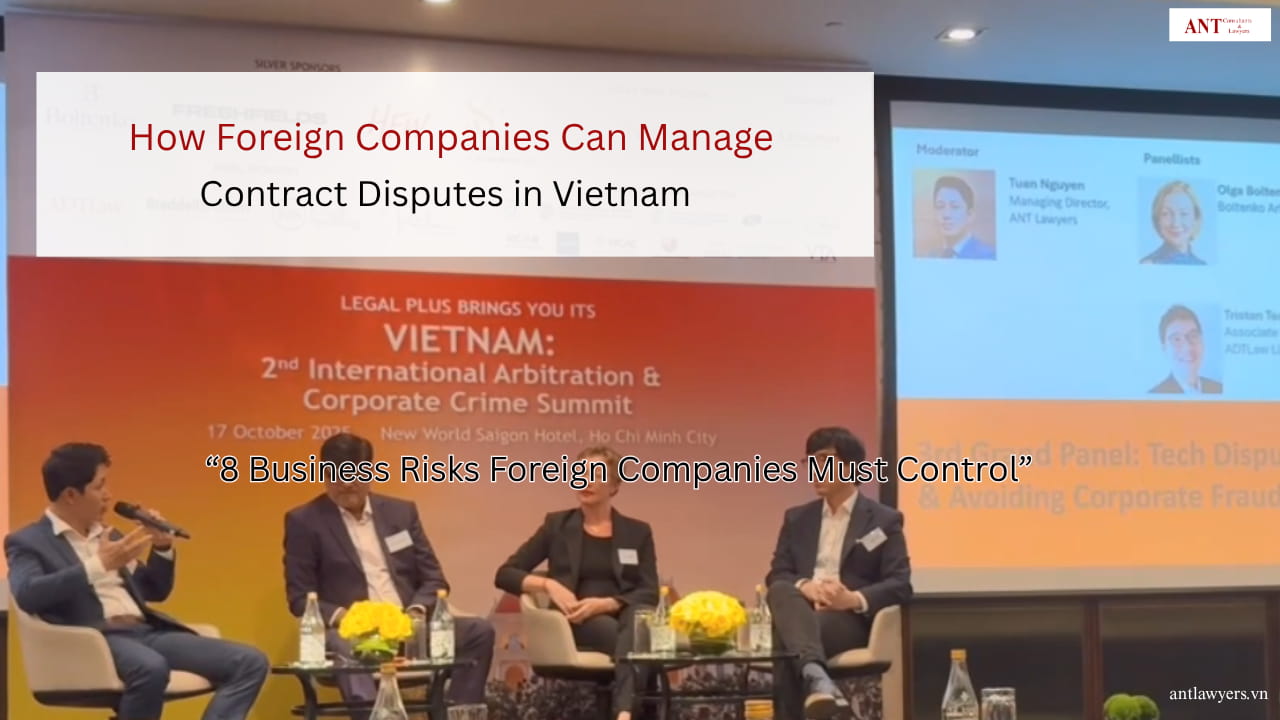
Contract Disputes in Vietnam: 8 Business Risks Foreign Companies Must Control

Evidence for Contract Disputes in Vietnam: Can Your Company Prove Its Case?
7 Powerful Truths about Breach of Contract in Vietnam That Every Business Must Understand
Evidence in Arbitration in Vietnam: 7 Problems Foreign Companies Often Underestimate
How ANT Lawyers Could Help Your Business?
You could learn more about ANT Lawyers Dispute Resolution Practice or contact our dispute lawyers for advice via email ant@antlawyers.vn or call our office at (+84) 24 730 86 529