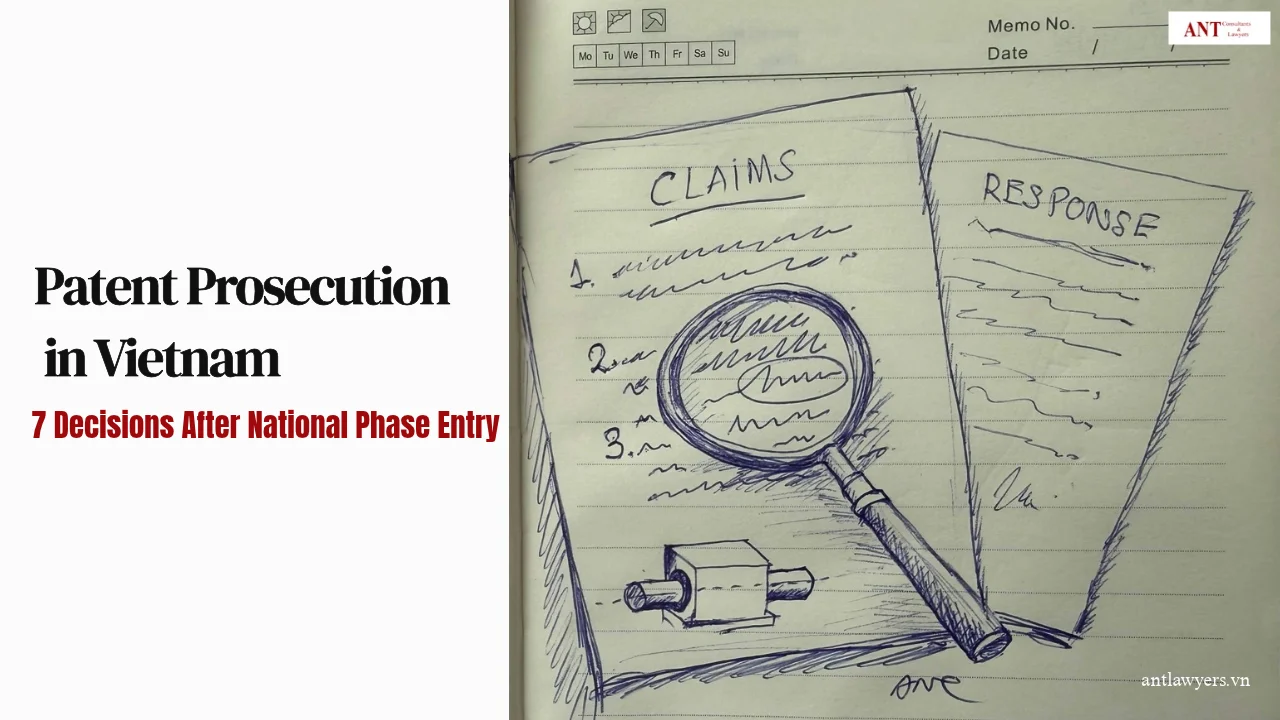
Patent Prosecution in Vietnam: 7 Decisions After National Phase Entry
After a PCT application enters the national phase in Vietnam, the applicant must complete the local examination and grant procedure to obtain a Vietnamese patent. This work, known as patent prosecution in Vietnam, can include requesting examination, answering objections and amending the claims, which set out the protection being sought. The business needs to assess whether the patent it is seeking would protect technology that is important to its operations.
The Intellectual Property Office of Vietnam, known as IP Vietnam, checks the application and assesses whether the invention meets the legal conditions for patent protection. The assessment of those conditions is called substantive examination. A favorable international report or a patent granted abroad can help, but it does not guarantee a grant in Vietnam.
The local IP representative should explain the legal options, while the technical team explains how proposed claim changes affect the technology covered. Management then decides what to approve and whether the likely benefit justifies further cost. These decisions form part of the company’s wider approach to intellectual property in Vietnam.
Entering the national phase does not mean that a Vietnamese patent has been granted. The application must still pass examination. Confirm that substantive examination has been requested and the required fees have been paid. If IP Vietnam raises objections, ask the IP representative to explain the response options and how any claim changes would affect the protection sought. Management can then decide whether to approve the response and continue pursuing those claims. Confirm the deadlines for the particular application, as earlier filings may be subject to different rules. If IP Vietnam indicates that it intends to grant the patent, complete the required payments and arrange payment of annual maintenance fees.
The national phase filing receipt confirms that the documents were received. Check separately that a valid request for substantive examination has been filed and the required search and examination fees have been paid. The request may have been included at entry. Obtain copies of the request and payment record rather than relying on a general report that the application has been filed.
If examination has not been requested, confirm the applicable deadline immediately and instruct the representative in writing if the business wishes to continue. Earlier applications may be subject to different procedural rules, so the representative needs to check the filing history and the rules for the step now being taken. If no examination request is filed within the applicable deadline, the application is treated as withdrawn.
Ask for a short status report identifying what has been completed, any outstanding national phase entry requirements and the next action. It should explain whether IP Vietnam is still checking the filing formalities, whether the application is waiting for substantive examination, or whether the applicant must answer an objection. The report should also state the relevant deadline and who must act, so that each side understands its responsibility.
A foreign company without a production or business establishment in Vietnam must act through an authorized IP representation service organization. Choose an organization with practitioners qualified to handle patent matters, referred to here as the IP representative. Confirm that its engagement covers the continuing examination work and identifies who will report notices, prepare responses and handle grant payments.
The Power of Attorney for IP registration in Vietnam also needs to remain effective throughout the work. An authorization accepted at entry may expire before prosecution ends, and leaving its duration unstated does not make it permanent. Agree on a clear scope and duration, and arrange any replacement before authority lapses.
Claims are the numbered statements that define the protection being requested. The invention’s title, drawings and abstract help explain it, but do not replace the claims. Management therefore needs a plain explanation of what a patent based on the current claims would cover if granted, and how that relates to the company’s manufacturing, sales or licensing plans in Vietnam.
During examination, the applicant may need to narrow a claim to overcome an objection. That change can improve the chances of grant while narrowing the range of products or processes the patent would cover. Before agreeing, ask the technical team and IP representative to explain both effects. Obtaining a patent has limited value if its claims leave the commercially important technology outside its scope.
Review the claims together rather than approving a single amended claim in isolation. A narrower claim could still provide useful protection if granted, while another claim may no longer justify the cost of pursuing it. Ask the technical team and IP representative to explain what the amended claims would cover and what would fall outside them.
Agree on who can approve routine corrections and who must approve changes to what the claims cover. Foreign counsel, the IP representative and the technical team should review the same version showing the proposed amendments, together with a clean version intended for filing. Preserve the approved text and the text actually filed, so that the business can check whether its instructions were followed.
Patentability and freedom to operate are separate questions. Examination does not clear the company’s planned activities against other parties’ Vietnamese patents. A business preparing to manufacture, import or sell a product may need a separate freedom-to-operate assessment even if its own application is progressing well.
An official notice from IP Vietnam, often called an office action, may identify missing documents, unclear wording or an objection to patentability. Its significance depends on what it asks the applicant to do and what happens if the applicant does not respond. A notice proposing refusal leaves an opportunity to answer within the applicable procedure; a final refusal decision calls for a different response.
The representative should identify the notice type and exact response deadline as soon as it arrives. Do not work from a standard period copied from another file. Ask for a concise explanation of the issues, the available responses and the technical input needed, so that management can allocate the work before the deadline becomes urgent.
Because notices arrive in Vietnamese, foreign decision-makers need a prompt English summary from the IP representative explaining the notice and the decisions it requires. Waiting for a full technical translation before reporting an urgent deadline can leave too little time for engineering input, approval and filing. Agree on an early internal date for those tasks, with a backup contact if the usual approver is unavailable.
The response needs to address each reason given in the notice. If the examiner relies on earlier technical publications, the technical team should identify what those publications disclose and compare that with the claimed invention. The legal argument must then explain why the claim meets the relevant requirements, or why an amendment supported by the original application resolves the objection. Simply describing the product as innovative does not answer those points.
An examiner discussion can help clarify an issue, but a required written response still needs to be filed. If more time is needed, ask promptly whether the deadline can be extended. An extension requires a written request filed before the current deadline and payment of the required fee. Record the new deadline rather than assuming that discussions with the examiner have changed it.
After filing, keep the response, attachments, amended text and submission evidence. If a final refusal follows, obtain prompt advice on the complaint or court route and the prospects of obtaining commercially useful protection. The business then needs to decide whether further cost and effort are justified.
An amendment must stay within what the original application disclosed and must not change the nature of the invention. A later improvement that was not disclosed there cannot be added to that application.
For a PCT application, compare any proposed Vietnamese amendment with the original international text and the version currently on file in Vietnam. Identify the passages and drawings that support each change. This is especially important when correcting technical terminology: a translation error and a deliberate change in claim scope require different explanations, even if both involve replacing words.
Where a technical term has no established Vietnamese equivalent, the translator, technical contact and IP representative need to agree on its meaning and use it consistently. Check the description, claims and drawing references together. Machine-translated claims require careful technical review; fluent wording alone does not show that the technical meaning has been preserved.
A divisional application is a separate application for technical subject matter already disclosed in the original application. It may be appropriate when the applicant wants to pursue that subject matter separately. It has its own procedure and costs and can retain the original filing date if the requirements are met. It cannot add new technical content or simply duplicate the subject matter remaining in the original application.
The applicant may also consider converting the application to seek a utility solution patent. This form of protection still requires the invention to be new, capable of industrial application and not common knowledge. It is not subject to the same inventive-step requirement as an invention patent, and its maximum term is shorter. Conversion has procedural conditions and will not cure every objection. Ask what the utility solution patent could cover, how long it could remain in force and what further work would be needed before choosing this route.
Review division and conversion while the procedural opportunity remains open. Waiting until a final refusal may remove or complicate those choices. Where the technical work involves unpublished know-how, control who receives it and why. A suitable Non-Disclosure Agreement (NDA) can support those arrangements, although it cannot restore secrecy to information already made public.
Foreign examination results can help explain how a corresponding application has been assessed. Relevant material can include search reports, examination reports, accepted claims and a granted patent. The IP representative needs the underlying documents and claim history, rather than a short message saying that another office has allowed the application.
IP Vietnam can consider foreign results as reference material during its own examination. A separate procedure allows an applicant to request use of qualifying foreign examination results. Before recommending that route, the representative should confirm whether the foreign results qualify, whether the Vietnamese claims need to change and whether the request can still be made at the current stage.
Under that formal procedure, the Vietnamese claims must match the claims assessed as meeting the protection requirements in the qualifying foreign results. The representative should arrange the supporting documents, translations and amendment explanations.
Before adopting the foreign claims, compare them with the claims currently being pursued in Vietnam. A narrower wording may help the application progress, but it may also exclude technology that matters to the business. Ask the representative whether the existing claims can still be defended and whether a permitted divisional application should be considered. A foreign grant does not require IP Vietnam to grant the Vietnamese application automatically.
A separate statutory route for faster examination has restrictive eligibility and filing requirements. An urgent launch does not, by itself, make the application eligible. For a PCT file, confirm whether a request made at national phase entry qualifies, whether the required request was made in time and whether later events affect eligibility. The business should rely on a faster timetable only after those points have been checked for its application.
The statutory time limit for substantive examination applies only to that stage. It does not mean that a patent will be granted by the end of that period. Its starting point depends on publication and the examination request, and the applicable rules must be checked for the particular application.
Time allocated for the applicant to respond to notices or supply required documents is excluded from the relevant processing period under the applicable rules. Further examination may be needed after substantive changes, and grant steps remain after a favorable examination result. These distinctions matter when planning a product launch, licensing discussion or investment that depends on a granted patent.
Coordinate the patent work with the product’s brand protection before committing to a launch. A trademark search in Vietnam helps assess the proposed name or logo, while trademark registration in Vietnam secures protection for the brand itself. These decisions belong in the same commercial plan, but a trademark assessment does not resolve patent risks.
Ask the representative for a realistic estimate based on the latest action in the application. The explanation should identify what IP Vietnam is considering and whether anything is waiting for the applicant. If there has been no progress, check for an unanswered notice, an outstanding requirement or a wait for examination. This helps management decide whether to act, follow up or revise its plans.
Third-party observations and formal opposition are separate procedures, and their effect depends on the grounds raised. An opposition concerning the right to register the invention can lead to processing being suspended while a court resolves that dispute. Management should understand whether the challenge concerns the technology’s patentability or who is entitled to apply, because the evidence and business response will differ.
An ownership challenge may require development agreements, assignments and approval records. Those documents can become evidence for contract disputes in Vietnam if entitlement is contested. Coordinate the contractual dispute with the patent application, while recognizing that a commercial settlement does not itself replace IP Vietnam’s examination or decision.
The budget should separate official charges from professional work, translation, technical input and any additional application. Review it after a significant objection or proposed narrowing of the claims. The decision to continue should depend on the prospect of obtaining a useful patent and the company’s plans for Vietnam, rather than simply on what has already been spent. Record any decision to continue, divide, convert or stop so that the representative can act on clear instructions.
When IP Vietnam issues a notice indicating that it intends to grant the patent, assign responsibility for the remaining steps and their deadlines. Obtain a complete list of the required payments, covering the prescribed grant, publication and registration charges together with first-year maintenance and use fees. Confirm what must be paid, who will pay it and what evidence will show that payment was completed.
Check the applicant details, inventor information and final claims before grant. Every named inventor must be a natural person who meets the inventorship requirements. The person or company entitled to own the patent is a separate matter. A company name change or transfer does not update the official record by itself. Raise any correction promptly, since a substantive change to the claims can require further examination.
First-year maintenance needs particular attention. Under the current procedure, paying the grant, publication and registration charges while leaving the required first-year maintenance and use fees unpaid can result in the patent being granted and then immediately terminated. The instruction should therefore cover the complete required payment package, with confirmation of what was paid and for which purpose.
After grant, retain the grant decision, the patent with its granted specification, and payment records. In Vietnamese, the invention patent is called the Bằng độc quyền sáng chế. The patent takes effect on grant. However, its maximum term is calculated from the filing date, which is the international filing date for a PCT application. Time spent in examination therefore leaves less time before expiry once the patent is granted. A utility solution patent has a shorter maximum term, which should be considered when assessing conversion.
Arrange a written handover for annual maintenance, sometimes called annuities. Identify the next maintenance payment, its due date, the person authorized to instruct payment and the provider responsible for reporting completion. The firm handling prosecution and the provider handling maintenance may be different. Check that the receiving team has the records and has accepted responsibility for the next payment.
The business can organize the work around five stages, with a clear handover whenever responsibility changes.
Step 1: Confirm what has been filed and what is due
Obtain the Vietnamese filing record, current claims, examination request, payment evidence and any outstanding notices. Confirm the representative’s authority, the applicable deadlines and the person responsible within the business.
Step 2: Agree on the claim strategy
Identify the technology that needs protection in Vietnam. Review relevant foreign results and decide what changes management is prepared to accept, with a budget for the next stage.
Step 3: Manage examination and responses
Route each notice promptly to the technical and legal teams. Before approving the response, understand how it affects the claims being pursued. Retain the filed version and evidence of submission.
Step 4: Decide whether and how to continue
As IP Vietnam’s objections and requirements become clearer, decide whether to pursue the claims, consider a permitted division or conversion, or stop. A final refusal requires separate advice on whether and how to challenge it, including the deadline.
Step 5: Complete grant and transfer maintenance responsibility
If IP Vietnam indicates that it intends to grant the patent, check the final details and complete the required payments. Obtain the grant decision and patent documents once issued. Record the next maintenance payment and confirm which team has accepted responsibility for it.
Further objections or claim changes may require another response and a fresh decision about whether to continue. Management should understand the expected benefit and cost before authorizing that work.
Q1: Does an objection mean that the application has failed?
No. A notice proposing refusal can allow a response within the applicable period. Review the grounds and available corrections promptly. A final refusal decision is a different event and requires separate advice on the available review route.
Q2: Can we use the claims granted in another country?
Possibly, if the claims are supported by the original application and meet the Vietnamese requirements. Compare their wording and the technology they would cover before adopting them. The formal procedure for using foreign examination results has additional conditions and a deadline for making the request.
Q3: Can we add a feature developed after the PCT filing?
A feature that was not disclosed in the original application cannot be added to it by amendment. A separate application may need to be considered. Before filing, assess what has already been disclosed publicly and whether the new application could meet the requirements for protection.
Q4: Can we change the IP representative during examination?
Yes, subject to the authorization and record requirements. Transfer every pending notice, deadline, filed claim version and payment record. Confirm when the new representative takes responsibility so that the change does not leave the application unattended.
Q5: Does a favorable examination result mean the patent is already granted?
No. The applicant must complete the remaining grant steps and required payments, and IP Vietnam must issue the grant decision. Obtain the final patent documents and confirm the next maintenance obligation before closing the prosecution file.
Management needs to understand what a patent based on the claims being pursued could protect if granted. That understanding helps the business approve responses, control spending and decide whether continuing remains worthwhile. The representative should explain the next required action and its deadline, while the business supplies instructions and technical input in time. If the application proceeds to grant, complete the payments and make responsibility for annual maintenance clear.
Tuan Nguyen is the Managing Partner and founder of ANT Lawyers, with more than 20 years of experience across legal practice, management and compliance. He advises foreign companies, investors and manufacturers on corporate, commercial, international trade, regulatory and dispute-related matters in Vietnam. His work also connects IP protection with the decisions businesses make when entering the market, working with local partners and managing their operations. He holds an LLB from Hanoi National University School of Law and an MBA from Warwick Business School, and is an Associate Member of the Chartered Institute of Arbitrators.
Founded in 2012, ANT Lawyers is a Vietnam law firm with offices in Hanoi, Ho Chi Minh City and Da Nang. Our intellectual property lawyers advise on trademark filing and opposition, enforcement and licensing in Vietnam. We combine legal analysis with practical understanding of Vietnam’s regulatory environment and local administrative practice.
This article is for general informational purposes only, does not constitute legal advice, and does not create a lawyer-client relationship. Vietnamese laws, regulations and administrative practice change over time, and the correct position for any matter depends on its specific facts and the rules in force when action is taken. Verify the current position before relying on anything stated here, and consult qualified counsel on your specific situation.
PCT National Phase Entry in Vietnam: 7 Checks Before Filing
Intellectual Property in Vietnam: 7 Decisions Foreign Companies Should Make Before Market Entry
Trademark Registration in Vietnam: 8 Issues for Foreign Applicants
Power of Attorney for IP Registration in Vietnam: 6 Checks for Foreign Applicants
How ANT Lawyers Could Help Your Business?
You could learn more about ANT Lawyers IP Practice or contact our IP Attorneys for advice via email ant@antlawyers.vn or call our office at (+84) 24 730 86 529
A company with an international patent application must complete a local filing step if it…
A conflicting trademark application can affect sales and distribution plans in Vietnam. The brand owner…
When the Intellectual Property Office of Vietnam (IP Vietnam) raises an objection to a trademark…
Before committing to an investment in a free trade zone (FTZ), a foreign investor needs…
A foreign design firm can take responsibility for a Vietnam construction project without sending a…
Foreign suppliers may sell equipment together with installation services. In Vietnam, both the supply contract…
This website uses cookies.