
A representative office in Vietnam (RO) may hire people, maintain an office and support promotion of the foreign trader. It cannot operate as the trader’s local revenue business. It should not issue sales invoices, conduct profit making activity in its own name or become the contracting party through the daily conduct of its team.
The practical boundary is set by what people actually do. An RO that begins as a market test can drift when staff are given sales targets, negotiate commitments, collect money or manage delivery. The structure remains suitable only while the duties, authority, bank payments and records support its licensed non-revenue purpose.
Quick Reference
A representative office in Vietnam is a dependent unit of an eligible foreign trader used mainly for liaison, market study and promotion within its licensed scope. It is not a separate legal entity and the foreign parent remains responsible for it. An RO may lease an office, hire employees, maintain a bank account for permitted expenditure and appoint a chief representative. It cannot operate as a local revenue-generating company or issue sales invoices. Before choosing an RO, management should identify and evaluate the Vietnam team’s duties, contracts, customer contact, money flows and planned growth. A company or, where available, a branch is more suitable when local contracting and revenue are required.
Representative Office in Vietnam: 10 Checks Before Choosing It
The Representative Office as a Dependent Presence
A representative office is a dependent presence of the foreign trader in Vietnam. It is licensed under the framework for representative offices and branches of foreign traders and does not have separate legal personality from the parent. Its rights and obligations are limited by the law, license and authority granted by the foreign trader.
This makes the RO light in one sense and exposed in another. It can support the parent without creating a full operating subsidiary, but the parent remains directly connected to its conduct. Internal controls should therefore be written as parent-company controls, not treated as a small local office outside the group’s compliance system.
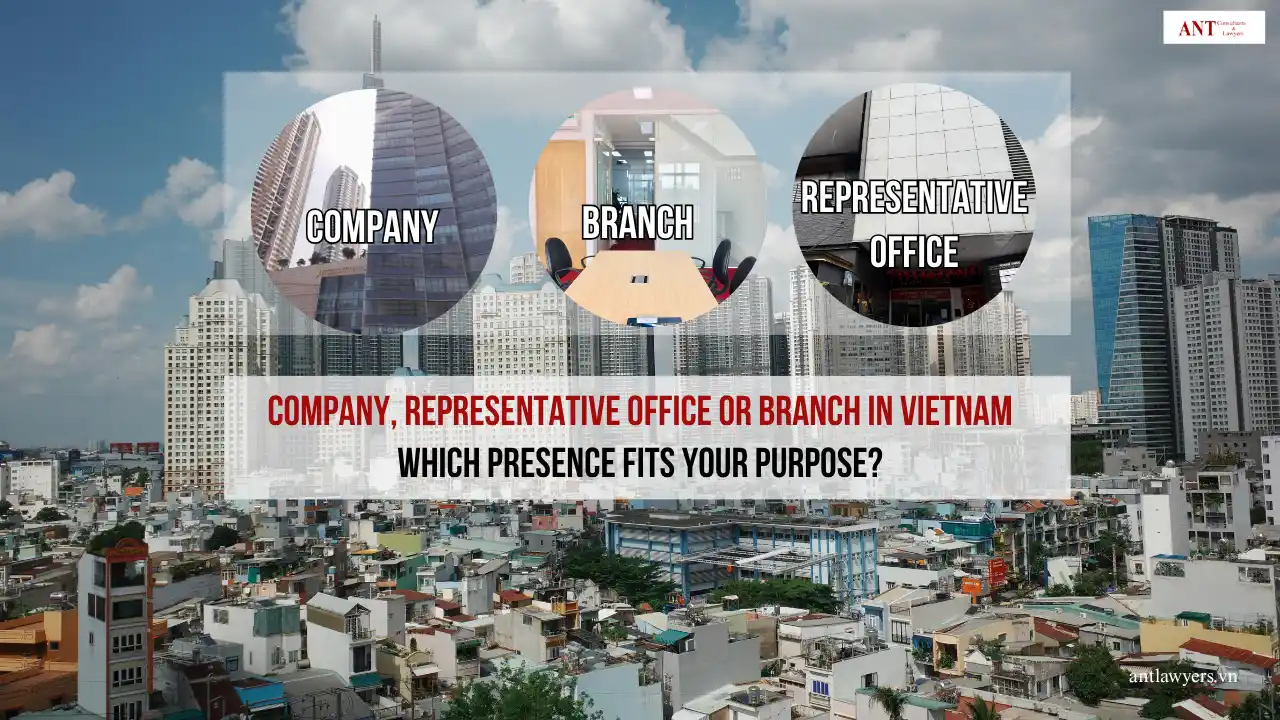
For a strategic decision, you can start with the wider Vietnam market entry strategy and make comparison among other structures company, representative office or branch in Vietnam.
A representative office can fit when the foreign trader needs people on the ground to understand customers, coordinate relationships, support promotion, monitor contracts signed by the parent and assess whether a larger investment is justified. It may also suit a regional company that needs liaison rather than a local sales entity.
The structure is less suitable where the Vietnam team must sign customer contracts, deliver the core service, hold inventory, receive revenue or take responsibility for regulated operations. The cost of changing structure later should be accepted at the start. An RO is a deliberate limited presence, not a company waiting to be used as one.
What the Representative Office May Do
The representative office may perform the functions allowed by its license and the applicable commercial framework. These commonly include liaison, market research and promotion of the foreign trader’s lawful business opportunities. These terms should be translated into specific job descriptions.
For example, staff may gather market information, arrange meetings and support the parent’s relationships. The risk rises when that support turns into control of price, acceptance of orders, binding commitments or delivery responsibility. The company should define which communications must be referred to the parent and who may approve customer-facing materials.
A representative office cannot act as the local seller. It should not issue commercial invoices for revenue activity or use its bank account as a collection channel for sales. Its letterhead, email signatures, website and proposals should not suggest that it is the contracting enterprise.
The chief representative may be authorized to sign certain documents for the parent, subject to applicable limits and a valid power. That does not convert the RO into an independent business. Every authority should state whose contract is being signed, what decisions remain with the parent and whether another license or local entity is required.
Hiring Employees and Appointing the Chief Representative
A representative office may employ Vietnamese and foreign personnel. Employment, payroll, personal income tax, social insurance and foreign worker requirements among others still apply. The job title is less important than the work performed.
The chief representative manages the RO and acts within the license and parent authority. Management should check whether the proposed chief holds another role that creates a legal or practical conflict, and whether the power of attorney is wide enough for administration but not so wide that it encourages unlicensed commercial conduct. Absence, replacement and document custody should also be planned.
Office Lease and Bank Account
The office address must be lawful and suitable as part of the location strategy in Vietnam. Review the landlord’s authority, permitted property use, signage, access to records and the lease term against the license. Special locations or buildings may create additional restrictions.
The representative office may maintain a bank account for its permitted operations. The account is not a sales account. Parent funding, payroll, rent and vendor expenses should be documented, approved and reconciled. A payment record that looks like customer revenue can raise both scope and tax questions even where the license describes the office as non-revenue.
Because the RO is not a separate legal entity, the foreign trader remains responsible for the RO and its commitments. The parent should approve the budget, authority matrix, employment model, bank signatories, records policy and escalation procedure.
This matters when a staff member makes a promise to a customer or supplier. The counter party may look to the foreign trader, while the regulator may ask whether the office exceeded its permitted scope. Group supervision is therefore a legal control as well as a management preference.
Eligibilities of the Foreign Traders
The foreign trader must satisfy the eligibility conditions under the current representative office framework. These include lawful establishment in its home jurisdiction and an operating history requirement, subject to the precise rule, treaty context and any specialized sector regime. The remaining validity of the foreign registration and compatibility between the trader’s business and the proposed activities must be checked.
Do this before legalizing documents or committing to a long lease. Check procedural steps on how to set up a representative office in Vietnam for preparation and filing sequence.
When to Establish a Company Instead
Set upgrade triggers when the RO is approved. Typical triggers include a need to issue local invoices, sign customer contracts in the local entity’s own name, hold goods, collect revenue, employ a delivery team, obtain an operating license or make a substantial long-term investment.
Another trigger is repeated scope ambiguity. If management must continually explain why staff with sales targets remain limited to promotion, the structure may no longer fit. Moving to a company should be planned before the first impermissible transaction, not after a compliance issue exposes the gap.
Ongoing Compliance and Closure
The RO needs a calendar for its annual activity report, license changes, renewal, employment and foreign-worker work, payroll and personal tax, bank records and document retention. The compliance system should test actual activities against the license at least annually and whenever the team’s role changes.
Closure also requires a sequence. Employees, tax, lease, vendors, bank, license, authority and records must be resolved. Also consider representative office compliance in Vietnam, representative office tax obligations and how to terminate a representative office to see through from beginning to end for better strategic planning.
Step by Step: Check Whether a Representative Office Fit
- List the daily duties planned for each Vietnam employee.
- Identify who signs customer, supplier and employment contracts.
- Check revenue, expense and bank-payment flows.
- Confirm foreign-trader eligibility and any specialized-sector regime.
- Define the permitted scope and prohibited activities in plain language.
- Select the chief representative and write a controlled authority matrix.
- Verify the office and lease against the proposed license.
- Establish staff, email, website, proposal and payment controls.
- Set annual compliance and document-retention responsibilities.
- Approve objective triggers for conversion to a company or other structure.
Frequently Asked Questions About Representative Office in Vietnam
Q1: Can a representative office in Vietnam hire employees?
Yes. It may hire local and foreign employees subject to employment, payroll, tax, social-insurance and foreign-worker rules. Their actual duties must remain within the RO’s permitted scope.
Q2: Can an RO issue invoices?
It should not issue sales invoices as a local revenue business. The foreign trader or another authorised entity must remain the contracting and invoicing party where lawful.
Q3: Can an RO sign contracts?
Yes, in some situations. But remember it is not an independent contracting company. The chief representative may sign certain documents for the foreign trader under valid authority, but the scope, license and nature of the contract must be reviewed.
Q4: Can an RO open a bank account?
Yes, for permitted office expenditure. The account should not be used to collect ordinary sales revenue.
Q5: Is an RO a legal entity?
No. It is a dependent unit of the foreign trader, which remains responsible for its activities.
Q6: Does an RO pay tax?
It is not an ordinary revenue company, but it can still have registration, payroll, personal-tax, withholding and record obligations. The facts may also create wider tax questions for the parent.
About the Author
Tuan Nguyen is the Managing Partner and founder of ANT Lawyers, with more than 20 years of experience across legal practice, management and compliance. He advises foreign companies, investors and manufacturers on corporate, commercial, international trade, regulatory and dispute-related matters in Vietnam. He holds an LLB from Hanoi National University School of Law and an MBA from Warwick Business School, and is an Associate Member of the Chartered Institute of Arbitrators.
About ANT Lawyers, a Law Firm in Vietnam
Founded in 2012, ANT Lawyers is a Vietnam law firm with offices in Hanoi, Ho Chi Minh City and Da Nang. Our corporate lawyers advise on company formation, investment licensing, M&A and corporate governance in Vietnam. We combine legal analysis with practical understanding of Vietnam’s regulatory environment and local administrative practice.
General Disclaimer
This article is for general informational purposes only, does not constitute legal advice, and does not create a lawyer-client relationship. Vietnamese laws, regulations and administrative practice change over time, and the correct position for any matter depends on its specific facts and the rules in force when action is taken. Verify the current position before relying on anything stated here, and consult qualified counsel on your specific situation.

How ANT Lawyers Could Help Your Business?
You could reach ANT Lawyers for advice via email ant@antlawyers.vn or call our office at (+84) 24 730 86 529