
Foreign companies doing business in Vietnam increasingly use arbitration to resolve commercial disputes outside the court system. But many of them underestimate what it takes to make arbitration in Vietnam actually work.
To put it simply, for arbitration to work in Vietnam, the arbitration clause must be valid, the procedure must be managed carefully, the evidence must be strong, and the tribunal, seat, and language must be chosen deliberately. Foreign companies should consider court support and interim measures early, plan enforcement before filing, and align contract strategy with dispute strategy from the start.
These are the seven realities that determine whether arbitration protects a company or creates further complexity. This guide explains each one using Vietnamese law, the New York Convention framework, and the operational challenges foreign businesses face on the ground, based on our experience in arbitration proceedings.
Quick Reference
Arbitration in Vietnam is governed by the Law on Commercial Arbitration and supported by Vietnam’s status as a contracting state to the 1958 New York Convention. It offers privacy, procedural flexibility, and a binding outcome that may be enforced in other Convention member jurisdictions, subject to procedural compliance. However, it only works well when the arbitration clause is properly drafted, deadlines are respected, evidence is organized early, the tribunal and language are chosen deliberately, interim court support is considered where needed, enforcement is planned before filing, and legal and business strategy are aligned from the start.
Why Arbitration Matters for Foreign Companies in Vietnam
When foreign companies sign contracts related to Vietnam, the dispute clause is often the last item reviewed. Parties being optimistic about the potential business relationship tend to focus on price, scope, delivery, and promised profit. But when a business relationship breaks down, that dispute clause becomes the most important part of the deal.
A bad arbitration clause can create two disputes instead of one.
The first is the commercial problem itself. The second is a procedural dispute over jurisdiction, language, notice, or enforceability. That second dispute can cost as much as the first.
Catching up with the development of arbitration in the Asia region, arbitration in Vietnam offers a structured alternative to court litigation. It can provide confidentiality, flexibility in procedure, and a binding outcome. For cross-border disputes, arbitration is often preferred because arbitral awards may be recognizable and enforceable across the more than 170 jurisdictions that are party to the New York Convention, whereas foreign court judgments generally lack a comparable multilateral enforcement framework.
But arbitration is not informal. It is private, but structured. It is flexible, but it also follows a procedure. It can be efficient, but only when the clause, the process, the evidence, and the enforcement path are all handled properly.
7 Realities Foreign Companies Must Get Right about Arbitration in Vietnam
A Valid Arbitration Agreement Is the Foundation
Arbitration starts with consent, which is the arbitration agreement, usually a clause inside a commercial contract acting as the legal basis for the entire process. If the clause is unclear, inconsistent, or poorly drafted, a party may spend significant time and money arguing about jurisdiction before the tribunal ever reaches the substance of the dispute.
Under Vietnamese law, an arbitration agreement must be in writing. It can be a clause within the main contract or a separate agreement. Under the Law on Commercial Arbitration, the arbitration clause is treated as independent from the underlying contract. That means even if the contract is terminated, cancelled, or declared invalid, the arbitration clause may still be enforceable on its own. This is called the separability doctrine.
For foreign companies, the practical lesson is straightforward. The clause should clearly identify the parties, confirm arbitration as the chosen dispute mechanism, name the exact legal name of the institution or specify ad hoc rules, define the number of arbitrators, state the language, and describe the scope of disputes covered.
Many parties only realize later that weak arbitration clause drafting creates avoidable uncertainty. A clause that simply says that any dispute shall be resolved by arbitration without specifying an institution, rules, seat, or language may be technically valid but practically difficult to implement. Naming a non-existent institution can be a serious mistake. Vietnamese courts tend to interpret institutional references strictly, and if the institution cannot be clearly identified, the clause may be declared void.
This is one reason arbitration should be treated as part of contract strategy, not as a legal afterthought to address only when a dispute starts.
Procedure Is Flexible but Structured
Many business people hear that arbitration is more flexible than court litigation and assume it must therefore be informal. In fact, arbitration in Vietnam still follows a structured procedure.
It involves formal notice, a response period, tribunal formation, document exchange, written submissions, hearings, and a final binding award. If the parties choose an institution, they must follow that institution’s rules. Under the current VIAC Rules, the respondent generally has 30 days to submit a statement of defense unless the parties agree otherwise or the applicable rules provide differently. Different institutions may set different timelines. The process therefore has deadlines, notice requirements, and procedural consequences for non-compliance.
This matters because foreign companies sometimes underestimate how quickly procedural weaknesses can develop. Ignoring a notice, waiting too long to respond, failing to preserve documents, or treating a formal notice of arbitration like an ordinary commercial email can damage a party’s position before the substantive dispute is even argued. We have seen this happen in practice.
Once notice is received, the case is started and it should be treated as a legal process, not as a business disagreement that will settle itself.
Institution, Tribunal, Seat, and Language All Shape the Process
The outcome of an arbitration case is shaped not only by the facts of the dispute, but also by where the arbitration sits procedurally, which rules govern it, what language is used, and who serves on the tribunal.
Institution:
In Vietnam, the Vietnam International Arbitration Centre (VIAC) at the Vietnam Chamber of Commerce and Industry is the most established domestic institution. VIAC maintains a panel that includes both Vietnamese and foreign arbitrators. There are other registered arbitration institutions in Vietnam, but VIAC handles the largest share of cases. Parties may also agree on international institutions such as the ICC, SIAC, HKIAC, or others. The choice affects rules, fees, administrative support, and the overall pace of proceedings.
Seat:
The seat of arbitration determines which country’s courts have supervisory jurisdiction over the process. For Vietnam related contracts, the seat is often Vietnam itself, but parties sometimes choose a regional seat such as Singapore or Hong Kong for reasons of neutrality or familiarity. The choice of seat can also affect the law governing the arbitration agreement and the available grounds for setting aside an award. The seat is a legal concept distinct from the physical venue where hearings take place. This is often misunderstood by parties unfamiliar with international arbitration.
Language:
Under the current VIAC Rules, disputes without a foreign element are generally conducted in Vietnamese. For disputes with a foreign element, the language is what the parties agree, or, failing agreement, what the tribunal determines. In arbitration involving foreign companies and Vietnamese counterparts, the language of the proceedings can significantly affect cost, timing, and clarity. If the tribunal selects Vietnamese and the foreign party’s documents are in English, those documents may need translation. Language should be treated as a strategic decision because cost and time are involved.
Tribunal:
The number of arbitrators (one or three) and the method of appointment matter for cost, speed, and balance. In cases with significant commercial value or complexity, a three member tribunal is common. Parties should consider the arbitrators’ language ability, industry knowledge, and familiarity with both Vietnamese and international arbitration practice.
The right procedural design is not always the most complicated one. It is the one that fits the contract, the parties, the likely dispute, and the expected enforcement path.
Evidence Requires Discipline
Arbitration is private, but it is still evidence driven. A company may feel commercially correct and still present its case poorly if the documents are incomplete, the records are disorganized, or key evidence is badly translated.
Contracts, amendments, notices, delivery records, invoices, payment proof, technical reports, and important correspondence are the building blocks of most arbitration cases. In practice, many disputes turn not on legal argument but on whether a party can prove what actually happened, when it happened, and whether proper notice was given.
A weak evidence file can damage a strong commercial position. This is especially true in complex cases involving technical performance, insurance, shipping, or construction, where the facts require structured documentation and expert support.
It is important to remember that if a fact may matter later, you need to preserve it now. Evidence planning should begin early, ideally as part of ordinary contract management, and not only after outside counsel requests documents under time pressure.
Court Support and Interim Measures
Once a case goes to arbitration, the courts may still become involved at certain points where needed.
In practice, Vietnamese courts can interact with arbitration proceedings in several important ways. Courts may support arbitration through interim measures, such as asset freezing or evidence preservation orders, assist with the appointment or replacement of arbitrators in certain circumstances, and handle enforcement of the final award after proceedings conclude. Under the Law on Commercial Arbitration, enforcement of an arbitral tribunal’s decision applying interim urgent measures follows the law on civil judgment enforcement.
Vietnam’s Civil Judgment Enforcement Law reinforces this. The law explicitly includes both arbitral awards and arbitral tribunal decisions on interim measures among decisions subject to civil enforcement. This helps reduce uncertainty about whether interim protection ordered during arbitration can actually be implemented in practice.
For foreign companies, the practical lesson is that arbitration should not be treated as a process that only matters at the final hearing. If assets, evidence, or negotiation leverage need protection, interim measures and court support may become commercially important long before the final award is issued.
Enforcement Is the Real Test
A favorable award is important, but it is not the end of the story. The final commercial question is whether the award can be turned into actual recovery.
For domestic awards (awards issued in Vietnam under Vietnamese arbitration law), enforcement follows the civil judgment enforcement framework. If the losing party does not comply voluntarily, the winning party can apply to the civil judgment enforcement agency.
For foreign arbitral awards (awards issued outside Vietnam or treated as non-domestic), enforcement follows a separate recognition procedure with a number of steps to be taken under the Civil Procedure Code (CPC), consistent with Vietnam’s obligations under the New York Convention. The petitioner must file within three years of the date on which the foreign arbitral award takes legal effect. Vietnamese courts review the application on procedural grounds, not on the merits of the underlying dispute. The court may refuse recognition only on the limited grounds set out in the CPC, which broadly mirror the grounds in Article V of the New York Convention.
In practice, enforcement can take several months. The process requires proper documentation, certified translations, and compliance with specific procedural requirements. Vietnamese courts have shown increasing familiarity with arbitral awards, but parties should still expect careful procedural review.
For general counsel and managers, the practical point is that arbitration should always be planned with enforcement in mind. It is not enough to ask whether the company can win. The better question is whether the company can collect, where the assets are, what procedural compliance is needed, and whether the award will be enforceable in the jurisdictions that matter.
Contract Strategy and Dispute Strategy Should Be Aligned Early
Arbitration works best when the contract, the process, the evidence plan, and the enforcement path all fit together from the beginning.
A company that treats arbitration as an afterthought often reacts too late. It signs an unclear clause, keeps uneven records, responds slowly after notice, and thinks about enforcement only after major costs have already been incurred.
A company that uses arbitration well usually does the opposite. It drafts the clause carefully, preserves documents as standard practice, chooses the process deliberately, and thinks about recovery before filing.
Vietnam’s arbitration framework is also evolving to catch up with international standards. Although Vietnam has not adopted the UNCITRAL Model Law as a whole, reform discussions and newer institutional developments show movement toward closer alignment with international practice. Topics often discussed in reform debates include emergency arbitrator mechanisms, summary disposal powers, clearer rules on the law governing the arbitration agreement, and stronger court support for interim measures. Foreign counsel should understand the direction of reform as part of a long-term strategy.
Since July 1, 2025, Vietnam’s court-jurisdiction rules for arbitration-related matters have also changed which foreign counsels cannot ignore. Most arbitration-related court matters have been shifted to regional People’s Courts, while some provincial courts retain jurisdiction over applications to set aside arbitral awards and register ad hoc awards. In parallel, Resolution No. 222/2025/QH15 and later implementing measures under the International Financial Centre framework signal Vietnam’s continued interest in developing more sophisticated dispute-resolution infrastructure. These developments point to a more arbitration-aware environment, even if the details continue to evolve.
Step by Step on How Foreign Companies Should Approach Arbitration in Vietnam
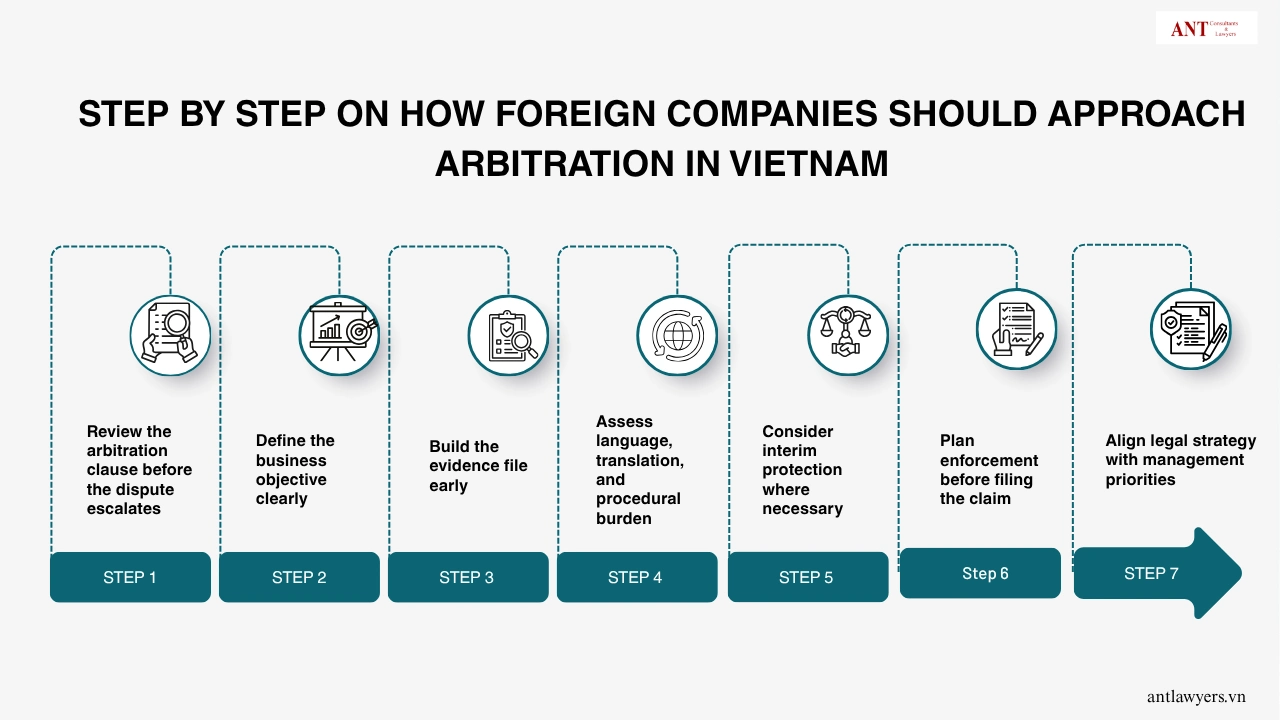
Step 1: Review the arbitration clause before the dispute escalates
Check the parties, institution (using the exact legal name), language, number of arbitrators, seat, and scope. Weak drafting often creates procedural conflict before the merits are even heard.
Step 2: Define the business objective clearly
Some companies want payment. Others want performance, leverage, confidentiality, speed, or enforceability across-borders. The business objective shapes how arbitration should be used.
Step 3: Build the evidence file early
Preserve the contract, amendments, notices, payment records, delivery records, technical reports, and relevant correspondence. Evidence quality often matters as much as legal argument.
Step 4: Assess language, translation, and procedural burden
Translation and hearing preparation can affect cost, timing, and clarity. If the tribunal selects Vietnamese, every foreign language document must be translated. Budget for this early.
Step 5: Consider interim protection where necessary
If assets, evidence, or leverage are at risk, think about urgent measures and court support early. Some strategic value is lost before the final award is issued.
Step 6: Plan enforcement before filing the claim
Identify asset location and the likely enforcement path. For foreign awards, the petitioner generally has three years from the date the award takes legal effect to file for recognition in Vietnam. The commercial value of the case depends heavily on realistic recovery.
Step 7: Align legal strategy with management priorities
The strongest outcomes come when the clause, the procedure, the evidence plan, and the business objective are aligned from the start.
Frequently Asked Questions About Arbitration in Vietnam
Q1: What is arbitration in Vietnam?
It is a legally recognized method of resolving eligible commercial disputes outside the court system. It produces a final, binding award under the Law on Commercial Arbitration.
Q2: Why do foreign companies choose arbitration over litigation?
Arbitration can offer confidentiality, procedural flexibility, a neutral forum, and a binding result. Arbitral awards may be enforceable across New York Convention member jurisdictions, whereas foreign court judgments generally lack a comparable multilateral enforcement path.
Q3: What makes an arbitration clause risky?
A clause that is unclear about the institution, seat, language, number of arbitrators, or scope of disputes covered. Naming a non-existent institution can render the clause void. Ambiguity leads to procedural fights that delay resolution and increase cost.
Q4: Can arbitration proceedings be conducted in English?
Yes, for disputes with a foreign element, the language is as agreed by the parties. If the parties do not agree, the tribunal decides. Language affects cost, timing, evidence handling, and witness preparation, so it should be addressed in the clause.
Q5: Why does evidence matter?
Because strong commercial claims still need proof. Incomplete records, poor translation, and weak document management can damage a case that seemed strong at the business level.
Q6: Do Vietnamese courts still play a role in arbitration?
Yes. Courts can support arbitration through interim measures, assist with tribunal formation in appropriate cases, and handle enforcement of awards at the post-award stage.
Q7: Can foreign arbitral awards be enforced in Vietnam?
Yes. Vietnam is a contracting state to the New York Convention. Foreign arbitral awards can be recognized and enforced through the Civil Procedure Code, subject to procedural compliance and the limited grounds for refusal set out in the CPC.
Q8: What should a company do first after receiving an arbitration notice?
Review the arbitration agreement immediately. Identify deadlines under the applicable rules, preserve evidence, assess language and translation needs, and engage experienced arbitration counsel. Delay often creates avoidable weakness.
About ANT Lawyers, a Law Firm in Vietnam
We help clients overcome cultural barriers and achieve their strategic and financial outcomes, while ensuring the best interest protection, risk mitigation and regulatory compliance. ANT Lawyers has lawyers in Ho Chi Minh city, Hanoi, and Danang, and will help customers in doing business in Vietnam.

Dispute Resolution Through Arbitration in Asia
8 Essential Lessons Arbitration Counsel Helps Companies to Build Effective Dispute Strategies
Arbitration Procedure in Vietnam: 7 Stages Foreign Companies Should Prepare For

Arbitration Law Firms in Vietnam: 4 Advantages Resolving Disputes by Arbitration?

Procedures for Recognition and Enforcement of Foreign Arbitral Awards in Vietnam

Arbitration vs Litigation in Vietnam: 5 Facts and Cultural Insights Every Business Should Know

Vietnam Arbitration Law Reform: 7 Reasons Foreign Counsels Cannot Ignore
How ANT Lawyers Could Help Your Business?
You could learn more about ANT Lawyers Dispute Resolution Practice or contact our Dispute Lawyers for advice via email ant@antlawyers.vn or call our office at (+84) 24 730 86 529