
A breach of contract usually costs the company real money. The difficulty is that a court or an arbitral tribunal cannot work from that certainty. It needs a figure it can follow, step by step, from the contract to the breach, from the breach to the loss, and from the loss back to documents that were created at the time.
Revenue figures, accounting entries and management estimates are all important, but a number on its own does not answer every question a judge or a tribunal will ask. What makes the difference is a file that shows four things clearly: That the company had the legal right it says it had, how much it actually lost, why the breach and not something else caused that loss, and what the company did to keep the damage from growing.
Quick Reference
Proving contract damages in Vietnam usually takes more effort than just showing the list of invoices. In a commercial claim, the company should expect to show that there was a breach, that real loss followed, how much that loss came to, that the connection between the two was direct, and that reasonable steps were taken to limit it.
Direct profit the company would have earned may also be claimed, provided it is supported by ordinary business records rather than by a forecast prepared after the argument began. It is important to keep the unpaid principal, any repayment, the penalty, the damages and the interest on separate lines, because each of them rests on a different legal basis.
As with any part of the wider handling of contract disputes in Vietnam, the notices, the time limits, the choice of forum and the realistic prospect of recovery all deserve attention alongside the numbers.
In short: every amount in the claim should have a source document behind it and a clear explanation of why the breach produced it. Where one link in that chain is missing, it is usually wiser to reduce the claim.
Proving Contract Damages in Vietnam: 7 Records a Company Should Prepare

Keep the Contract and Remedy File Together
The place to begin is the signed contract itself, together with its annexes, the purchase orders, any accepted quotations, the variations and every later amendment. It is worth being precise about who is actually making the claim and who is said to be in breach. A cost paid by another company in the same group does not automatically belong to the company that signed the contract. Where the claim relies on an assignment, a reimbursement arrangement or an agency relationship, the file needs to explain it.
From there, it helps to mark up the obligation that was broken, the date it fell due, any cure period the contract allowed and the wording of the remedy itself. The same attention should go to the limits and exclusions of liability, any notice conditions, a sole-remedy clause, a penalty clause, the governing law and the agreed forum. None of the valuation work is safe if there is still doubt about which version of the contract actually controls.
Keeping the remedies apart from one another matters just as much. An unpaid invoice is normally a debt line rather than a damages line. A refund of an advance payment is a repayment. A contract penalty depends on there being an agreement to that effect, and under the general commercial framework the amount is subject to a statutory cap.
Damages follow proved loss and a proved causal link. Interest has its own basis and its own period. A clause described as “liquidated damages” may be treated in different ways depending on how it is worded, which law governs it and which sector the contract sits in. Construction contracts may also be subject to specific rules under the construction legislation.
Those rules need to be checked on their own terms before the general commercial framework is applied, and they should not be borrowed for an ordinary sale or service contract.
Build a Breach and Causation Timeline
The second record is a short dated timeline, and it is often the most useful document in the whole file. It should set out what was supposed to happen, what in fact happened, and the point at which the loss began. Delivery records, acceptance or rejection documents, test results, site records, service reports, emails, messages and formal notices all feed into it. It is also worth noting who created or received each important record, since that person may later need to explain it.
The harder part is connecting each item of loss back to the breach. Late delivery may quite reasonably have led to an urgent replacement purchase, and that connection is easy to show. It does not, by itself, prove that every hour of a factory shutdown was caused by the same delay. A shutdown may involve equipment failure, low stock levels, a change of mind by a customer, or the company’s own scheduling. These other causes are worth recording even where they weaken the claim, partly because an honest file is more persuasive, and partly because the other side will find them in any event.
The general commercial test looks to actual and direct loss, to direct profit that would have been earned, and to a direct link between the loss and the breach. Some foreign laws take a different approach and apply a foreseeability limit instead. This is worth checking before any loss is included or excluded simply because the contract describes it as “consequential” or uses another label borrowed from a foreign legal system.
Prepare an Actual-Loss Table
The third record is a table with one row for every cost. The items that usually appear include the extra price paid for replacement goods, reasonable repair costs, the cost of doing work a second time, storage, inspection, disposal, urgent transport and other spending that became necessary because of the breach. Each row is more convincing when it carries the invoice, the contract or order behind it, the proof of payment, the accounting entry, the date, the supplier and a short note on the business purpose.
There is a distinction here that is easy to overlook. An invoice shows that an amount was charged. It does not always show that the company paid it, that it is obliged to pay it, or that it arose because of the breach. Matching each invoice to a bank record, a receipt, a payment allocation or a contract closes that gap. Where an amount is still an estimate, it is far better to label it clearly as an estimate than to let it sit in the table looking like a cost already incurred.
Ordinary overhead also needs to be separated from genuinely additional cost. Salaries, rent and general management time usually continue whether or not the breach happened, so including them without explanation invites challenges. Legal and expert costs call for the same care, because the court, the tribunal or the applicable rules may treat those as costs of the case rather than as damages, and adding them to the damages figure automatically can look careless.
VAT, credit notes, insurance, the resale or reuse value of damaged goods and any other recoveries all belong on the face of the table rather than buried inside a net figure. Where the company is able to recover input VAT, claiming the gross invoice amount will overstate what it actually lost. Tax treatment turns on the particular payment and transaction, so it is sensible to have finance and tax reviewers confirm the net position before the claim goes anywhere.
Prepare a Direct Lost-Profit File
Lost revenue and lost profit are not the same thing, and confusing them is one of the most common reasons a claim is cut down. A workable model begins with the transaction that would probably have gone ahead had there been no breach. It then takes out the variable costs, the costs the company avoided, and any substitute sale it managed to make instead. What remains is a direct profit figure that ordinary business records can support.
The records most likely to be accepted are a signed customer order, past orders placed under a framework agreement, evidence of confirmed production capacity, available stock, a history of sales at the same margin, and a budget that was prepared before the dispute arose. Market data can help support a model, but a price difference on its own often remains a forecast rather than proof.
The most helpful thing the file can do is explain, in plain terms, what would probably have happened without the breach. What would the company have sold, and to whom? At what price? Could it actually have produced or supplied that quantity? Which costs would it have incurred along the way? What substitute business did it pick up instead? Where a model has been built after the breach, it is worth testing it against records that already existed before the dispute began.
Future profit is almost always challenged as too uncertain, and that challenge is often fair. An accountant or a damages expert can test the model and check the logic, which helps. What an expert cannot do is supply sales records that were never kept, evidence of capacity that does not exist, or proof that the breach was what caused the opportunity to be lost.
Record Mitigation, Avoided Cost and Recoveries
A company in this position is expected to take reasonable steps to limit its loss, and the file should show that it did. What matters is the picture as it looked at the time: which options were available, who considered them, what each would have cost and why one was chosen over the others. Replacement quotations, tender results, repair options, substitute orders, resale documents, customer discussions and management approvals all belong here.
It is worth writing down the reasoning as well as the outcome, using the information the company actually had on the day. The cheapest option is not always the reasonable one, particularly where it brings safety, licensing, quality or continuity risk with it. Where the company made an urgent purchase, carried out a temporary repair or refunded a customer, the quotations and approvals behind that decision are what make it defensible later.
The benefits of mitigation belong in the record too, not only the costs. Revenue from substitute sales, freight that was saved, production cost that was cancelled, supplier credits, insurance proceeds, salvage value and anything already recovered should all be deducted. If reasonable action could have avoided part of the loss and was not taken, the other side will ask for that part to be removed, and it will often succeed. A proper mitigation file protects the claim, and it also lets management see the true net position rather than an optimistic one.
Keep a Separate Payment, Interest and Currency Schedule
The damages table should not become the place where payment and interest questions quietly disappear. A separate schedule for each invoice or monetary obligation is clearer for everyone. It should show the principal, the due date, any partial payments, credits, how each payment was allocated and the remaining balance. Alongside that, it should record the interest clause, the legal basis, the rate evidence, the start and end dates, the day-count method and the calculation date.
Under the commercial rules, interest on a late payment may be available for an overdue price, a service fee or another reasonable expense even where the contract does not mention interest at all, subject to the framework that applies.
Court guidance directs a court to market evidence when establishing the average overdue rate in the relevant cases. Interest claimed on a penalty or on a damages amount is a different question again, and a harder one. It turns on the nature of the amount, the date it became payable, the legal basis relied on and the relief actually requested, so it deserves its own analysis rather than being carried across from the payment schedule.
It is worth treating late payment interest in Vietnam as its own review rather than applying a single rate across every line of the claim.
Currency matter is different. The original transaction currency should be preserved in the records. Where a conversion is needed, the file should note the lawful payment currency, the source of the exchange rate and the date of conversion. Vietnam’s foreign-exchange rules can affect how payment is made inside the country, and a court or tribunal may approach conversion differently depending on the contract and the remedy sought.
Reconcile Accounting Records and Expert Work
The last record is a claim schedule that pulls everything together. Each row is most useful when it shows the loss category, the amount, the currency, the breach it relates to, the causal explanation, the source document, the payment proof, any mitigation or recovery, the tax treatment and the current status. Marking each row as supported, provisional, disputed or excluded gives management something it can actually make decisions from.
The schedule then needs to be matched against the general ledger, the bank statements, the management accounts and, where relevant, the audited financial statements and tax records. Differences are not necessarily a problem, but they do need explaining. An accounting entry shows how the company chose to record a cost. It does not on its own establish a legal entitlement or a direct causal link.
An expert is worth bringing in where the value turns on technical repair questions, market pricing, complex accounting, capacity or future profit. Whoever is instructed should receive the full data set, including the records that do not help the preferred answer, and the assumptions and any later changes to them should be stated openly. A report that begins with a target figure and works backwards towards it is straightforward to attack, and experienced opponents will do exactly that.
Procedure has an effect on form and timing as well. Records in a foreign language may need a proper Vietnamese translation before a court will accept them. Arbitral tribunals set deadlines for evidence and may refuse material that arrives late. The source file should stay consistent with the wider approach to evidence for contract disputes in Vietnam, including keeping native electronic records, noting where each came from and maintaining version control.
Management Decisions Before Sending the Claim
Before anything is sent, management should be asked to approve three separate figures rather than one: the amount that is supported by evidence today, the amount that still needs work before it can be relied on, and the amount that should stay outside the formal claim altogether. Alongside those, it is sensible to settle the negotiating range, the position on continuing to do business with the other party, and the next procedural date.
A breach of contract demand letter in Vietnam should be built on the supported figure, with any genuinely provisional element described as such. What it should not do is reveal the internal settlement range. The limitation period for contract claims in Vietnam, together with any contractual or statutory complaint period, needs its own separate check. It would be unwise to assume that continuing negotiations safely stops the clock, because that is not the position in every case.
Reconsider the Claim When
It is worth stopping to reconsider the claim in any of these situations:
- There is still doubt about the controlling contract, the company making the claim or the governing law;
- The figure has been built from revenue rather than from net direct profit;
- Invoices cannot be matched to a payment or to a real obligation;
- The timeline does not actually show how the breach produced the loss;
- Mitigation, avoided cost, credits or insurance recoveries appear to be missing;
- Penalty, damages, debt and interest have become mixed together;
- VAT or currency treatment changes the net amount materially; or
- A notice, complaint, filing or evidence deadline may be close to expiring.
Step-by-Step: Prepare the Contract Damages File
The order below works for most claims of this kind.
1. Begin by preserving the contract, the transaction records, the accounting data and the relevant messages before anything is lost or overwritten.
2. Confirm which company is making the claim, who the other party is, which law governs, where a dispute would be heard and whether any special law applies.
3. Identify each obligation that was broken and build a dated timeline around it.
4. List each item of loss and state, in a sentence, the direct causal link being claimed for it.
5. Match every actual cost to its invoice, commitment, payment and accounting entry.
6. Build any lost-profit model from transaction records, capacity evidence and net margin rather than from revenue.
7. Record the mitigation decisions, the avoided cost, the substitute business and the recoveries.
8. Prepare separate schedules for principal, interest, currency, tax and payment.
9. Reconcile the claim against the finance records and obtain technical or expert review where the value calls for it.
10. Remove anything counted twice, mark what remains uncertain, check the deadlines and put the result to management for approval.
Frequently Asked Questions About Proving Contract Damages in Vietnam
Q1: Is an invoice enough to prove contract damages?
Usually not. An invoice shows that a supplier charged an amount, which is only part of the picture. The company will generally also need to show that it paid or is liable to pay, what the business purpose was, that the breach directly caused the cost, and whether VAT, a credit note or another recovery reduced what it really lost.
Q2: Can a company claim lost profit in Vietnam?
Yes, in principle. Direct profit that the company would have earned can be claimed under the commercial framework where it is properly proved. Customer transactions, historic margins, evidence of capacity, avoided costs and any substitute sales are what support that claim. A broad revenue forecast, on its own, tends to be weak evidence.
Q3: Does the 8% commercial penalty cap also limit damages?
No. The 8% figure applies to an agreed penalty in a commercial contract, and it is measured against the value of the obligation that was breached rather than the value of the whole contract. Damages are a separate remedy resting on proved loss, and they are not capped by that figure. Special laws and the contract itself still need to be reviewed.
Q4: Can a company claim both a penalty and damages?
This depends on which framework governs the contract, and the two frameworks point in opposite directions. Under the commercial rules, where the parties agreed a penalty, damages generally remain available as well unless they agreed otherwise. Under the Civil Code the default runs the other way: where the parties agreed a penalty and said nothing about damages, the breaching party may only be liable for the penalty. For a foreign company whose contract turns out to be civil rather than commercial, that reversal can come as an unwelcome surprise, so it is worth confirming which framework applies before relying on either. In every case, the same loss should not be recovered twice.
Q5: How long does a company have to claim contract damages?
That depends on how the claim is classified, which law governs and whether a special law applies. The forum matters as well, because Vietnamese arbitration legislation sets its own limitation period for starting an arbitration, and that period can differ from the one that would apply to the same claim in court. A contractual notice or complaint period may be shorter than either. This is a question to settle early rather than late.
Q6: Can interest be claimed on an awarded damages amount?
Interest after judgment or after an award may well apply under the decision itself and the enforcement rules. Interest on a damages amount is a harder question and should not simply be assumed. It depends on the nature of the amount claimed, the date on which it became payable, the legal basis relied on and the period for which interest is sought. For that reason it is best analysed separately from interest on an overdue price or service fee, which rests on a different basis.
Conclusion
Proving contract damages in Vietnam becomes more manageable when the document follows a clear logic from beginning to end: the contract, the breach, the direct cause, the loss, the mitigation and the final figure. What management gets in return is the ability to see which part of the claim is proved, which part still needs work, and which part is better left out. That is a far more comfortable position to negotiate from than a large number with nothing behind it.
About the Author
Written by Thuong Nguyen, a lawyer at ANT Lawyers and contributors to the Vietnam chapter of GAR Know-How: Commercial Arbitration. Their work focuses on arbitration, enforcement, and cross-border dispute strategy for foreign companies doing business in Vietnam.
About ANT Lawyers, a Law Firm in Vietnam
Founded in 2012, ANT Lawyers is a Vietnam law firm with offices in Hanoi, Ho Chi Minh City and Da Nang. Our dispute resolution lawyers advise on commercial litigation, arbitration and enforcement of awards in Vietnam. We combine legal analysis with practical understanding of Vietnam’s regulatory environment and local administrative practice.
General Disclaimer
This article is for general informational purposes only, does not constitute legal advice, and does not create a lawyer-client relationship. Vietnamese laws, regulations and administrative practice change over time, and the correct position for any matter depends on its specific facts and the rules in force when action is taken. Verify the current position before relying on anything stated here, and consult qualified counsel on your specific situation.
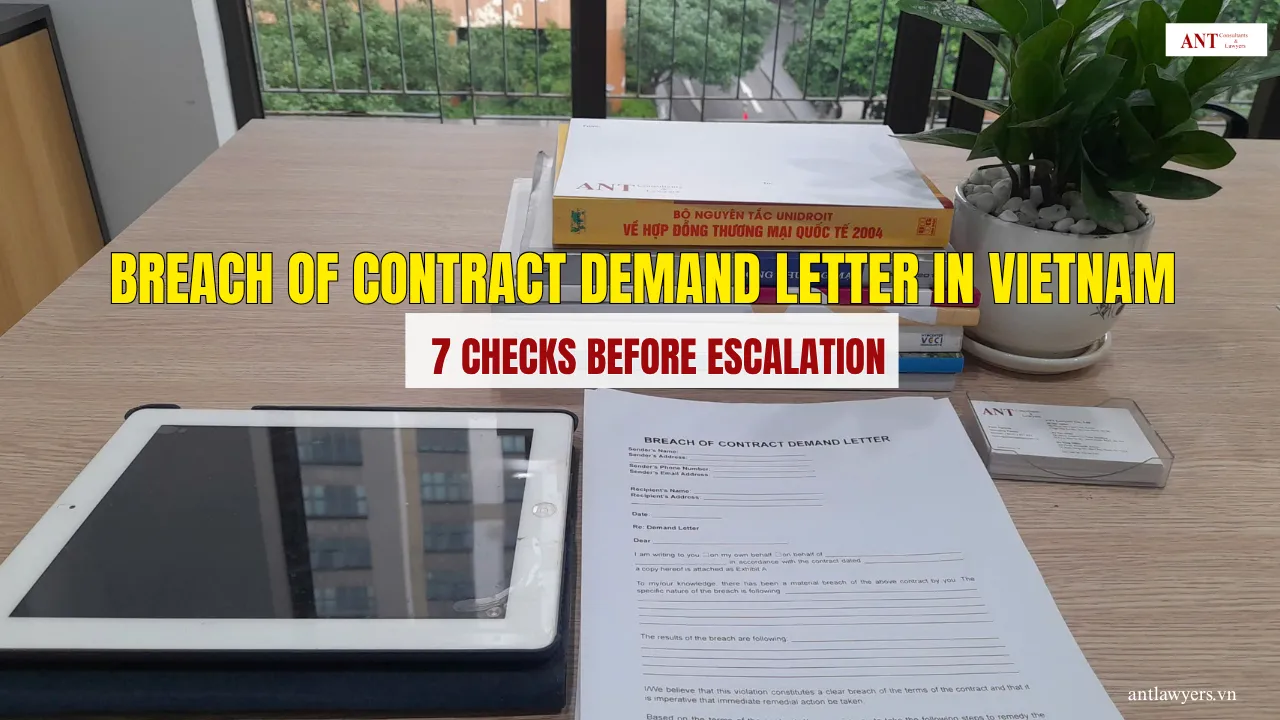
Breach of Contract Demand Letter in Vietnam: 7 Checks

Late Payment Interest in Vietnam: 6 Checks Before Calculating a Claim

Evidence for Contract Disputes in Vietnam: Can Your Company Prove Its Case?

Contract Disputes in Vietnam: 8 Business Risks Foreign Companies Must Control

7 Powerful Truths about Breach of Contract in Vietnam That Every Business Must Understand
How ANT Lawyers Could Help Your Business?
You could learn more about ANT Lawyers Dispute Resolution Practice or contact our dispute lawyers for advice via email ant@antlawyers.vn or call our office at (+84) 24 730 86 529