
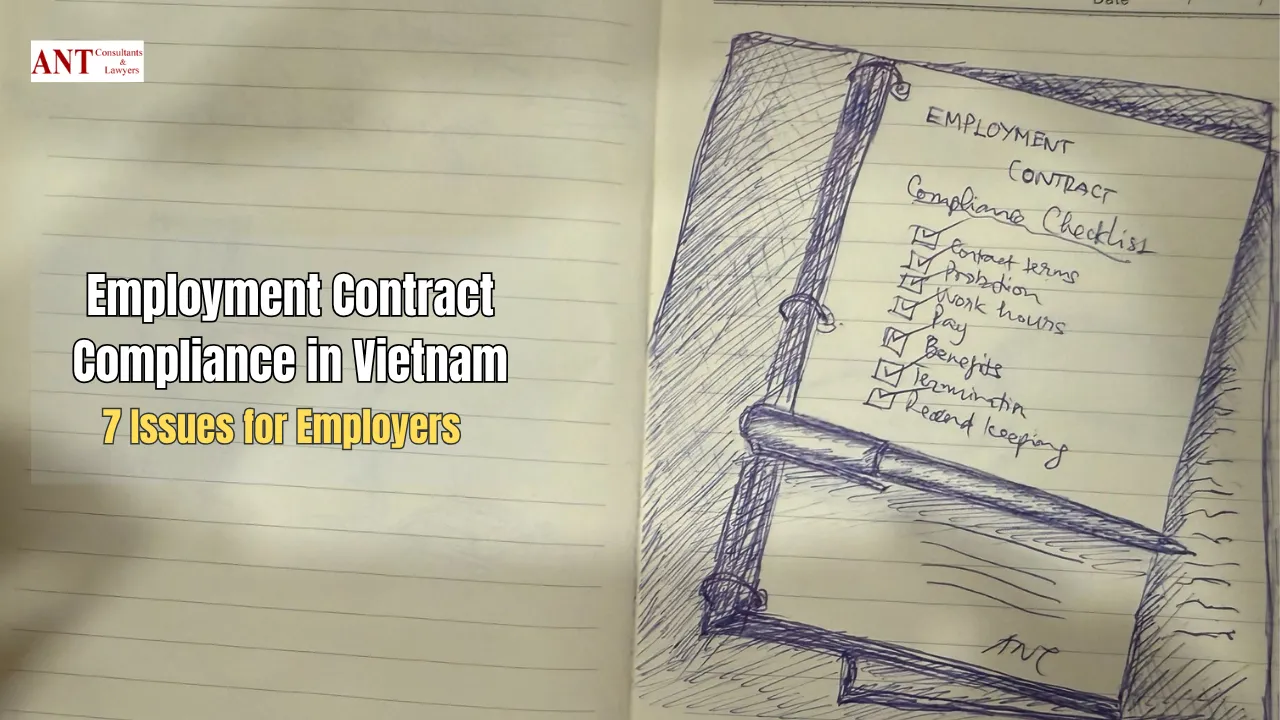
Employment contract compliance in Vietnam means keeping the signed agreement consistent with the work an employee actually does. Employers need the correct agreement before work begins, lawful terms during employment, and records showing what both sides accepted. A contract that was complete at hiring can become unreliable after a change in salary, duties or workplace.
Vietnam’s labor law includes mandatory employee protections that may differ from the rules familiar to overseas managers. Before making an employment decision, business owners, country managers and HR teams should share a clear understanding of the employee’s agreed terms and the legal requirements. A missing signature or an informal pay promise can affect a renewal, transfer or salary claim. Checking the records early gives the company time to address gaps and explain the position clearly to the employee.
These contract issues sit within the wider framework of employment law in Vietnam. This article focuses on seven key requirements for an employment contract in Vietnam under the Labor Code. Foreign employees also need a separate review of work-permit or exemption requirements, visa or residence status, and the terms of their assignment.
Quick Reference
When reviewing employment contract compliance in Vietnam, start with employees whose records could affect an immediate employment decision:
- Employees working without the required signed agreement or with unclear signing authority.
- Employees nearing the end of probation or a fixed term, including those whose earlier renewals affect the next contract.
- Employees whose actual pay, duties or workplace differ from the signed terms.
- Employees who lack a completed copy, or whose electronic signing and delivery records cannot be retrieved.
Clarify the employment history and address any outstanding entitlements before treating a gap as resolved.
7 Issues for Employers
Missing Signed Contracts and Unclear Employment Status
Employers generally must conclude an employment contract before an employee starts work. A lawful separate probation arrangement is one permitted way to begin an agreed trial. Allowing someone to start ordinary employment while waiting for head-office approval can leave the company without the required agreement.
Written contracts are the normal rule, and a compliant electronic contract can have the same legal value. Oral agreements are allowed only within a narrow exception for very short contracts, and some cases still require writing. Check whether the exception applies before relying on it; short duration alone is not a sufficient reason to skip the document.
The contract label also needs attention. An agreement called consulting or services may still be an employment contract when it provides paid work under another party’s management, direction or supervision. Review the actual arrangement before deciding which documents and obligations apply.
Where someone has already worked without a signed contract, establish the actual start date, agreed pay, work performed and benefits due. Payroll, recruitment correspondence and work instructions may help explain the relationship. Confirm which entity employed the person and whether the proposed signer has authority before preparing corrective documents.
A regional manager’s title does not automatically authorize that person to sign for the Vietnamese company. Checking signing authority is a basic contract control; keep the relevant authorization with the employment contract. Where signing was late, record the true signing date and deal expressly with the earlier period. Do not ask either side to certify that a signature occurred on a date when it did not.
HR should compare the active worker list with the contract register and payroll. Each unmatched person needs an explanation, a responsible person and a deadline for correction. Signing now may address an ongoing gap, but earlier liabilities still need separate review.
Probation Arrangements That Fit the Actual Job
Probation is optional and must be agreed. The parties may include it in the employment contract or sign a separate probation contract. They should choose the arrangement before the trial begins, including the job, pay, assessment criteria and person responsible for communicating the result. Recruitment files and assessment notes also form part of the employer’s Vietnam data compliance review: decide who needs access, how the records will be used and how long they should be kept.
Probation cannot be repeated for the same job, and it is not permitted for certain very short employment contracts. The maximum probation period depends on the position and its required qualifications. HR should confirm the applicable limit before agreeing the start and end dates.
The longer probation period for statutory enterprise-manager positions does not cover every employee whose title contains “manager.” HR needs to confirm that the position falls within that legal category. For other roles, use the qualification requirements of the job when selecting the permitted period.
The agreed probation pay must meet the legal minimum linked to the salary for that job. At the end of probation, the employer must notify the employee of the result. If the employee passes, the existing employment contract continues where probation was included in it. Where there was a separate probation contract, the parties must conclude an employment contract.
During lawful probation, either party may cancel the probation contract or the employment contract containing probation without advance notice or compensation. Earned pay remains due. Managers should decide and communicate within the agreed lawful period. An internal delay does not automatically extend probation, and the company should not assume that probationary cancellation rights remain available after it ends.
Contract Duration and Renewals Before the Expiry Date
The Labor Code recognizes indefinite-term contracts and fixed-term contracts. An indefinite-term contract has no agreed expiry date. A fixed-term contract has an agreed expiry date and must stay within the statutory maximum duration. A project label does not create a separate contract category outside these rules.
If an employee continues working after a fixed-term contract expires, the parties must sign a new contract within the statutory period. Until then, the previous contract governs their rights and obligations. Missing that deadline generally causes the contract to become indefinite-term. HR should make the renewal decision before expiry rather than treat the post-expiry period as its normal timetable.
Fixed-term renewals are limited. Once the ordinary renewal limit is reached, continued employment requires an indefinite-term contract, unless a statutory exception applies. Review the full sequence of agreements before approving another term. A newly printed contract does not restart the employee’s history.
There are statutory exceptions, including rules for foreign employees, elderly employees and certain other positions. Foreign employees may agree successive fixed terms. Where a work permit is required, the employment contract must not exceed its validity. For exempt employees, also check the exemption basis and the validity of any exemption confirmation against the proposed period of work. HR should check the employee’s category before applying the ordinary renewal rule.
An appendix cannot amend the duration of an employment contract. This matters when a manager asks HR to extend the term using a short attachment. An appendix may record other agreed changes, but the renewal requires the appropriate new contract and a check of the permitted contract type.
An expiry calendar should therefore record earlier contracts, the permitted next term and the manager’s decision. A fixed end date also does not give the employer a general right to terminate early when sales fall or a project changes. Any early exit needs its own lawful basis and should be considered within the wider employment termination and restructuring framework.
Required Terms and Documents That Match Up
The contract must identify the employer, its address and the name and position of the employer’s signer. It must also include the employee’s required identity and residence details. The company name should match the actual employing entity, even where a group brand appears on recruitment materials.
For an ordinary employment contract, the required substantive content covers the job and workplace, contract duration, and salary for the job or title. It also includes the payment method and timing, salary allowances and other additional payments, and arrangements for wage or grade increases.
Other required subjects include working time and rest, protective equipment, social insurance, health insurance, unemployment insurance, and training or development of vocational skills. State the applicable arrangements clearly. The insurance categories named in the contract must be implemented according to the employee’s actual statutory coverage.
Employment contract compliance in Vietnam also depends on how these terms work together. Compare the contract with the offer, job description, pay schedule and relevant policies. An annual salary review should not be described as a guaranteed increase if that is not the agreement. A mandatory benefit cannot be removed by calling it discretionary.
Attachments need identifiable versions and effective dates. A reference to “company policies from time to time” does not give management unlimited power to reduce agreed rights. Where a policy supplies relevant detail, employees should be able to access and understand it.
Bilingual documents can help employees and overseas managers work from the same terms. Check names, figures and obligations across both versions, and explain how differences will be handled. A language-priority clause cannot override mandatory Vietnamese protections. Avoid importing a global right to dismiss at will or a blanket employee waiver into the local contract.
For roles involving software, designs or technical information, check ownership and permitted use of the work produced. Confidentiality terms should identify the information to protect and the employee’s responsibilities. Clear ownership records and access controls help protect intellectual property in Vietnam, including work created by employees. A general confidentiality clause does not settle every ownership question or give the company rights over an employee’s unrelated work.
Salary and Allowances That Payroll Can Apply Correctly
The contract should let the employee and payroll team understand what is payable, when it is payable and how it is calculated. Separate the salary for the job from salary allowances, other additional payments, expense reimbursements and bonuses. Explain any conditions attached to a payment.
The salary for the job or title must meet the applicable minimum wage. Adding allowances to an inadequate job salary does not remove that requirement. Employers should check the current regional rate when hiring, changing the workplace or revising pay.
State whether an agreed amount is gross pay before lawful deductions or a promised net amount. If the company promises net pay, finance needs to understand the additional employer cost. Salary must generally be stated and paid in Vietnamese dong. For foreign employees in Vietnam, it may be stated and paid in foreign currency, subject also to applicable foreign-exchange rules.
A fixed monthly housing payment promised in the offer should not become discretionary simply because the contract uses a broad allowance clause. Identify which payments are guaranteed and which depend on stated conditions. Resolve inconsistent wording before payroll applies it; the name given to a payment does not decide the employee’s entitlement.
The same care applies to bonuses. A guaranteed contractual payment and an award dependent on stated business or performance conditions can create different obligations. Record the intended arrangement clearly and use consistent wording in recruitment emails, contracts and bonus policies.
For employees whose wages are set by the employer, salary allowances and other fixed additional payments agreed to be paid regularly and consistently each pay period are generally included in the compulsory social insurance contribution base. Calling a payment an allowance does not decide its treatment. Payroll should check the nature and conditions of each component, including any statutory exclusions, and apply the relevant rules for each insurance scheme.
Employers must pay fully and on time and provide a pay statement showing salary, overtime, night work and deductions where applicable. Trace the agreed package through the payslip to the payment record. If the figures differ, establish whether the cause is a calculation error, an agreed change or an unpaid entitlement. Keep the agreed terms, payslips and payment confirmations together so the evidence of what was agreed and paid can be checked if a dispute arises.
Changes to Jobs or Workplaces After Hiring
The employee’s work and workplace should follow the contract. Routine assignments within the agreed role differ from a material change to the job or normal location. Before announcing a transfer, management should establish whether the existing agreement already covers it or whether employee agreement is required.
A party proposing changes to contract terms must give the other party the required advance notice describing those changes. If both sides agree, they can sign an appendix or a new contract, subject to the separate restriction on changing duration by appendix. If they do not agree, the existing contract continues.
An email announcing a new position is therefore not necessarily an agreed amendment. Record the accepted duties, workplace, pay and effective date before implementing a permanent change. A broad instruction to perform any work anywhere should not be treated as unlimited consent.
Temporary reassignment to different work has a separate legal route. It can apply to specified unexpected difficulties or production and business needs. Where the employer relies on production or business needs, the relevant circumstances must be specified in its internal labor regulations. The company must also meet the notice, duration and pay conditions below.
The employer must give the legally required advance notice, state how long the reassignment will last and assign work suitable for the employee’s health and gender. HR should track the cumulative period of reassignment during the year and obtain the employee’s written agreement before the statutory limit is exceeded. These rules concern temporary different work; they are not general permission for a permanent relocation.
The employee receives the pay for the new work. If it is lower, the previous salary must be preserved for the initial period required by law. After that, any reduced salary must meet both the legal floor linked to the previous salary and the applicable minimum wage. Payroll should confirm these protections before applying a reduction.
Before moving a team, HR should distinguish a permanent amendment from a lawful temporary reassignment and check the consequences for each employee. If the move involves a new office or factory, coordinate the employment changes with the company’s location and relocation planning in Vietnam, including the premises and any related registration or licensing changes. Foreign employees also need a separate review of their work authorization. A signed employment amendment does not itself update a permit or complete any required notification.
Signed Copies and Electronic Records That Remain Available
For a written paper contract, the employer and employee must each retain a signed copy. HR should confirm delivery of the completed version and all agreed attachments. Sending a draft before signature does not show that the employee received the final agreement.
A scan makes a paper contract easier to retrieve, but scanning alone does not convert it into a compliant electronic employment contract. Keep paper originals where the agreement was completed on paper. If the company wants an electronic original, use a process that meets the applicable rules on identity, signing, integrity and access.
If the company uses electronic contracts, confirm that its signing and recordkeeping process meets the rules applicable to the signing date and provider, including any transitional arrangements. Keep evidence of how the agreement was signed and delivered.
Give the employee the completed electronic contract through the agreed method. HR should be able to retrieve the signed file, attachments and amendments, even after the employee leaves or the company changes providers.
Employment contract compliance in Vietnam requires a clear history of the agreement. Preserve earlier versions and show which amendment changed each term. These records may also provide evidence for contract disputes in Vietnam if the terms become contested. Employment disputes follow their own legal procedures, which must be checked separately from the rules for commercial disputes.
Employee files contain personal information, so Vietnam data compliance also matters when storing or sharing them. Limit access to staff who need it, set appropriate retention periods and preserve records required for an ongoing dispute. Before sharing files with an overseas parent or HR platform, check the purpose, recipients and applicable requirements. Signing an employment contract does not give the employer unrestricted permission to use or share personal data.
Step by Step Guide to Employment Contract Compliance in Vietnam
Step 1: Establish the complete employee list
Compare payroll, HR and department lists. Record the employing entity, actual start date, role, workplace and whether a signed agreement exists. Ask managers about people working outside the normal onboarding process. The result should be one reconciled list with each missing file identified.
Step 2: Reconstruct the agreement and its history
Collect the signed contract, probation terms, earlier fixed terms, amendments, offer and relevant policies. Check signing authority and the dates of changes. Preserve recruitment and management messages that explain a disputed term. Separate an original record from a later explanation of what happened.
Step 3: Check current terms and approaching deadlines
Apply the seven issues above to the employee’s actual position. Confirm whether probation has ended, whether the next fixed term is permitted, and whether pay or work has changed. Check the current legal limits and notice periods, then record the exact dates that apply. Give priority to an imminent expiry, an ongoing underpayment or a proposed transfer.
Step 4: Agree and document the correction
Explain the discrepancy to the employee and identify the lawful correction. Obtain agreement where required, use a new contract for a permitted renewal, and record true signing dates. Calculate any unpaid amounts separately. A replacement document should not describe a disputed history as agreed or remove mandatory rights.
Step 5: Put the agreed terms into operation
Give the employee the completed documents. Send authorized pay and role changes to payroll and the relevant manager, with their effective dates. For electronic records, keep the signing and delivery evidence and confirm any transitional treatment. Close the task only after the correction is reflected in both the documents and actual practice.
Step 6: Keep the next review visible
Update the contract register with the current version, probation end, expiry date and next action. Assign a person to each deadline and test a sample of completed files. Repeat the review when pay, duties, workplace or the employing entity changes. Unresolved questions affecting termination or a significant entitlement need review before management acts.
Frequently Asked Questions About Employment Contract Compliance in Vietnam
Q1: Can an employee start while head office is still approving the contract?
The employer generally must conclude the employment contract before ordinary employment starts. An agreed, lawful separate probation arrangement is possible. An unsigned draft or pending internal approval is not a reliable substitute. Plan the local signing authority and required documents before setting the start date.
Q2: Does a missing signature mean the person has no employment rights?
No. Paid work under the employer’s management, direction or supervision can establish an employment relationship despite the document’s label or a missing contract. Review the facts and existing entitlements. Preparing a contract later does not automatically settle liability for the earlier period.
Q3: Can probation be extended because the manager needs more time?
A manager’s preference cannot override the agreed arrangement or statutory maximum. Probation cannot be repeated for the same job. Assess the result within the lawful period and notify the employee. Do not assume that an expired probation arrangement continues because no decision was communicated.
Q4: Can a fixed-term contract be renewed through an appendix?
No. An appendix cannot change the contract’s duration. Use the appropriate new contract and check the employee’s earlier terms. The renewal history determines whether another fixed term is permitted or continued employment requires an indefinite-term contract, subject to statutory exceptions.
Q5: Can the company stop an allowance when business slows?
That depends on the agreed payment and its lawful conditions. A guaranteed contractual payment cannot be treated as optional merely because it is called an allowance. Review the offer, contract, policy and actual payments, then use the proper agreement process for any proposed change.
Q6: Can a transfer clause let the employer move an employee anywhere?
Its wording and the proposed move both matter. Check whether the agreed job and workplace cover the change. A permanent amendment may require agreement; temporary different work has separate conditions and limits. Foreign-worker authorization must also be checked independently of the employment clause.
Q7: Must every paper employment contract be replaced electronically?
No. Paper contracts remain a permitted form. Keep the signed originals and give the employee the completed copy. If electronic contracting is chosen, verify the rules applicable to the provider and signing date, including any transitional treatment. A scan is useful for access but does not itself complete the electronic contracting process.
Q8: Does an employee’s signature make every contract clause enforceable?
No. Agreement does not remove mandatory employee protections. A clause allowing dismissal at will, withholding a statutory entitlement or making unrestricted use of personal data may conflict with applicable law. Review the particular term and the action proposed instead of relying on the signature alone.
Conclusion
Employment contract compliance in Vietnam needs attention when someone joins, when probation ends, before a contract expires and whenever work or pay changes. HR should maintain the agreement and its history, managers should explain proposed changes, and payroll should check that payments follow the applicable terms.
Start with the unresolved issue most likely to affect an employee’s rights or the company’s next decision. Confirm the facts, agree the appropriate correction and keep evidence that it was completed. A reliable contract file helps both sides understand what has been agreed and reduces avoidable disagreement later.
About the Author
Written by Thuong Nguyen, a lawyer at ANT Lawyers and contributors to the Vietnam chapter of GAR Know-How: Commercial Arbitration. Their work focuses on arbitration, enforcement, and cross-border dispute strategy for foreign companies doing business in Vietnam.
Reviewed by
Tuan Nguyen, Managing Partner, ANT Lawyers; member of the Hanoi Bar Association and Vietnam Bar Association.
About ANT Lawyers, a Law Firm in Vietnam
Founded in 2012, ANT Lawyers is a Vietnam law firm with offices in Hanoi, Ho Chi Minh City and Da Nang. Our employment lawyers advise on hiring, work permits, internal labour regulations and termination disputes in Vietnam. We combine legal analysis with practical understanding of Vietnam’s regulatory environment and local administrative practice.
General Disclaimer
This article is for general informational purposes only, does not constitute legal advice, and does not create a lawyer-client relationship. Vietnamese laws, regulations and administrative practice change over time, and the correct position for any matter depends on its specific facts and the rules in force when action is taken. Verify the current position before relying on anything stated here, and consult qualified counsel on your specific situation.

Related expertise
Employment
Learn about ANT Lawyers’ employment legal services in Vietnam.
Explore our Employment practice
For enquiries, contact ant@antlawyers.vn.