
When a company in Vietnam stops trading while it still owes tax, it must settle that debt before it can complete a voluntary dissolution. If the legal conditions are met, the tax authority may temporarily restrict the company’s legal representative from leaving Vietnam, whether the representative is Vietnamese or foreign. The company owes the tax, but the notice may name a hired manager who needs someone else’s approval to release company funds. A manager who also owns shares may face a different problem if the company has run out of cash and the other shareholders decline to provide more funding. The first step in resolving a tax exit ban in Vietnam is to check why the tax office issued the notice, what the company can pay and who can approve payment.
A Vietnam market entry strategy should cover what happens if the investment is scaled back or the owners decide to leave. When appointing a local representative, agree who can release company funds, who will keep the tax records and who can approve closure. Those arrangements matter most when the business stops earning revenue but still has returns to file and debts to settle.
Quick Reference
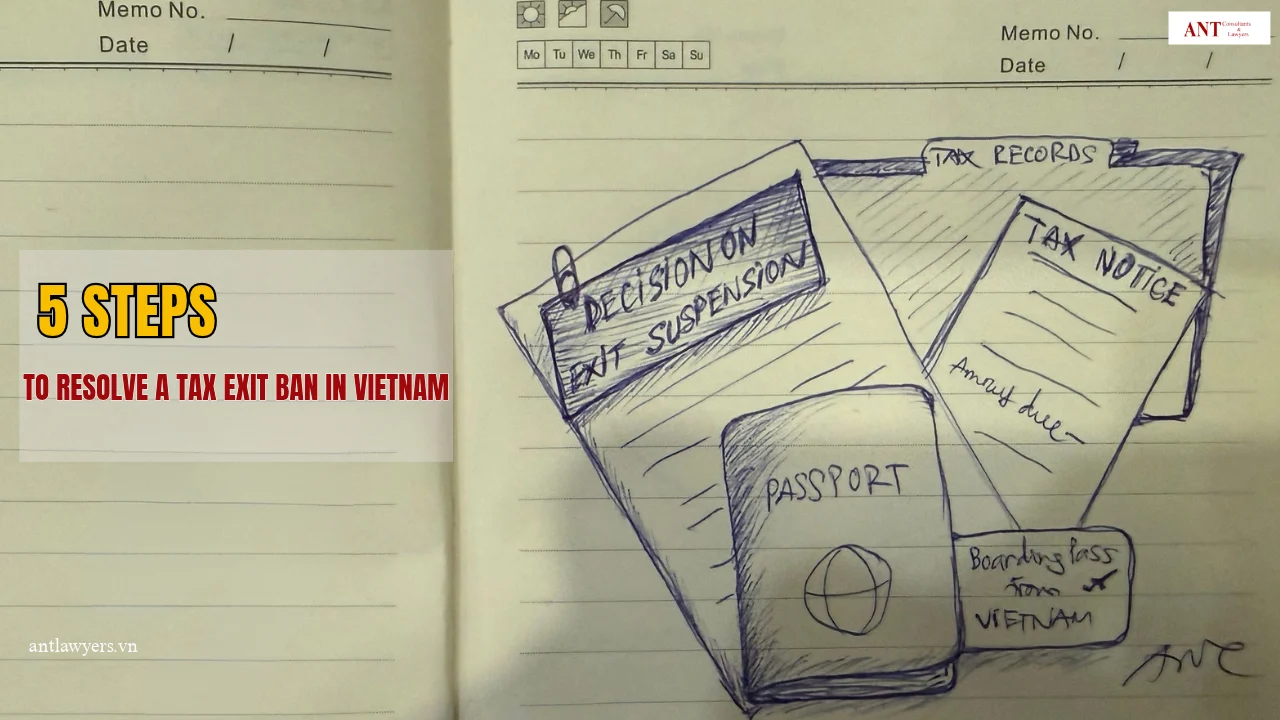
To resolve a tax exit ban in Vietnam, start with the latest notice from the managing tax office. An address notice records a finding about the company. A warning gives it an opportunity to respond. An active suspension names the individual whose departure is restricted. Check the reason given and ask the managing tax office what would allow it to cancel that notice.
Check the tax notice and the company’s ability to pay at the same time. If funds are available, establish who can release them. If the company cannot pay, the age of its unpaid debts can trigger a filing duty for the legal representative while the tax office is still reviewing the restriction.
How to Resolve a Tax Exit Ban in Vietnam Step by Step
Step 1. Check who is named and why
Get the original notice and any later correspondence from the managing tax office. Record the issue date and the deadline shown, particularly if someone forwarded the notice after the company stopped operating. Match the company’s tax code and the individual’s details, then confirm which notice is in force.
If the notice names you as a beneficial owner, ask the tax office which records it relied on to identify you and compare them with the company’s ownership and control records. Check whether the notice concerns overdue tax subject to enforcement or an unresolved tax registration issue after the company was recorded as inactive at its registered address. An active suspension restricts your ability to leave Vietnam. Any claim that you personally owe the company’s tax requires a separate legal basis.
Match the person and role in the notice to the company’s registration and appointment records. If the notice names the wrong person, or relies on a debt already paid, send the evidence to the managing tax office and request a written correction. If the authority maintains a decision you believe is unlawful, consider a formal complaint or ask an administrative court to annul it. Check the filing deadline. Filing alone leaves the restriction in force. If delay would cause serious harm that cannot be remedied later, ask whether the court can temporarily suspend the decision.
Step 2. Establish what the company owes and who can approve payment
Ask the accountant for the tax balance by period and due date, including penalties and late-payment charges. Match payments to receipts. List unpaid wages, supplier invoices and amounts due to other creditors alongside the tax debt. The figures show whether the company has money to pay but lacks a signature, or whether its funds will run out before the debts are paid.
When employees dispute their final pay, compare their contracts and payslips with the amounts they actually received. If a supplier claims late payment interest, check the invoice due date and any partial payments before recording the interest claimed.
A hired manager may be able to sign tax returns while another person controls the bank account. The same is true of a manager who owns a minority stake. Check the appointment, bank mandate and company charter. Send the tax notice to the people who can act, asking for a specific decision such as releasing available funds or calling a meeting. Record the vote, any refusal and any requests that went unanswered. If records are withheld, explain the gap to the tax office and ask what it can confirm about the notice in your name.
If the other shareholders decline to invest more, check what each person has already signed. A shareholder who has fully paid for their shares generally owes no fresh investment simply because tax is overdue. If a shareholder promised the company a further payment and it is due, the company can seek to enforce that promise. Check the agreement, payment date, who can act for the company and any arbitration clause. The same rules apply to the representative’s own commitments.
A hired manager can bring a personal claim for an obligation owed to them. Unpaid salary or agreed expenses usually give the manager a claim against the company. A shareholder who personally guaranteed repayment of a loan to the manager may also be liable under that guarantee. Keep the signed terms, payment records and meeting minutes as evidence of who owes what. If the manager brings a wage claim, check whether labour mediation is required and arrange separate representation for the company.
A manager who also owns shares has another possible route. Suppose a fellow shareholder used their position as director to divert company money to their own business. In a limited liability company with more than one member, a member can sue a manager for breach of duty. In a joint-stock company, a shareholder or group meeting the legal ownership requirement can sue a board member, director or general director for such a breach. If the money belonged to the company, a claim on its behalf seeks to recover it for the company.
In a shareholder dispute over funding, an eligible owner can challenge a resolution that breaches the law or the company charter. Keep the meeting minutes and check the filing deadline. A lawful vote against further investment does not, by itself, require the other shareholders to put in more money.
Step 3. Decide whether the company can continue, close or enter bankruptcy
If the shareholders agree on funding, record who will provide it, on what terms and when it will be available. If another creditor offers more time to pay, record the agreed repayment terms, which debts they cover and when each payment falls due. Before taking steps to close the company in Vietnam, confirm it can pay all its debts and has no dispute pending in court or arbitration. Obtain the required approval, settle employee, tax and other creditor claims, and keep the final closure record.
If funding falls through, check each unpaid debt against its due date and any agreed extension. A vote against further funding alone does not establish insolvency. If the company is at risk of insolvency or already insolvent and has a viable recovery plan, its registered legal representative can apply for court-supervised rehabilitation. Once a debt remains unpaid beyond the statutory period and the company meets the legal test for insolvency, the representative must petition the competent court for bankruptcy unless a rehabilitation petition has already been filed.
The registered legal representative can file a bankruptcy petition directly or authorize someone to file. They can do so even if they own no shares or the other shareholders refuse to approve it. A senior employee who is not the registered representative needs a separate basis to file in their own name, such as a qualifying unpaid wage claim. An owner filing solely as a shareholder or member must meet the applicable ownership requirement, alone or with others. Check the company charter for a lower threshold.
Bankruptcy gives a manager facing uncooperative owners a way to put the company’s accounts before the court. The insolvency administrator checks what the company owns, who owes it money and which creditors have claims. If the court declares the company bankrupt, its decision ends the representative’s authority to act for the company and sets out how the available assets will be distributed under the legal order of payment. A manager who lent the company money can submit a creditor claim. Anyone seeking to hold a manager or shareholder personally liable still needs a legal basis, such as a guarantee or a proven breach of duty.
The company’s assets normally cover the costs of bankruptcy proceedings. The judge sets the advance for work such as valuing assets or checking creditors’ claims. If someone else controls the company’s bank account, send the court’s payment notice to the authorized signatory and keep their response. If the company owns equipment it could sell, identify it for the court. The judge can direct the insolvency administrator to sell assets to cover costs.
If the company has no assets, cannot sell or recover what it owns, or would raise too little to cover the costs, the representative can ask the court to use the expedited procedure. Provide bank statements, an inventory and a list of amounts owed to the company, with evidence of what it can collect. If the court accepts this ground, the state provides the advance. The manager’s personal finances and the shareholders’ refusal to invest do not, by themselves, establish eligibility.
If the company can pay the outstanding tax, arrange payment with the tax office. If it already paid, send the payment records. If the duty to file for bankruptcy has arisen, file promptly and explain any funding difficulty to the court.
Step 4. Resolve the issue recorded by the tax office
For overdue company tax, ask the managing tax office how much the company must pay for the restriction to be lifted. If the accountant believes the company already paid, reconcile the records before making a second payment. If the court has opened bankruptcy proceedings, check the payment rules with the insolvency administrator before using company funds to settle the tax.
If the tax office has recorded the company as inactive at its registered address, check the date of that notice and whether the company took the required steps to restore or terminate its tax code. A company that is closing should complete tax-code termination. A company that will continue must apply for restoration, file the required returns and bring its remaining debt below the applicable threshold. It should also check that its registered office is suitable for receiving official notices.
Step 5. Obtain confirmation that the restriction has been lifted
Bankruptcy can help lift a restriction based on company tax debt. If the court declares the company bankrupt and no assets remain after the payments required by bankruptcy law, the unpaid tax can qualify for a formal write-off. For the tax office’s review, obtain the bankruptcy decision, the enforcement officer’s distribution record showing how much tax was recovered, and the decision closing enforcement. Filing the petition or receiving the bankruptcy decision alone does not cancel the ban.
Once the competent authority approves the write-off of the debt behind the notice, the managing tax office can issue the cancellation. The Tax Department’s cancellation guidance also covers companies that pay enough to bring the debt below the applicable threshold. If the notice was based on inactivity at the registered address, check the tax registration requirements in Step 4 as well. Match the cancellation to the individual and the original notice, then confirm that the immigration authority has lifted the restriction.
If the same person represents several companies, check which company each notice concerns. A separate order may still be in force. Its issuing authority and legal basis determine how long that departure restriction can last.
Frequently Asked Questions About a Tax Exit Ban in Vietnam
Q1: Can a small unpaid tax balance trigger a tax exit ban in Vietnam?
No. For a restriction based on company debt, the amount outstanding, how long it has been overdue and whether the company is subject to tax enforcement all matter. Ask the managing tax office which amounts it counted and for which periods. If its figures differ from the company’s, give it the relevant returns and payment receipts to check.
Q2: Does the individual have to pay the company’s debt personally?
A manager’s appointment or ownership of fully paid shares does not, by itself, make the manager personally responsible for the company’s tax. Check any unpaid capital commitment or personal undertaking separately. The representative can also be accountable for loss caused by a breach of their own duties, including a failure to file when the company is insolvent.
Q3: Do Vietnamese and foreign individuals face the same rules for their own tax?
The company-related rules above apply to both. For personal tax, the rules differ. A foreign individual’s own overdue tax can trigger a separate restriction. There are also specific rules for Vietnamese citizens leaving to settle abroad and for overseas Vietnamese departing Vietnam. In those personal-tax cases, release generally requires full settlement or a lawful write-off.
Q4: What if the person named has already left the company?
A resignation may end employment while the register and the tax notice still name the individual. Ask the company in writing to appoint a replacement and register the change. If a change was registered, send the evidence and effective date to the tax office and request a review of the notice. Check for any separate beneficial-owner ground and obtain a written outcome for the existing restriction.
Q5: Why did we receive a warning if the accountant says the company owes nothing?
Look for an earlier notice that the company could no longer be found at its registered address. A zero tax balance can be correct while the company’s registration still needs attention. Ask the tax office which filings remain outstanding and who will handle them if the company is closing.
Q6: Can the restriction be lifted before the company is dissolved?
Yes. The tax office can cancel the restriction once the conditions for that notice are met. The company can still have work to do before it is dissolved. Keep both the cancellation issued for the individual and the final registration record for the company.
About the Author
Linh Pham is a Legal Research Specialist at ANT Lawyers. Trained in corporate law, she has more than 10 years of experience supporting legal teams through regulatory research, document review and liaison with Vietnamese authorities. Reviewed by Tuan Nguyen, Managing Partner of ANT Lawyers. He advises foreign investors and management teams on corporate governance and regulatory compliance in Vietnam and is a member of the Hanoi Bar Association and the Vietnam Bar Association.
About ANT Lawyers, a Law Firm in Vietnam
Founded in 2012, ANT Lawyers is a Vietnam law firm with offices in Ho Chi Minh City, Hanoi and Da Nang. Our Corporate and Commercial team advises foreign investors on company registration, governance and closure. When unpaid company tax leads to an exit restriction, we help the representative identify the notice in their name and work with the owners and accountant to establish what the company must settle. Where the company may be unable to pay its debts, our bankruptcy lawyers work with directors on creditor negotiations and the options for recovery or bankruptcy proceedings.
General Disclaimer
This article is for general informational purposes only, does not constitute legal advice, and does not create a lawyer-client relationship. Vietnamese laws, regulations and administrative practice change over time, and the correct position for any matter depends on its specific facts and the rules in force when action is taken. Verify the current position before relying on anything stated here, and consult qualified counsel on your specific situation.