Company, Representative Office or Branch in Vietnam
A foreign company does not need an operating subsidiary merely because it wants employees and a visible presence in Vietnam. A representative office can support market research, liaison and promotion, and can hire staff for those permitted functions.
The dividing line is the business activity. If the Vietnam presence must sell, provide the contracted service, issue invoices or receive commercial revenue, an RO is the wrong structure. A branch or company may support business activity, but each has different availability, liability and licensing consequences.
Choosing a company, representative office or branch in Vietnam should therefore start with what the local team will actually do.
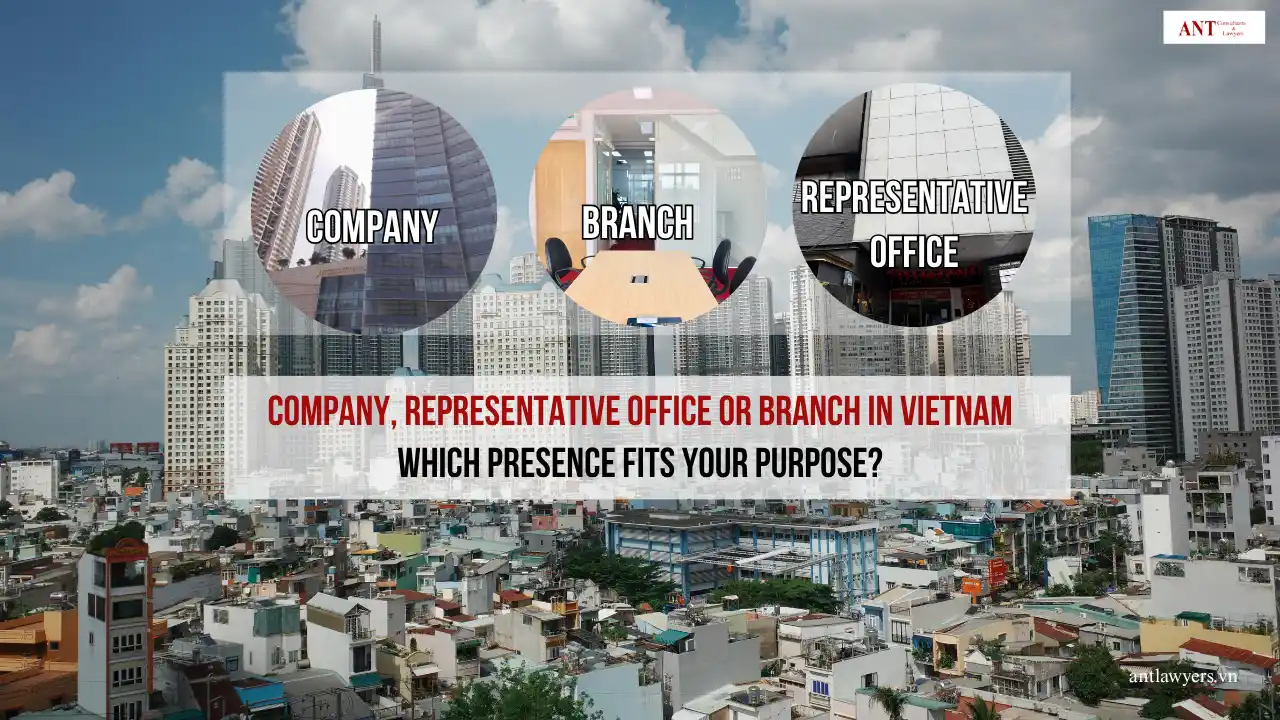
Choice of company, representative office or branch in Vietnam depends. Use a representative office where the foreign trader needs a non-revenue presence for market research, promotion and liaison. Consider a branch where the sector permits it and the foreign parent accepts direct exposure for the licensed activity. Use a Vietnamese company where the investor needs a separate operating entity for contracts, invoices, assets, staff and long-term control. Check market access and sector licences before selecting any of the three.
An RO can fit a market-entry stage where the foreign trader wants to understand demand, support relationships, promote the parent’s business and monitor distributors or customers.
Vietnam permits representative offices of foreign traders under the commercial framework, subject to eligibility and licensing conditions. The RO remains part of the foreign trader rather than becoming a separate Vietnamese company.
It can hire Vietnamese and foreign employees for its permitted work. That staffing ability should not be confused with a right to conduct the parent’s commercial business locally. Job descriptions, authority, contracts and daily activity should remain inside the licensed scope.
The office cannot be used as a disguised sales company. Employees should not issue local invoices, collect sales revenue or perform the core paid service as if the RO were an operating entity.
The risk appears when the business grows. A team may begin with liaison and then move into quotations, negotiation, project delivery or customer support that belongs to a revenue operation. Management should set an upgrade trigger before the boundary is crossed.
A branch can carry out business within the scope stated in its licence where Vietnamese law and the relevant international commitment permit that form.
The branch is dependent on the foreign trader. The parent normally bears direct responsibility for its activities. This can be acceptable where the group wants the parent to remain the contracting enterprise and the sector permits a branch.
Availability is narrower than many investors expect. The foreign trader’s operating history, the proposed service, treaty position and specialised sector rules may affect whether a branch can be licensed and what it may do.
The branch should be chosen because it fits the activity and parent-risk position, not because it sounds simpler than a subsidiary.
A company fits a continuing local operation that needs its own contracts, invoices, bank accounts, employees, assets and licences.
The company is a separate Vietnamese legal entity. The foreign investor can hold the permitted ownership and establish corporate governance around the local operation.
This structure requires a wider compliance system. Investment, enterprise, tax, accounting, beneficial-ownership, labour, foreign-exchange and sector rules may all connect to the launch.
The Vietnam market entry strategy should confirm that the local revenue and control benefits justify the added commitment.
An RO is not a local revenue vehicle. A branch may earn revenue within its licensed scope. A company may conduct its registered and licensed business activities.
An RO and branch remain dependent units of the foreign trader. A company is a separate legal entity. The separation does not remove all parent or shareholder risk, but it changes contracting, governance and liability analysis.
All three can involve local staff, subject to the applicable employment and foreign-worker rules. The employee’s actual duties must fit the entity’s lawful activity.
The RO needs an RO licence. A branch needs a branch licence and may face sector conditions. A company needs enterprise and, where applicable, investment and operating licences.
An RO usually requires less operating commitment because it does not run the revenue business. A company needs capital suitable for the operating plan. A branch should be assessed against parent exposure, tax and licensed activity rather than assumed to be the middle-cost option.
The first risk is allowing an RO team to drift into revenue activity. The second is treating a branch as universally available. The third is forming a company too early, before demand or licences are understood.
Another risk comes from titles and authority. A chief representative, branch head or company legal representative can carry different powers and obligations. Parent delegations, bank authority and customer communications should match the legal structure.
Where the investor prefers indirect entry, a distributor or local commercial partner in Vietnam may be a better comparison than any local presence.
Q1: Can a representative office hire people in Vietnam?
Yes. The employees must work within the RO’s permitted non-commercial functions and comply with labour and foreign-worker rules.
Q2: Can an RO sign customer contracts?
An RO should not act as the local revenue business. Authority to perform limited liaison or administrative acts should not be expanded into sales or service delivery.
Q3: Is a branch a separate legal entity?
No. It is a dependent unit of the foreign trader, which affects parent exposure and contracting.
Q4: Can every foreign company open a branch?
No. Eligibility, sector rules and Vietnam’s relevant commitments must be checked.
Q5: Does a company always require 100% foreign ownership?
No. It may be wholly foreign owned or a joint venture, subject to market access and the investor’s strategy.
Q6: Which structure is cheapest?
Cost should be measured against purpose. A low-cost presence that cannot perform the required activity creates a more expensive correction later.
Q7: Can an RO later become a company?
The investor can establish a company and close or retain the RO as appropriate, but the transition requires separate corporate, labour, tax, contract and licence planning.
Prepare a duties-and-revenue map for the Vietnam team before selecting the presence. Consult lawyers in Vietnam if needed to compare the three structures and identify where the planned work crosses from promotion into commercial operation.
Tuan Nguyen is the Managing Partner and founder of ANT Lawyers, with more than 20 years of experience across legal practice, management and compliance. He advises foreign companies, investors and manufacturers on corporate, commercial, international trade, regulatory and dispute-related matters in Vietnam. He holds an LLB from Hanoi National University School of Law and an MBA from Warwick Business School, and is an Associate Member of the Chartered Institute of Arbitrators.
Founded in 2012, ANT Lawyers is a Vietnam law firm with offices in Hanoi, Ho Chi Minh City and Da Nang. Our corporate lawyers advise on company formation, investment licensing, M&A and corporate governance in Vietnam. We combine legal analysis with practical understanding of Vietnam’s regulatory environment and local administrative practice.
This article is for general informational purposes only, does not constitute legal advice, and does not create a lawyer-client relationship. Vietnamese laws, regulations and administrative practice change over time, and the correct position for any matter depends on its specific facts and the rules in force when action is taken. Verify the current position before relying on anything stated here, and consult qualified counsel on your specific situation.
How ANT Lawyers Could Help Your Business?
You could reach ANT Lawyers for advice via email ant@antlawyers.vn or call our office at (+84) 24 730 86 529
A power of attorney for IP registration in Vietnam allows a representative to act for…
Trademark registration in Vietnam requires a business to identify the applicant entitled to register, define…
A trademark search in Vietnam helps a company assess a proposed brand before filing an…
For a foreign nongovernmental organization (NGO) or international organization in Vietnam, hiring local employees involves…
Decree 219/2025/ND-CP has governed employing foreign workers in Vietnam since August 7, 2025. Today, it…
Foreign suppliers considering public contracts in Vietnam need to know whether the buyer can accept…
This website uses cookies.