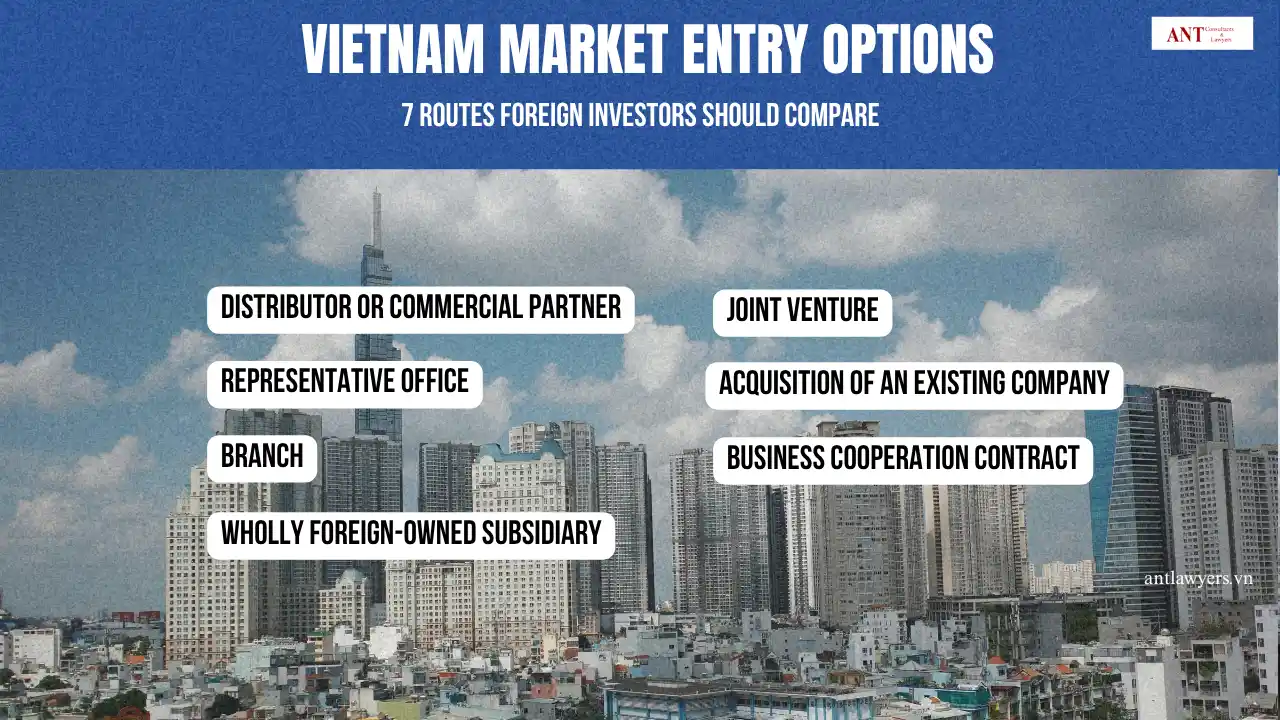
Vietnam Market Entry Options
The fastest way into Vietnam is not always a new company. A distributor may test demand with less fixed cost, while a representative office can place employees on the ground for market research and promotion without creating a local revenue business.
The structure becomes more demanding when the Vietnam presence must sign contracts, invoice customers, hold inventory, obtain sector licences or control an operating team. Management should compare Vietnam market entry options against the business model before choosing the registration route.
Foreign investors should compare seven main Vietnam market entry options: distributor or commercial partner, representative office, branch, wholly foreign-owned subsidiary, joint venture, acquisition and Business Cooperation Contract. The right route depends on local revenue, control, ownership limits, capital, parent exposure, licences and exit flexibility. A phased strategy may begin with distribution or an RO and move to a subsidiary after demand is proven.
A Vietnamese distributor can buy, import, market and resell products under a commercial contract. This route can reduce early fixed cost and use an established customer network.
The trade-off is control. The foreign supplier may have limited visibility over end customers, pricing, inventory and market data. Contract terms should address territory, exclusivity, targets, brand use, product registration, compliance, data, audit rights and termination.
The distributor or local partner model in Vietnam fits a market test where direct local revenue and full customer control are not yet required.
A representative office gives the foreign trader a licensed presence for permitted non-commercial functions such as liaison, market research and promotion. It can employ a local support team within that scope.
It does not provide a local platform for direct sales or service revenue. The foreign parent remains responsible for the office’s activities.
The RO can fit a company that wants people in Vietnam to understand the market, support relationships and monitor partners before committing to an operating entity.
A branch is a dependent unit of the foreign trader. It may conduct business within its licensed scope where the legal and sector conditions permit the branch form.
Branch availability should never be assumed. The parent’s operating history, treaty commitments, sector rules and proposed activities can matter. The parent also carries direct exposure because the branch is not a separate subsidiary.
The strategic comparison between a company, representative office and branch in Vietnam should be completed before the foreign trader treats the branch as a shortcut.
A subsidiary is a Vietnamese legal entity owned by the foreign investor. Where market access allows, it can provide direct control over contracts, staff, assets, bank accounts, customer relationships and local revenue.
The investor takes on a wider compliance platform. Corporate governance, tax, accounting, capital, investment registration, employment and sector licences must be planned together.
This route fits a committed operating model where the investor wants control and expects the business to continue beyond a short market test.
A joint venture places a Vietnamese partner and foreign investor in the same company. It may be required by market-access conditions, or selected because the local partner brings licences, relationships, facilities, customers or operational knowledge.
The partner’s value should be tested rather than assumed. Governance, funding, related-party transactions, IP, deadlock, transfer and exit should be negotiated before incorporation.
The foreign-owned company or joint venture comparison should focus on control and partner risk, not on a general belief that local ownership makes every approval easier.
Buying shares or capital in an existing Vietnamese company can provide staff, customers, facilities, licences and operating history.
Those benefits come with legacy exposure. Tax, labour, land, environment, contracts, disputes, licences, data and beneficial ownership should be reviewed. The transaction may also require market-access or M&A registration before the ownership change.
An acquisition fits where the target platform has real value that cannot be built efficiently through a new company.
A BCC allows investors to cooperate and divide profits or products without forming a new economic organisation for the cooperation itself. It can fit a defined project or contractual cooperation where the parties are prepared to manage allocation of rights, costs, tax, control and liability through contract.
It is not a lighter substitute for governance. The absence of a new company can make the contract, accounting and operational coordination more important.
The route does not need to remain static.
A foreign company may begin with a distributor, add a representative office to strengthen market supervision, then establish a subsidiary when demand and licensing justify local revenue. Another investor may acquire a small local platform after a period of commercial cooperation.
The Vietnam market entry strategy should identify the triggers for moving from one stage to another.
1. Define the first business result and the expected market-entry period.
2. Confirm whether the Vietnam presence must earn revenue or sign customer contracts.
3. Map foreign ownership and sector conditions for each proposed activity.
4. Set the required level of customer, pricing, staff, IP and data control.
5. Compare capital, fixed cost, parent exposure and licence burden.
6. Review the proposed partner or acquisition target where relevant.
7. Test how each route can scale, change or exit.
8. Select the structure and record the commercial reasons before filing.
Q1: Which Vietnam market entry option is fastest?
A distributor is often faster than creating a licensed local operation, but speed depends on partner selection, product approvals and the commercial contract.
Q2: Can a representative office sell products in Vietnam?
No. An RO is intended for permitted non-commercial functions and cannot become the local seller merely because it employs staff.
Q3: Is a branch easier than a subsidiary?
Not automatically. Branch availability and scope depend on the foreign trader, sector and applicable commitments, while the parent carries direct exposure.
Q4: When is a wholly foreign-owned company suitable?
It fits where market access permits the intended ownership and the investor needs direct control over a continuing local business.
Q5: Does a joint venture reduce licensing risk?
Only where the partner or structure addresses a real legal or operational condition. A local shareholder does not cure an unsuitable business model or weak licence plan.
Q6: Can an acquisition avoid investment procedures?
No universal exemption applies. Market access, ownership thresholds, land location and sector rules can trigger registration or approval before the change.
Q7: Can investors change the entry route later?
Yes, but the change may require corporate, investment, tax, labour, foreign-exchange and licence planning. The transition should be designed at the start.
Tuan Nguyen is the Managing Partner and founder of ANT Lawyers, with more than 20 years of experience across legal practice, management and compliance. He advises foreign companies, investors and manufacturers on corporate, commercial, international trade, regulatory and dispute-related matters in Vietnam. He holds an LLB from Hanoi National University School of Law and an MBA from Warwick Business School, and is an Associate Member of the Chartered Institute of Arbitrators.
Founded in 2012, ANT Lawyers is a Vietnam law firm with offices in Hanoi, Ho Chi Minh City and Da Nang. Our corporate lawyers advise on company formation, investment licensing, M&A and corporate governance in Vietnam. We combine legal analysis with practical understanding of Vietnam’s regulatory environment and local administrative practice.
This article is for general informational purposes only, does not constitute legal advice, and does not create a lawyer-client relationship. Vietnamese laws, regulations and administrative practice change over time, and the correct position for any matter depends on its specific facts and the rules in force when action is taken. Verify the current position before relying on anything stated here, and consult qualified counsel on your specific situation.
How ANT Lawyers Could Help Your Business?
You could reach ANT Lawyers for advice via email ant@antlawyers.vn or call our office at (+84) 24 730 86 529
A power of attorney for IP registration in Vietnam allows a representative to act for…
Trademark registration in Vietnam requires a business to identify the applicant entitled to register, define…
A trademark search in Vietnam helps a company assess a proposed brand before filing an…
For a foreign nongovernmental organization (NGO) or international organization in Vietnam, hiring local employees involves…
Decree 219/2025/ND-CP has governed employing foreign workers in Vietnam since August 7, 2025. Today, it…
Foreign suppliers considering public contracts in Vietnam need to know whether the buyer can accept…
This website uses cookies.