
For a long time, many businesses have thought that the main legal challenge in multi level marketing (MLM) is obtaining a license. Today, getting a license is only the beginning.
A serious investor now needs to look further and ask whether the MLM model in Vietnam remains safe after launch. A license is only part of the requirement. The real structure of the business completes the full compliance. The product, recruitment process, seminars, local activities, IT system, and financial structure all play a role in compliance control.
Management should not wait for a regulator to point out the problem. It is better to review the MLM model in Vietnam early, while the structure can still be adjusted without major disruption.
This article focuses on one practical issue, the signs that an MLM model in Vietnam may be becoming more risky in actual operation.

Why Businesses Should Review an MLM Model in Vietnam Early
In many businesses, risk increases over time.
When a business has been running for some time, management and the people involved often become comfortable with the product, the compensation plan, the participant contract, and the training materials. But as time passes, business pressure increases. Without constant review and control, things may gradually get out of hand and make the MLM model in Vietnam much riskier.
That is why early review matters. It helps ensure that the business remains aligned with the broader multi level marketing regulation in Vietnam. A company that checks its structure regularly is in a better position to correct problems before they become legal or reputational issues.
Recruitment Becomes Too Important
Recruitment can be a clear risk sign.
A lawful MLM model should still be built around the sale of goods, not digital products in an MLM model in Vietnam. The structure becomes more concerning when participants appear to earn mainly by bringing in more people rather than by selling products to real customers.
In practice, management should look at what behavior the system actually rewards. The formal compensation plan may say one thing, but the real business may show another. If top performers are known mainly for building downlines rather than selling products, that is a warning sign. If participant conversations focus more on joining the network than on the goods themselves, that is also a warning sign.
The Product Becomes Less Important Than the Income Promise
A second risk sign appears when the product stops being the center of the business.
A sustainable MLM model in Vietnam should still make sense as a product business. The goods should have real value. People should want to buy them because they are useful, not mainly because buying them gives access to a network or a reward structure.
Risk rises when the business begins selling something more than the product itself. Presentations spend more time on income than on the product. Seminar speakers focus more on “opportunity” than on customer demand. Participants appear more interested in what they can earn than in what they can sell.
This does not always mean the model is already unlawful, but it does mean management should pay close attention. If the income incentive becomes stronger than the product’s value, the MLM model in Vietnam may be relying too much on the network itself rather than on real market value.
Internal Buying Inside the Network Becomes Too Large
This is a common weakness in network-based structures.
A business may look active because there is a lot of product movement within the participant network. But activity inside the network is not always the same as healthy outside demand. Sometimes participants keep buying mainly to remain active, qualify for benefits, or maintain their status. That can make the MLM model in Vietnam look stronger than it really is.
Management should therefore review who is actually buying the products. Are sales being made to real outside customers, or mainly to people inside the system? Are participants buying because there is genuine product demand, or because the structure encourages them to keep buying in order to stay in the game?
This matters because a product business should not depend too heavily on internal circulation alone. If most of the sales energy stays inside the network, the MLM model in Vietnam may appear less stable and more exposed.
The Compensation Structure Is Too Complex to Explain Clearly
A sustainable MLM model in Vietnam should be explainable in plain language.
Management should be able to describe how participants earn money, what behavior is being rewarded, and why the reward structure remains linked to real product sales.
Risk grows when the structure becomes too layered, too technical, or too hard to explain. There may be too many ranks, too many categories of benefit, too many overlapping incentives, or too many special exceptions. The more complicated the explanation becomes, the harder it is to see whether the business is still centered on goods.
If management cannot explain the compensation structure clearly and consistently, the MLM model in Vietnam deserves closer review.
Contracts, Training, and Seminars Do Not Match
A company may have careful contracts and formal policies. But if training materials, seminar presentations, website content, and what salespeople say in the field do not match, the real risk increases. The authorities may not look only at what the contract says. They may also consider what participants are actually told in practice.
A reliable MLM model in Vietnam needs alignment across its key materials: participant contracts, operating rules, training content, seminar messaging, website disclosures, and records maintained in the system.
If the contract is cautious but salespeople at seminars promise easy income, that is already a warning sign. If official documents say one thing but field messaging says something stronger, management should take that gap seriously.
The Business Expands Faster Than Its Compliance Controls
A business may move into new provinces because the network is gaining momentum. Events are organized, new participants join, and product activity begins. But if local compliance has not kept pace, the MLM model in Vietnam may become non-compliant.
Under the current framework, local activity and provincial compliance need to be properly prepared and put in place, especially when seminars, training, or participant-related activities take place outside the company’s original base.
A better approach is to check first whether the company’s compliance systems are ready for that activity. If expansion moves faster than control, the MLM model in Vietnam may begin to face greater risk even while sales appear to rise.
Management Is Not Reviewing the Structure Often Enough
An MLM model in Vietnam should not be treated as something that is designed once and then not yet being reviewed again.
Products change, promotions change, sales strategies change, field teams change, new digital features may be added, and training may be adjusted over time. These changes can gradually alter the real business model.
If management is not reviewing the structure regularly, risk may increase slowly until it becomes too serious to manage easily.
Ongoing review is therefore important. Management should revisit the product, compensation design, seminar materials, website disclosures, and local activities on a regular basis. A business that keeps checking its structure is more likely to keep its MLM model in Vietnam under control.
What Businesses Should Do if They See These Risk Signs
If several of these signs appear, it is time for a structured review.
Start by reviewing the product. Then review how participants are actually being rewarded. Compare the official documents with the training materials, seminar presentations, and website content. Then look at internal buying patterns and local activity in each province. Finally, ask whether the management team can still explain the MLM model in Vietnam clearly, simply, and honestly as a product-led business.
Step-by-Step Guide to Reviewing an MLM Model in Vietnam
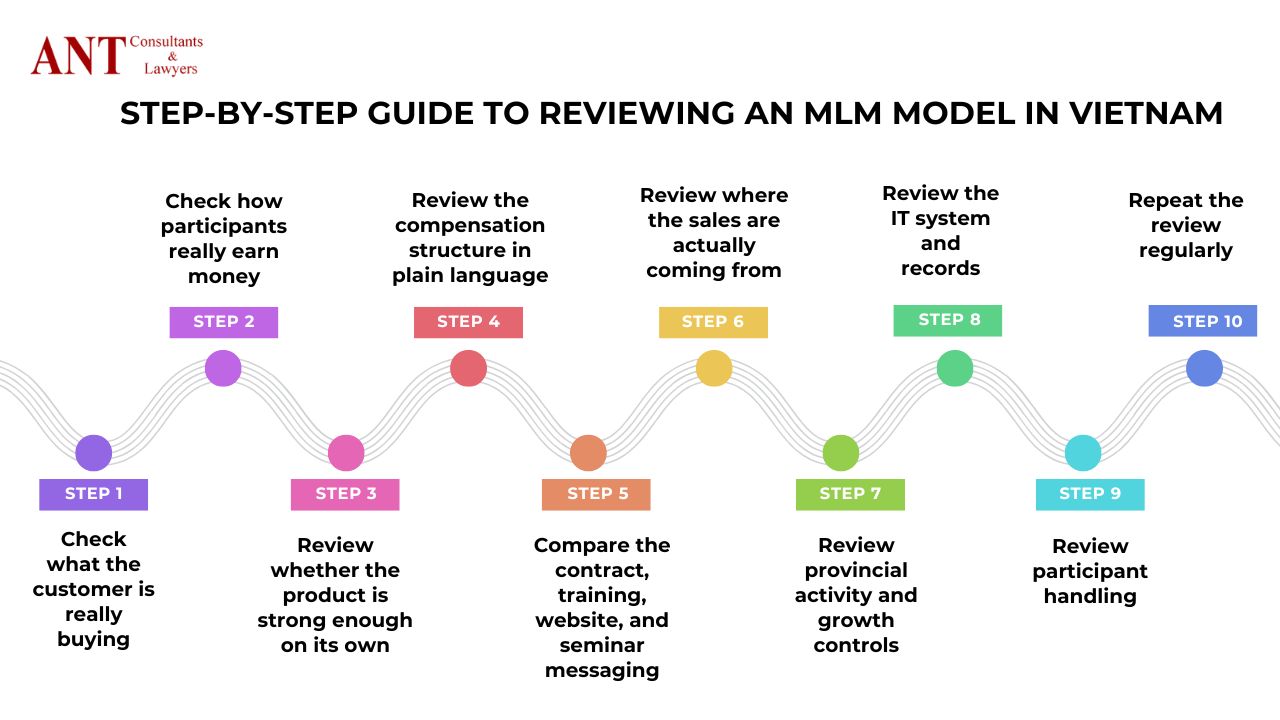
Step 1: Check what the customer is really buying
Review whether the real value lies in goods, or in something else such as digital content, subscriptions, app access, or membership benefits.
Step 2: Check how participants really earn money
Look closely at whether participants are mainly rewarded for product sales or for bringing in more participants.
Step 3: Review whether the product is strong enough on its own
Ask whether the goods would still have commercial value even without the network story behind them.
Step 4: Review the compensation structure in plain language
Make sure management can explain the reward structure clearly and link it to genuine product sales.
Step 5: Compare the contract, training, website, and seminar messaging
All participant-facing materials should support the same compliant story.
Step 6: Review where the sales are actually coming from
Check whether real outside customer demand exists, or whether most activity is happening inside the network.
Step 7: Review provincial activity and growth controls
Look at where events, recruitment, or participant-related activities are taking place and whether local compliance is ready.
Step 8: Review the IT system and records
The business should be able to track participant information, commissions, network structure, and disclosures in a reliable way.
Step 9: Review participant handling
Check how the company manages returns, payments, complaints, and contract termination. Weak handling in these areas can create wider problems.
Step 10: Repeat the review regularly
The safest approach is ongoing review. An MLM model in Vietnam should be checked again whenever products, compensation, promotions, or field practices change.
FAQ on an MLM Model in Vietnam
Q: What is the biggest risk sign in an MLM model in Vietnam?
Usually, it is when recruitment begins to matter more than real product sales.
Q: Can an MLM model in Vietnam still be legal?
Yes. An MLM model in Vietnam can still be legal, but it should remain built around the sale of goods and controlled in practice.
Q: Why is internal buying a warning sign?
Because strong activity inside the network does not always prove real outside demand. Sometimes it only shows that participants are buying to stay active.
Q: Why should management review seminar content?
Because seminar language often shows how the business really operates in the field. It can reveal claims or promises that go beyond the official documents.
Q: Why is product value so important in an MLM model in Vietnam?
Because a compliant structure should still make commercial sense as a product business. If the product becomes secondary to the income story, risk rises.
Q: How often should an MLM model in Vietnam be reviewed?
Regularly, especially when products, incentives, field practices, or expansion plans change.
About ANT Lawyers, a Law Firm in Vietnam
We help clients overcome cultural barriers and achieve their strategic and financial outcomes, while ensuring the best interest protection, risk mitigation and regulatory compliance. ANT Lawyers has lawyers in Ho Chi Minh city, Hanoi, and Danang, and will help customers in doing business in Vietnam.




How ANT Lawyers Could Help Your Business?
You could reach ANT Lawyers for advice via email ant@antlawyers.vn or call our office at (+84) 24 730 86 529