How to Set Up Representative Office in Vietnam
This guide explains how to set up representative office in Vietnam in 2026. It covers the full licensing process, required documents, post licensing procedures, realistic timelines, costs, and ongoing compliance obligations. Foreign companies looking for a low risk market entry into Vietnam will find a clear, actionable roadmap from preparation to full operation.
As one of the fastest-growing economies in Southeast Asia, Vietnam has already attracted many foreign companies, with many more planning to establish a presence here. Understanding how to set up representative office in Vietnam is the first step for businesses that want to test the market before making a full commitment. However, the process often confuses foreign investors because of unfamiliar regulations, multiple government agencies, and document requirements that differ from other countries.
The core challenge is straightforward. Foreign companies want to explore the Vietnamese market, build local relationships, and monitor business opportunities. However, they do not want to commit to the complexity and cost of forming a full subsidiary. A representative office solves this problem perfectly. It allows your company to operate legally in Vietnam for liaison and market research purposes, all without the burden of company registration in Vietnam as a separate legal entity.
This guide walks you through every stage of the process. By the end, you will know exactly what documents to prepare, which government agencies to visit, how long the process takes, and what ongoing obligations to expect.
A representative office, often called an RO, is a dependent unit of a foreign company established in Vietnam. It is governed by the Commercial Law 2005 and Decree 07/2016/ND-CP. The RO is not a separate legal entity and cannot generate revenue. Instead, it serves as a bridge between the parent company abroad and the Vietnamese market.
Foreign businesses that want to learn how to set up representative office in Vietnam should first understand what the RO can and cannot do.
Permitted activities include conducting local market research, liaising with Vietnamese partners and suppliers, monitoring the execution of contracts signed by the parent company overseas, and promoting the brand and products of the foreign parent company.
Prohibited activities include selling products or services locally, issuing value added tax invoices, signing commercial contracts independently, and generating any form of revenue within Vietnam.
Key takeaway: A representative office is the simplest, lowest risk way for a foreign company to establish a legal presence in Vietnam. It is ideal for market research and trade promotion before committing to a full foreign investment in Vietnam.
Choosing between a representative office and a company is one of the most important decisions for foreign investors entering Vietnam. The comparison below highlights the key differences to help you decide whether learning how to set up representative office in Vietnam is the right path or whether a full company establishment better suits your goals.
| Criteria | Representative Office | Company (Subsidiary) |
| Legal entity | No | Yes |
| Revenue generating | No | Yes |
| Corporate income tax | No | Yes |
| Issuing VAT invoices | No | Yes |
| Signing contracts independently | No | Yes |
| Setup complexity | Low | High |
| Setup timeline | 3 to 4 months | 3 to 6 months |
| Typical use | Market research and liaison | Full investment and commercial operations |
Under Vietnamese tax law and applicable Double Taxation Agreements (DTAs), if an RO performs activities beyond its permitted liaison scope, the tax authorities may treat it as a Permanent Establishment of the parent company. According to Official Letter 855/TCT-HTQT (2019) issued by the General Department of Taxation, activities such as negotiating or signing commercial contracts, conducting sales promotion, or providing after sales services can trigger PE status. If a PE is established, the parent company becomes subject to Vietnamese Corporate Income Tax on income attributable to Vietnam.
Separately, when the parent company sells goods or provides services into Vietnam, the Vietnamese buyer is generally required to withhold Foreign Contractor Withholding Tax (FCWT) under Circular 103/2014/TT-BTC, regardless of whether the RO exists. The RO itself does not change this obligation. To manage risk properly, foreign companies should ensure the RO strictly performs only liaison and market research functions as permitted under its license.
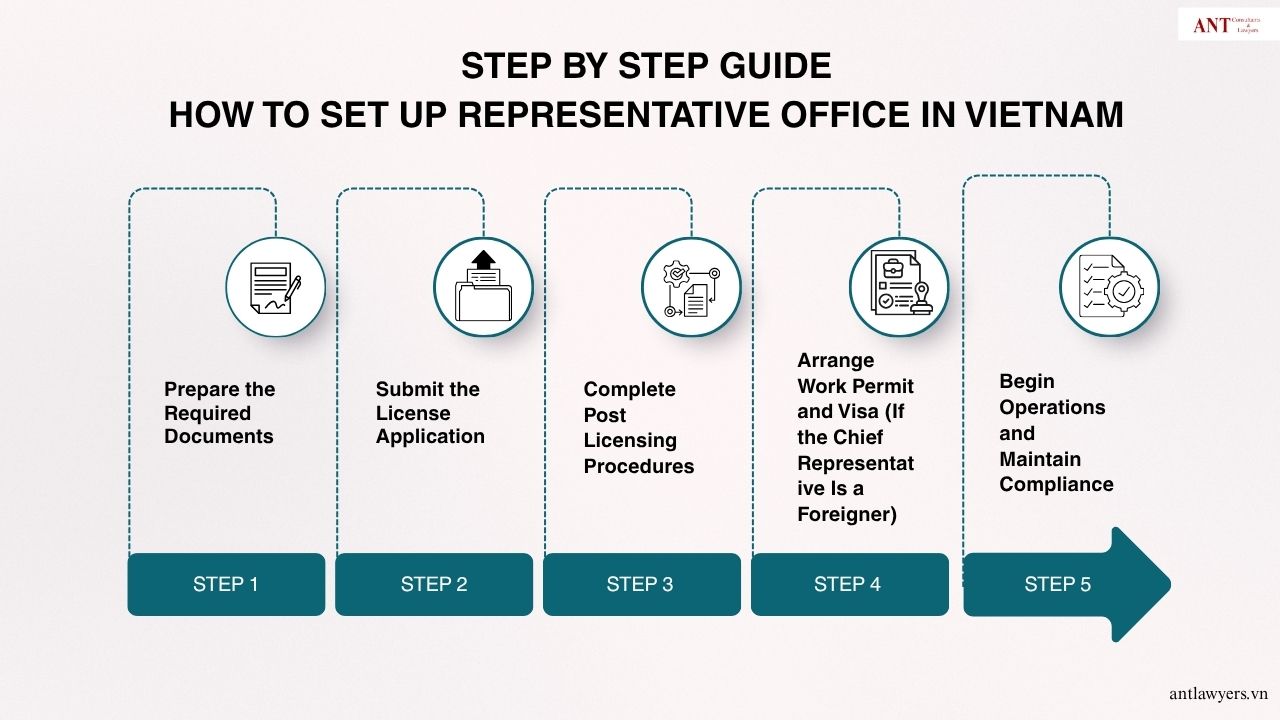
The process of learning how to set up representative office in Vietnam becomes manageable when broken into 5 clear steps. Each step involves specific documents, government agencies, and timelines.
Step 1: Prepare the Required Documents
Foreign investors must gather and legalize a set of documents before submitting any application. All documents issued overseas must be notarized and consular legalized by the Vietnamese Embassy or Consulate in the home country.
Documents needed: Parent company business registration certificate, audited financial statements for the latest financial year, appointment letter for the Chief Representative, passport copy of the Chief Representative, and a commercial office lease agreement in Vietnam. Note that the office address must serve a commercial function and cannot be a residential apartment under the Housing Law 2014. Estimated timeline: 2 to 4 weeks.
Step 2: Submit the License Application
Applications are submitted to the licensing authority based on your chosen office location. For offices in major cities such as Hanoi or Ho Chi Minh City, the Department of Industry and Trade (DOIT) is the competent authority. For offices within industrial or export processing zones, applications go to the relevant Zone Management Board. Under Article 11 of Decree 07/2016/ND-CP, the licensing agency has 3 working days to check the dossier completeness and 7 working days from receipt of a complete and valid dossier to grant the license.
Estimated timeline: 7 to 10 working days from submission of a complete dossier. In practice, total processing may take up to 15 to 20 working days if additional documents are requested.
Step 3: Complete Post Licensing Procedures
After receiving the Establishment License, the RO must register with several state agencies. These include the Police Department for obtaining a physical seal and Seal Specimen Certificate, the local Tax Department for a 13 digit tax code used in Personal Income Tax declarations, and a commercial bank for opening an expenditure account in VND or foreign currency.
Estimated timeline: 1 to 2 weeks.
Step 4: Arrange Work Permit and Visa (If the Chief Representative Is a Foreigner)
This step applies only when the Chief Representative is a foreign national. A Vietnamese citizen appointed as Chief Representative does not need a work permit or visa. For a foreign Chief Representative, the RO must apply for a work permit from the Department of Labor, Invalids and Social Affairs (DOLISA). After the work permit is approved, the Immigration Department will issue a business visa or Temporary Residence Card (TRC). The RO must also register an employer code with the Social Insurance Agency for mandatory insurance contributions for all employees.
Estimated timeline: 2 to 3 months.
Step 5: Begin Operations and Maintain Compliance
Once all permits and registrations are complete, the Representative Office can begin operations. From this point forward, the RO must meet ongoing compliance requirements including monthly or quarterly Personal Income Tax declarations, annual PIT finalization for all staff, and annual activity reporting to DOIT before January 30th of each year.
Warning: Failure to submit the Annual Activity Report on time results in administrative fines of VND 10,000,000 to VND 20,000,000 for individuals. For organizations (including Representative Offices), the fine is doubled to VND 20,000,000 to VND 40,000,000.
Foreign investors researching how to set up representative office in Vietnam should plan for a total of 3 to 4 months from start to finish.
| Stage | Estimated Time |
| Document preparation | 2 to 4 weeks |
| License processing (from submission) | 7 to 10 working days |
| Post licensing procedures | 1 to 2 weeks |
| Work permit and visa (foreign Chief Rep only) | 2 to 3 months |
The costs of learning and executing how to set up representative office in Vietnam fall into two categories. One time setup costs include government licensing fees, document notarization and legalization fees, and professional legal consulting services. Ongoing operational costs include office rent, salaries for the Chief Representative and local staff, mandatory social insurance contributions, Personal Income Tax compliance, and annual accounting services. In practice, ongoing operational costs represent more than 95 percent of the total cost of maintaining a Representative Office.
Many companies that research how to set up representative office in Vietnam overlook one crucial step. Registering your trademarks and intellectual property in Vietnam should happen at the same time as your RO establishment. Vietnam follows a first to file system, which means competitors or local agents can register your brand name before you do. Early trademark registration protects your business from squatting and costly disputes when you eventually expand into full commercial operations.
A Representative Office cannot be directly converted into a legal entity. If your Vietnam strategy evolves beyond market research, you will need to establish a new foreign invested company separately. This process involves applying for an Investment Registration Certificate and an Enterprise Registration Certificate, followed by rigorous tax audits and formal closure of the RO with DOIT. Planning this transition early is strongly recommended for businesses that see long term potential in the Vietnamese market.
Q1: Is there a limit on how many employees a Representative Office can hire?
Vietnamese law does not impose a strict limit on the number of employees an RO can hire. However, the headcount should logically correspond to its permitted non commercial liaison functions. An unusually large workforce may attract scrutiny from authorities.
Q2: Can a Representative Office sign commercial contracts?
No. An RO may assist in negotiating contracts, but it cannot sign commercial contracts independently. All revenue generating contracts must be signed directly by the overseas parent company. Signing contracts locally may trigger Permanent Establishment risk.
Q3: Can a virtual office address be used for a Representative Office?
The office address must be a legitimate commercial address with a valid lease contract. Virtual offices are closely scrutinized by DOIT, and the authorities may verify the physical location before granting the license. Using a virtual office is risky and often leads to application rejection.
Q4: Does a Representative Office need its own seal?
Yes. Upon receiving the license from DOIT, the RO must apply for a physical seal and a Seal Specimen Certificate from the provincial Police Department. The seal is required for official correspondence and government filings.
Q5: Who qualifies as a Chief Representative?
The Chief Representative is the head of the RO, appointed by the parent company. This person can be a Vietnamese citizen or a foreign national. If the Chief Representative is a foreign national, obtaining a work permit from DOLISA is legally mandatory before they can begin working in Vietnam. A Vietnamese citizen appointed as Chief Representative does not need a work permit.
Q6: What happens if the Annual Activity Report is filed late?
Failure to submit or late submission of the Annual Activity Report to DOIT results in administrative fines of VND 10,000,000 to VND 20,000,000 for individuals. For organizations such as Representative Offices, the fine is doubled to VND 20,000,000 to VND 40,000,000. Repeated noncompliance may also create difficulties when renewing or amending the RO license.
We help clients overcome cultural barriers and achieve their strategic and financial outcomes, while ensuring the best interest protection, risk mitigation and regulatory compliance. ANT Lawyers has lawyers in Ho Chi Minh city, Hanoi, and Danang, and will help customers in doing business in Vietnam.
How ANT Lawyers Could Help Your Business?
You could reach ANT Lawyers for advice via email ant@antlawyers.vn or call our office at (+84) 24 730 86 529
A power of attorney for IP registration in Vietnam allows a representative to act for…
Trademark registration in Vietnam requires a business to identify the applicant entitled to register, define…
A trademark search in Vietnam helps a company assess a proposed brand before filing an…
For a foreign nongovernmental organization (NGO) or international organization in Vietnam, hiring local employees involves…
Decree 219/2025/ND-CP has governed employing foreign workers in Vietnam since August 7, 2025. Today, it…
Foreign suppliers considering public contracts in Vietnam need to know whether the buyer can accept…
This website uses cookies.