
Choosing an industrial cluster for a factory involves more than comparing rent, transport costs, and available space. The site needs to accommodate the proposed manufacturing activity and be ready for lawful production when the business plans to launch.
Decree 303/2026/ND-CP on Industrial Clusters took effect on September 15, 2026. It amends Decree 32/2024/ND-CP on the management and development of industrial clusters. For foreign investors, the changes affect site selection, infrastructure readiness, and the assumptions behind a factory investment. These decisions belong within the wider Vietnam market entry strategy before major payments and construction commitments are made.
Why Vietnam Issued Decree 303
The Government’s explanation connects the changes with Vietnam’s two-tier local government system, more workable cluster development, and better use of industrial land. It also notes that limited funding has left infrastructure incomplete or deteriorating in some clusters, particularly environmental facilities.
The decree adjusts the conditions for establishing and expanding clusters and gives clearer recognition to different cluster types and investor groups. For a prospective factory tenant, this creates reasons to look again at available locations. It also makes the condition of the shared infrastructure an important part of deciding whether a site can meet the factory’s timetable.
Quick Reference
Since September 15, 2026, Vietnam’s industrial cluster rules have recognized additional cluster types, reduced the general minimum cluster size, and changed conditions for expansion. The provincial decision for each cluster remains important because it identifies the industries and investors the cluster is intended to accommodate. A foreign investor should confirm that the proposed factory fits that decision before committing to the site.
The decree expressly allows production and business operations only after the cluster’s common technical infrastructure is completed. A finished factory building alone does not settle that question. Reserved land and rent support also have eligibility conditions. The investor should connect the site review, project approvals, and lease terms so that an attractive offer can support a realistic launch.
Issues Under Decree 303/2026/ND-CP on Industrial Clusters
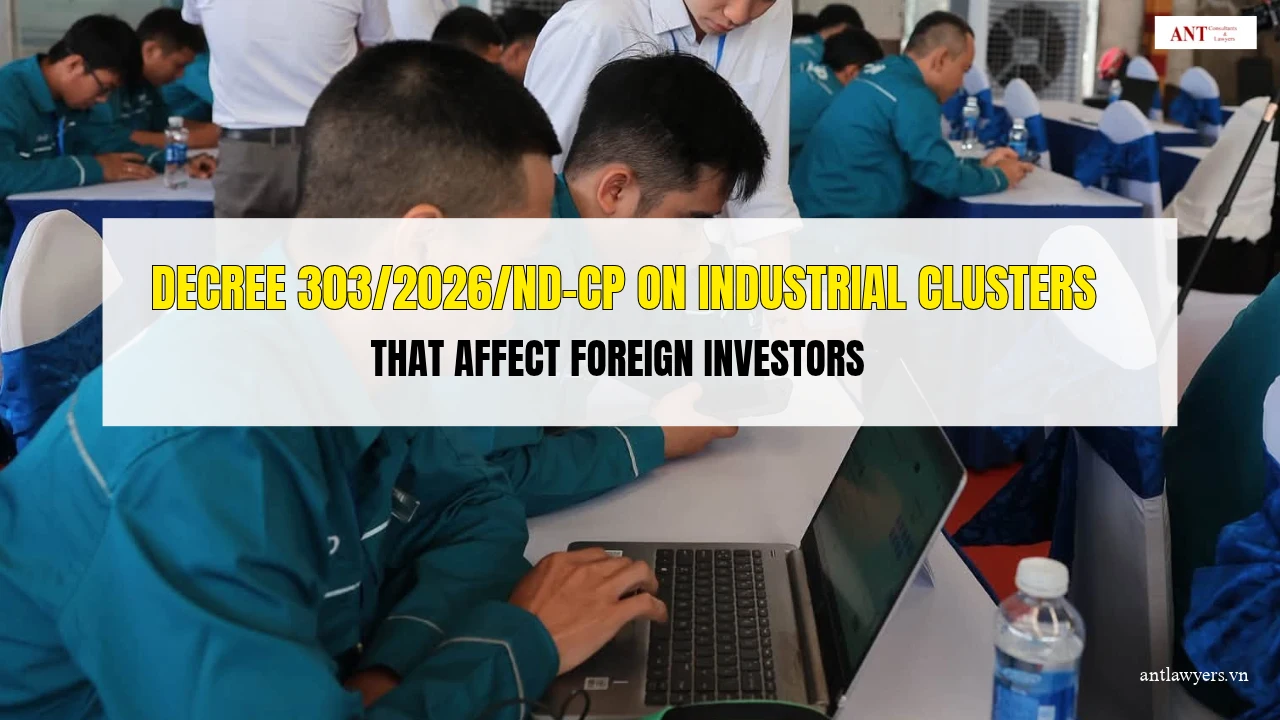
Confirm That the Cluster Can Accept Your Factory
The decree adds definitions for specialized, supporting-industry, high-tech, and ecological industrial clusters. These categories describe different development models, including concentrations of similar activities, supporting production, or cooperation to use resources more efficiently.
The province decides the specific industries, investor groups, and cluster type in its establishment or expansion decision. A developer’s description of a site as suitable for manufacturing should therefore be checked against that decision and the approved planning documents. A high-tech or ecological label alone does not establish that every factory can enter or that a particular incentive applies.
It is important to check whether the proposed products, production processes, capacity, and waste streams are suitable for the site. A factory involving surface treatment, for example, may need a different assessment from a simple assembly operation. This is part of a Vietnam company location strategy: the actual operation must fit the site, as well as the investor’s commercial plan.
Check the Shared Infrastructure Before Fixing the Production Date
Decree 303 expressly states that businesses may begin production and business operations only when the industrial cluster has completed its common technical infrastructure. The earlier wording already required leased land to have common infrastructure meeting environmental requirements. The new wording makes the link between infrastructure completion and the start of operations explicit.
The common system includes roads, water supply and drainage, wastewater and solid-waste facilities, fire protection, electricity, and other shared works. A finished factory shell or a temporary utility connection does not, by itself, establish that the cluster has met this requirement.
It is important to ask for the approved infrastructure scope, completion records, and evidence that the relevant facilities can serve the proposed factory. Check available capacity as well as physical construction. A wastewater system may exist without being suitable for the factory’s proposed discharge. Construction acceptance inspection in Vietnam is a related issue where the relevant works require such inspection; the exact requirements depend on the project.
If the developer proposes opening in phases, obtain a clear legal basis for the proposed start date. Do not assume that finishing the road and utilities beside one plot is enough.
Treat Smaller Clusters and Future Expansion as Options to Verify
The general minimum area for an industrial cluster falls from 10 hectares to 5 hectares. Some clusters already qualified for the lower minimum under the previous rules. The general maximum remains 75 hectares. These figures concern the cluster as a whole, rather than the minimum plot that an individual factory must lease.
The occupancy threshold used for cluster expansion also falls from at least 60% to at least 50%. The alternative based on demand for industrial land exceeding the cluster’s existing industrial land remains available. Other expansion conditions and the approval process still apply.
This may broaden the locations worth considering, especially where a smaller cluster fits the production scale or an existing cluster plans to expand. However, land shown in a proposed second phase should not be treated as confirmed space for the factory’s future growth. Ask which area is already approved, what remains subject to approval, and when infrastructure can actually be delivered.
Check Reserved Land and Support Before Including Savings in the Budget
The revised rules provide for land reserved for specified high-tech enterprises in the private sector, small and medium-sized enterprises, and innovative startups. Provincial decisions determine the reserved area for individual clusters. A national policy also sets a minimum reduction in sublease rent for an initial period, with the province deciding the applicable rate.
A foreign-invested manufacturer should confirm whether it qualifies for this support before including the savings in its budget. Eligibility depends on the category claimed and the applicable rules and local arrangements. Describing the project as high-tech or relatively small is not enough to establish entitlement. Ask what supporting evidence is required, which charge is reduced, and whether the offer includes infrastructure and service fees.
Reserved land can also affect availability for other tenants. For clusters established after the decree took effect and without state infrastructure support, the developer may seek an adjustment after two years from infrastructure completion if the specified tenant groups have not leased the land. The developer must report to the province for the relevant decision to be adjusted. Vacant reserved land does not become available to every investor automatically.
Verify the Developer and the Right to Offer the Plot
The cluster’s establishment or expansion decision identifies the infrastructure developer, project schedule, operating term, and relevant responsibilities. These details help an investor test whether the party offering the site can deliver what is promised. In a publicly managed cluster without an infrastructure business as developer, tenants lease land under the land-law framework; confirm the applicable State leasing procedure rather than assume a developer sublease.
Decree 303 also addresses cooperation between two or more organizations acting as infrastructure investors. They may establish an economic organization or authorize one participant to act as developer under the prescribed arrangement. For a factory tenant, the point is to identify the responsible legal entity and the authority of the party signing the lease or receiving the deposit.
Review the land and leasing documents, the remaining term, the approved plot boundary, and any restrictions affecting the proposed transaction. If the developer changes, the decree requires the lawful rights and obligations of affected parties to be addressed before the provincial decision is adjusted. Keep the lease and project records consistent with the site actually used. The companion alert on land compliance for FDI factories explains why those records continue to matter after operations begin.
Make the Lease Reflect What Still Needs to Be Completed
When leasing from an infrastructure developer, the agreement should clearly state what the developer will deliver and when. The investor should be able to distinguish access for construction or fit-out from the point at which lawful production can begin.
Consider linking payments and rent commencement to defined milestones supported by documents. When reviewing the lease, the investor should check that it addresses utility capacity, wastewater connection conditions, handover requirements, and the developer’s cooperation with project approvals. It should also explain how the parties handle delay and which circumstances allow termination or the return of a deposit.
These are commercial protections to negotiate, rather than automatic refund or cancellation rights created by Decree 303. Their wording and enforceability need review under the applicable law. Agreeing on the documents that demonstrate completion can reduce later arguments about whether a promised milestone has been reached.
Connect the Site Decision With Factory Approvals and Deliveries
Approval of an industrial cluster does not replace the factory investor’s own legal requirements. Investment, land, construction, environmental, and fire-safety matters still need to be assessed for the proposed project. Where an Investment Registration Certificate in Vietnam is required, the location, production scale, and schedule should be consistent with the actual site and implementation plan.
The decree continues to recognize supporting activities such as warehousing, packaging, transport, and industrial maintenance, subject to the applicable conditions. The relevant service area may not exceed 10% of the cluster’s total area. That provision already existed; it does not create a new general permission for foreign-owned logistics businesses.
For a manufacturer, check how equipment and materials will reach the factory and how finished products will leave it. Delivery access, storage arrangements, and provider responsibilities belong in the review of transport and logistics in Vietnam. Import conditions and the intended export arrangements also need a separate assessment under international trade law in Vietnam. A suitable factory location should support the supply plan as well as the production line.
Frequently Asked Questions About Decree 303/2026/ND-CP on Industrial Clusters
Q1: Can a foreign investor set up a factory in an industrial cluster?
It may be possible, subject to the proposed activity, foreign-investment requirements, the cluster’s approved scope, and a lawful land or premises arrangement. Decree 303 does not give every foreign investor automatic admission. Review the particular project and cluster together.
Q2: Is an industrial cluster the same as an industrial park?
No. This decree concerns industrial clusters. Industrial parks have a separate regulatory framework. Confirm the site’s legal category before relying on its marketing description or assuming the same procedures apply.
Q3: Does renting a ready-built factory remove the infrastructure check?
No. The completed building is only part of the assessment. The cluster’s common infrastructure and the tenant’s own operating requirements still need to be checked. The landlord’s existing documents should also be reviewed for the proposed tenant and manufacturing activity.
Conclusion
For a prospective factory investor, Decree 303/2026/ND-CP on Industrial Clusters makes the site decision more specific. Before paying a substantial deposit, request the cluster decision and planning documents, the land and leasing evidence, and the infrastructure completion file. Compare them with the proposed factory and launch date. Any unresolved point should be reflected in the investment decision and the lease before the business commits further funds.
About the Author
About ANT Lawyers, a Law Firm in Vietnam
Founded in 2012, ANT Lawyers is a Vietnam law firm with offices in Hanoi, Ho Chi Minh City and Da Nang. Our corporate lawyers advise on company formation, investment licensing, M&A and corporate governance in Vietnam. We combine legal analysis with practical understanding of Vietnam’s regulatory environment and local administrative practice.
General Disclaimer
This article is for general informational purposes only, does not constitute legal advice, and does not create a lawyer-client relationship. Vietnamese laws, regulations and administrative practice change over time, and the correct position for any matter depends on its specific facts and the rules in force when action is taken. Verify the current position before relying on anything stated here, and consult qualified counsel on your specific situation.
How ANT Lawyers Could Help Your Business?
You could reach ANT Lawyers for advice via email ant@antlawyers.vn or call our office at (+84) 24 730 86 529